

Introduction
Marketing ROI is the number that decides whether your next budget meeting is a comfortable one or an awkward one. Followers, impressions and website traffic look encouraging on a slide, but none of them pays the bills.
If a UK business can’t say which pound spent on marketing turned into a pound (or five) of revenue, that business is guessing, not managing. The real question every marketing manager should be asking isn’t “did the campaign get attention?”
It’s this: which marketing activity generates measurable business value? Analytics frameworks exist to answer exactly that, connecting spend, conversions and revenue into something you can actually act on.
What follows isn’t a general chat about analytics. It’s a working process for measuring Marketing return, step by step, that small and growing UK businesses can put into practice this quarter.
Table of Contents
How to Calculate Marketing ROI
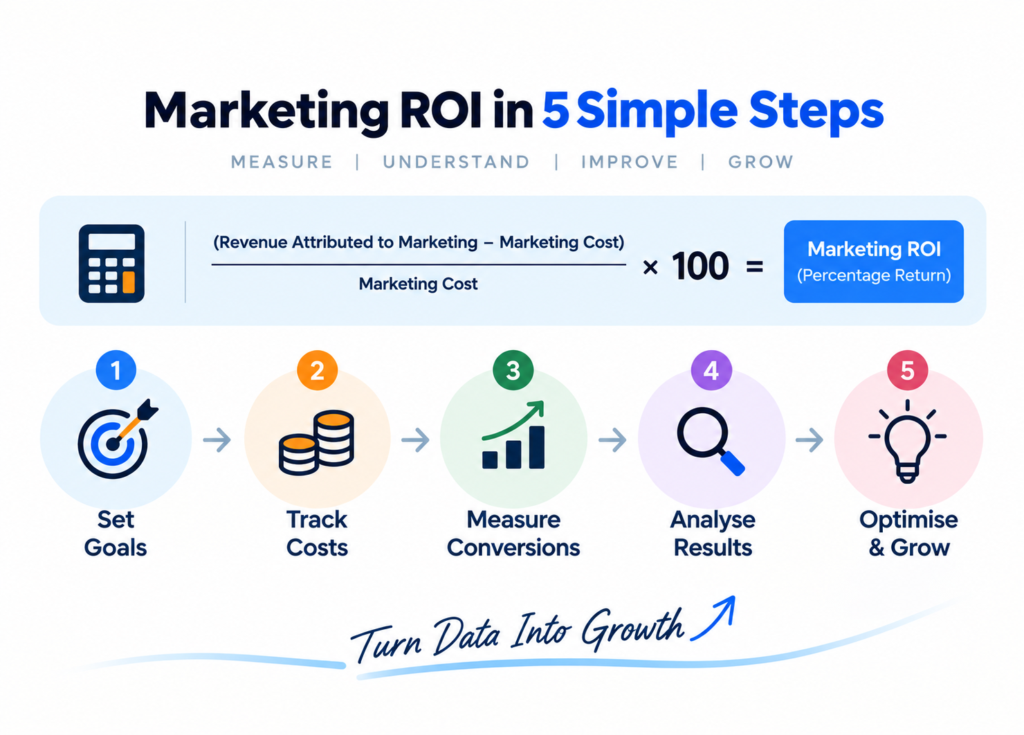
Marketing ROI is calculated as (Revenue Attributed to Marketing − Marketing Cost) ÷ Marketing Cost × 100. The result is expressed as a percentage, showing how much return a business earned for every pound spent on marketing.
Start With the ROI Formula
Marketing cost should include everything that made the campaign happen: media spend, agency fees, creative production, software subscriptions, even the internal hours spent managing it.
Leave any of that out and the number flatters you. Consistency matters more than precision here. Use the same cost definitions and the same revenue definitions every time you calculate it, or comparisons across months become meaningless.
Set Revenue Goals First
Revenue goals should be set before a campaign launches because they determine which metrics actually matter. Without a defined goal, ROI measurement becomes arithmetic for its own sake rather than a tool for decision-making.
A lead-generation campaign, a direct sales push and a brand-awareness project each need different metrics, and mixing them up is how businesses end up celebrating the wrong wins. The goal you set determines which numbers deserve your attention and which ones are just noise.
Separate Revenue From Marketing Spend
Separate revenue from marketing spend by recording every channel, platform, agency retainer and piece of creative work in its own cost line, then weighing total revenue against total investment for a defined reporting period, not against a single campaign in isolation.
Measuring revenue without considering total campaign cost is a common trap, and a costly one. Comparing a 30-day campaign against a 90-day one, without adjusting for the difference, tells you nothing useful either.
Build a Marketing Return On Investment Measurement Framework
A Marketing ROI measurement framework is built by mapping the customer journey, choosing metrics tied to revenue, connecting data across every channel, and tracking conversion points consistently. Each stage feeds the next, and skipping one weakens the whole picture.
Map the Customer Journey
Map every stage a customer moves through, from the first ad they see to the moment they hand over payment, then connect each marketing activity back to an outcome that actually matters to the business, not just clicks that made the campaign look busy.
Pick Metrics That Prove Value
Conversions, revenue, cost per acquisition and profit-adjacent numbers earn their place on a dashboard. Everything else is decoration.
Each KPI should exist for one reason: it helps someone make a decision. If a metric can’t influence a choice about budget, creative or targeting, it’s probably not worth reporting at all.
Connect Data Across Channels
Cross-channel data matters because SEO, PPC, social media, email and the website each generate their own pockets of data that, left isolated, tell half-truths. A campaign might look weak on its own while actually feeding conversions elsewhere.
Bringing that data together, even in a fairly basic shared spreadsheet to start, gives a far more honest picture than five separate dashboards ever will.
Track the Right Conversion Points
Track conversion points by separating primary conversions, the ones tied directly to revenue, from micro-conversions, the smaller signals along the way, and recording both the same way every single time.
Not every action a visitor takes carries equal weight. A newsletter signup and a completed purchase both count as conversions, but they’re not the same thing.
Use Marketing Analytics to Find What Actually Works
Conversion tracking, customer acquisition cost, customer lifetime value and return on ad spend, supported by marketing analytics, together reveal which marketing activity is genuinely profitable, rather than which activity simply generated the most activity.
Conversion Tracking That Tells a Story
Conversion tracking links a campaign to an actual outcome, such as a form submission, phone call, booking or purchase. Get the tracking wrong, though, and every conclusion built on top of it is wrong too.
Check tracking accuracy before drawing insights from the data, not after a quarter of decisions have already been made on faulty numbers.
CAC: The Cost of Winning Customers
Customer acquisition cost is what it actually costs a business to win a paying customer, not a lead, not a click, a customer. Watching how CAC moves over time reveals whether growth is getting easier or more expensive.
On its own, though, CAC only tells half the story. It needs to sit alongside customer value to mean anything.
LTV: Measure Value Beyond the First Sale
Customer lifetime value is the total revenue a customer generates over the full relationship, not just their first purchase.
Judging marketing purely on first-purchase revenue tends to undersell channels that bring in loyal, repeat customers rather than one-off buyers. LTV, used properly, can shift acquisition and retention decisions in ways a single-sale view never would.
ROAS vs ROI
ROAS measures revenue generated against ad spend alone, while ROI accounts for the full cost of running that marketing, including agency fees and creative. A campaign can post a brilliant ROAS and still be quietly unprofitable once the full cost picture is added in.
Marketing performance measurement and ROAS answer different questions, and knowing which one applies to which decision matters more than either number in isolation.
Measure Marketing Performance Across Channels
Measuring marketing performance across channels means applying consistent KPIs, revenue, acquisition cost and conversion quality, to each channel rather than judging every channel by traffic volume alone.
Channel | Key Metrics | What to Measure | ROI Question |
SEO | Organic traffic, leads, conversions, revenue | Growth and conversion value | Is organic search generating profitable customers? |
PPC | Spend, conversions, CPA, ROAS | Revenue against ad spend | Are paid campaigns generating worthwhile returns? |
Social Media | Engagement, clicks, leads, conversions | Traffic and assisted conversions | Is social activity contributing to business outcomes? |
Open rate, clicks, conversions, revenue | Campaign and customer value | Is email generating repeat or incremental revenue? |
Compare Channels on Business Outcomes
Compare channels using revenue, acquisition cost and conversion quality instead of raw traffic, because traffic alone rewards volume over value. This is usually where it becomes clear which channels deserve a bigger budget and which have been coasting on assumptions for too long.
Find High-Value Campaigns
Find high-value campaigns by analysing campaign-level revenue and conversion data rather than headline volume. The campaign generating the most clicks isn’t always the one making the most money; sometimes it’s the smaller, quieter one that converts at three times the rate.
Spot Wasted Marketing Spend
Spot wasted marketing spend by looking for campaigns with high cost, low-quality leads and poor conversion rates, then following the trend rather than a single bad week. The data doesn’t just flag the problem; it gives you the evidence to justify reallocating that budget somewhere it will actually work harder.
Use Marketing Attribution to Understand the Full Customer Journey
Marketing attribution assigns credit for a conversion to the marketing touchpoints that influenced it, whether that’s the first interaction, the last interaction, or everything in between. Which model a business uses changes which channels appear to be working.
First-Touch vs Last-Touch
First-touch attribution credits whatever introduced the customer to the brand; last-touch credits whatever closed the sale. Relying exclusively on either one builds an incomplete picture, since first-touch ignores the closing effort and last-touch ignores everything that built trust along the way.
See the Middle of the Journey
The middle of the customer journey matters because interactions between first discovery and final conversion: SEO, content, paid ads, social posts and direct visits, often play a supporting role before a purchase happens. Handing all the credit to whichever channel closed the deal ignores the groundwork that made the close possible in the first place.
Choose an Attribution Model
Choose an attribution model based on the sales cycle and business type, since a long B2B cycle behaves very differently from a same-day e-commerce purchase. Whatever model gets chosen, keep it consistent when comparing periods, because switching models purely to flatter a recent campaign is how businesses end up trusting numbers they shouldn’t.
Turn ROI Data Into Better Marketing Decisions
ROI data becomes useful once it sits inside a simple dashboard, gets reviewed as a trend rather than a single result, and directly informs where budget gets reallocated.
Build a Simple ROI Dashboard
A working dashboard needs spend, conversions, revenue, CAC, ROI and channel performance in one place. Prioritise the metrics that support a real decision, and keep the layout understandable for people outside the marketing team. If a finance director can’t read it in two minutes, it’s too complicated.
Review Trends, Not Single Results
Trends matter more than single results because seasonality, campaign changes and longer sales cycles all distort short-term numbers. Making a budget call based on one good, or one bad, week is a mistake almost every business makes at least once.
Reallocate Budget With Evidence
Reallocate budget by putting more money behind channels showing sustainable returns, and testing underperforming ones properly before cutting them outright. ROI trends, tracked over time, should be doing the talking here, not gut feeling, and not last year’s budget copied forward out of habit.
Keep Improving the Framework
Keep a framework accurate by auditing, tracking regularly and updating KPIs as business goals shift. Marketing performance measurement isn’t a report you file once a quarter and forget about; it’s a process that gets sharper the longer you stick with it.
Conclusion
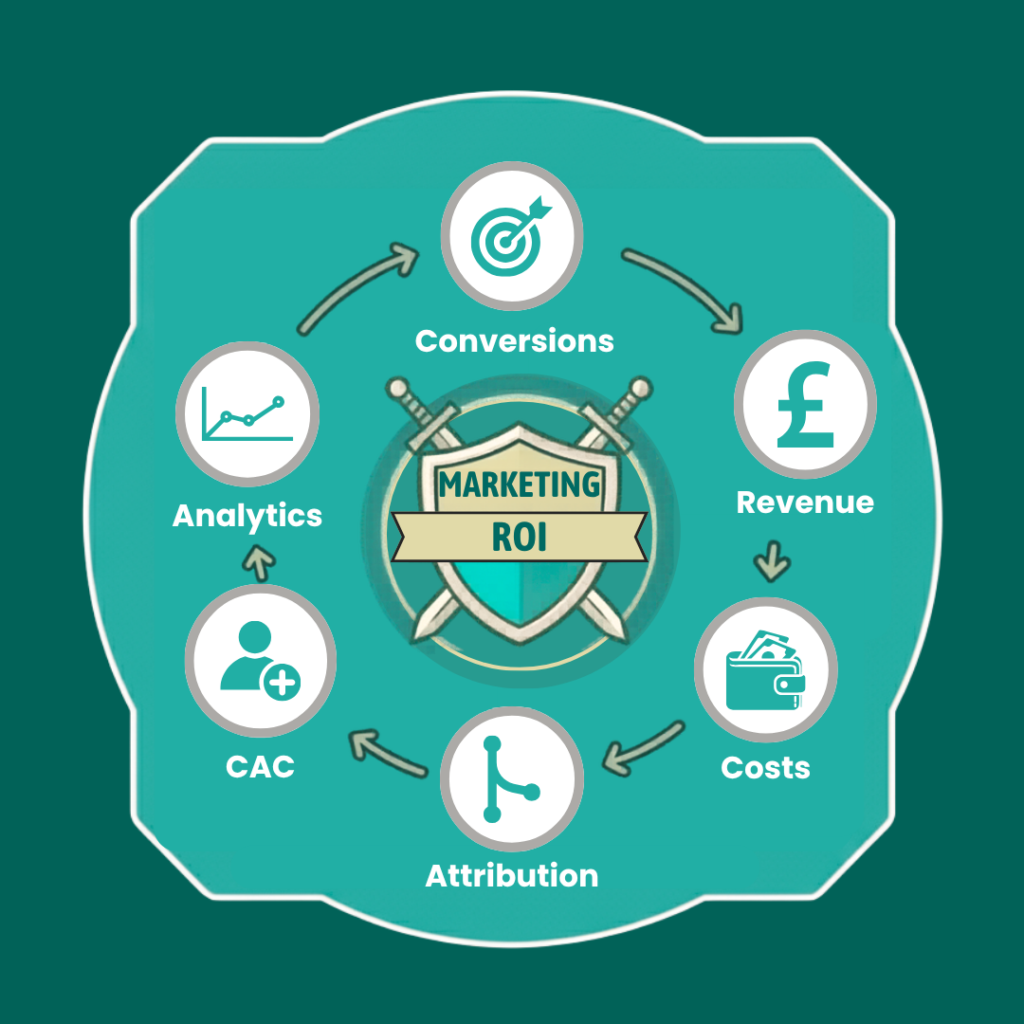
Marketing ROI, at its core, is about connecting what a business spends to what that spending actually produces. The framework holds together in six steps: define goals, track conversions, measure costs, attribute revenue, compare channels, optimise spending.
None of it is complicated. Most of it just requires discipline. Collecting more data isn’t the goal. Collecting the right data, tracked consistently, is worth more than a dashboard full of numbers nobody acts on.
Midland Marketing has worked with UK businesses long enough to know that clear, measurable marketing beats vague performance claims every time. Midland Marketing’s SEO services are built around exactly that principle.
For further reading on structuring measurement frameworks, Google’s guide to marketing analytics is a solid starting point. The businesses that get ahead aren’t the ones reporting the most metrics. They’re the ones measuring the activity that actually moves revenue, and ignoring the rest.
Frequently Asked Questions
- What is Marketing return on investment?
Marketing return on investment is the measure of how much revenue a business generates relative to what it spent to generate it. It connects marketing investment directly to business outcomes, rather than relying on engagement numbers that don’t reflect actual value.
- How do you calculate Marketing performance?
Subtract marketing cost from the revenue attributed to marketing, divide that figure by the marketing cost, then multiply by 100. Getting this right depends on including every relevant cost and defining revenue consistently across reporting periods.
- What is the difference between ROI and ROAS?
ROI accounts for the full cost of a marketing effort, including agency fees, creative and management time. ROAS looks specifically at revenue generated against ad spend alone, which makes it narrower and, on its own, easy to misread.
- Which metrics are most important for measuring marketing performance?
Conversions, revenue, CAC, LTV, ROI, ROAS and conversion rate all matter, though which ones take priority depends entirely on the business objective. A lead-gen business and an e-commerce business won’t lean on the same numbers.
- How can small UK businesses measure Marketing return on investment accurately?
Set clear conversion goals before a campaign launches, track leads and sales consistently, record every marketing cost, not just the obvious ones, and keep the reporting dashboard simple enough that someone outside marketing can still make sense of it

Written by - Lauren Davison
Introducing Lauren – one of our content writers who has a flair for SEO and creative strategy!
With a Master’s Degree in Creative Writing, Lauren has niched down into SEO and content writing.
Outside of work, she loves watching the darts, reading and the pub on the weekend.
Want some more?
Latest Insights & News

Types of Social Media Influencers: The Complete Guide to Nano, Micro, Macro and Mega Creators
Introduction Choosing an influencer looks easy from the outside. In real campaigns, it is not that simple. A creator with 7,000 followers can know their
How to Measure Marketing ROI: Data-Driven Analytics Frameworks for Success
Introduction Marketing ROI is the number that decides whether your next budget meeting is a comfortable one or an awkward one. Followers, impressions and website

How UK Marketers Use Powerful AI Ad Testing to Test Hundreds of TikTok & Instagram Ads
Introduction Most UK paid social teams are not short on ideas. They are short on the hours needed to test them. A creative concept can