

Introduction
Choosing an influencer looks easy from the outside. In real campaigns, it is not that simple.
A creator with 7,000 followers can know their audience very well. Someone with 700,000 followers can reach a lot more people, but those people might not care about the product. Both are helpful. They suit different jobs.
The types of social media influencers a brand works with can affect reach, cost, trust and the type of content it gets back. So, before choosing a creator, it helps to know what each group can offer.
This guide looks at nano, micro, macro and mega creators. It also covers how to compare them, what to check before a deal and how to choose a creator without relying on follower count alone.
Table of Contents
Types of Social Media Influencers: The Four Main Creator Tiers
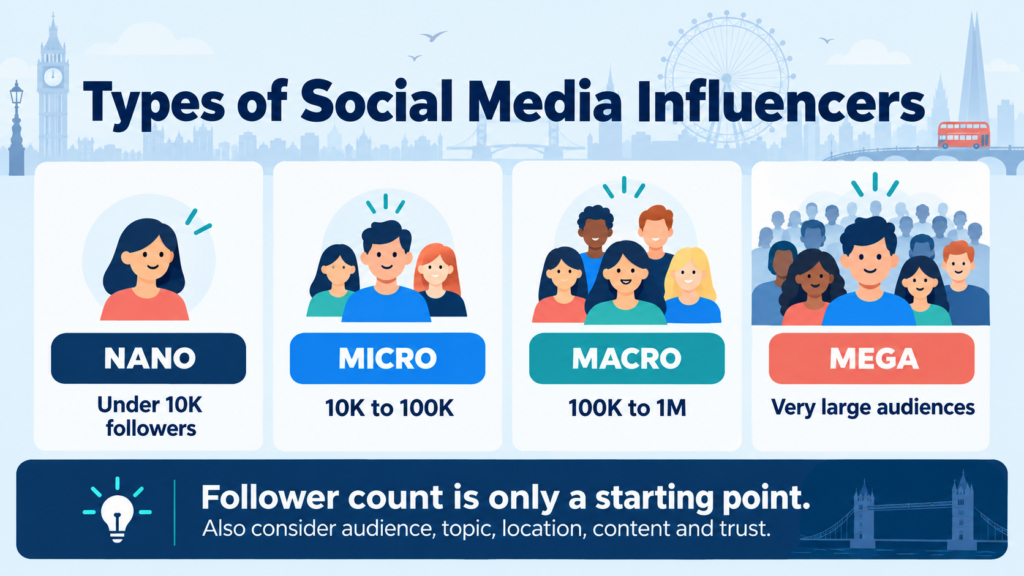
Creators are often grouped by audience size. The four groups are nano, micro, macro and mega.
The exact follower bands can differ across platforms and sources. The 2025 study uses fewer than 10,000 followers for nano creators, 10,000 to 100,000 for micro creators, and 100,000 to 1 million for macro creators.
These labels give brands a useful starting point. They do not tell the whole story, though.
A creator’s topic matters. So does their audience, content, location and level of trust.
For a broader look at how creator work can fit within a social media plan, you can use an influencer marketing service
Nano Influencers
Nano influencers have the smallest audiences in this group.
They often have a close link with their followers. Many focus on one place, hobby, job or interest. Their posts may feel less like an advert and more like a tip from someone the viewer knows.
This can work well for:
- Local brands
- Niche products
- Small launches
- Community campaigns
- Product testing
There is one clear drawback. Reach is limited.
One nano creator may not bring enough views for a large campaign. A brand may need to work with several creators to reach more people.
Micro Influencers
Micro influencers have a larger audience but often keep a clear area of focus.
Think of a food creator who talks only about local restaurants or a fitness creator who speaks to runners. The audience may be smaller than that of a huge celebrity, but it can be a better match for the brand.
Micro creators can suit:
- Product reviews
- Food brands
- Beauty products
- Fitness products
- Local campaigns
- Specialist services
They can also give brands more choice. Instead of putting all the budget into one large account, a campaign can work with several smaller voices.
Macro Influencers
Macro influencers bring much more reach. A macro creator can put a product in front of a large audience with one post or video. That can be useful when the main goal is awareness.
They may suit:
- National campaigns
- Product launches
- Seasonal campaigns
- Large awareness drives
- New market activity
There is a trade-off. Large reach can cost more. The audience may also be broad, so not every follower will be a good match for the product.
Mega Influencers
Mega influencers sit at the top end of the scale.
Their audiences can be very large. Some have followers across several platforms too. A post from one creator can attract a huge amount of attention.
That level of reach can be useful for a major launch or a campaign that needs wide public attention.
It can also bring more risk. Costs may be much higher. Campaign deals can take more work. There may also be more checks around reputation and brand fit.
Before working with a mega creator, look at:
- Audience location
- Audience interests
- Engagement
- Past partnerships
- Content style
- Public reputation
- Fit with the brand
A big account is not always the right account.
Nano vs Micro vs Macro vs Mega
The four creator types all have a place.
Creator type | Main strength | Often suits |
Nano | Close audience ties | Local and niche work |
Micro | Focused reach | Targeted campaigns |
Macro | Large audience | Wider awareness |
Mega | Huge visibility | Major campaigns |
The best types of social media influencers for one brand may be very different from those for another.
For example, a small specialist product may get more value from a trusted niche creator than from a huge account with a broad audience. The size of the account is a guide. It is not the answer.
How to Choose the Right Influencer for Your Campaign
How to choose the right influencer starts with one basic question:
- What do you want the campaign to do?
Do not start with a list of famous creators. Start with the result.
1. Set the Campaign Goal
Your goal may be to:
- Build awareness
- Bring people to the website
- Get leads
- Increase sales
- Gain sign-ups
- Test a product
- Create fresh content
Write down the main goal first. A creator who is great at getting views may not be great at driving sales. Another may have a smaller audience but create content that gets people to act.
2. Know Who You Need to Reach
Think about the people who may buy from you.
Look at:
- Age
- Location
- Interests
- Needs
- Buying habits
Then look for creators whose audiences line up with those people. A creator with 500,000 followers in the wrong market will not help much.
3. Match Creator Size to the Job
Different goals can call for different creator sizes.
- A local campaign may suit a nano or micro creator.
- A specialist product may work well with micro creators.
- A national launch may need macro reach.
- A major public campaign may call for a mega creator.
This is why choosing the right influencer should never come down to a single number.
4. Study the Audience
Do not stop at followers. Look at the comments. Read them. See what people ask. Check how the creator replies.
Also look at audience data where it is available.
Watch for:
- Audience location
- Audience age
- Engagement
- Shares
- Saves
- Comments
- Sudden follower growth
- Poor-quality engagement
Numbers can tell part of the story. The posts often tell the rest.
UK Rules for Working With Creators
A creator partnership is not just a marketing deal. There are rules around advertising too.
When a creator has a commercial link with a brand, that link must be clear to the audience.
This can apply when the creator receives:
- Money
- Free products
- Discounts
- Another form of payment or incentive
The UK guidance says promotional content should be clearly marked as advertising when there is a commercial relationship.
The rule is not only for very large creators. Smaller creators must make paid content clear too.
A useful campaign brief should explain:
- What needs to be marked as an advert
- Which posts are paid
- When content will be published
- What product claims are allowed
- What the creator should not say
The CMA also advises brands to make creators aware of their disclosure duties before content is published.
What Should Be in a Creator Agreement?
A simple written agreement can prevent a lot of back-and-forth. Set out the basics before work starts.
Include:
- Number of posts
- Type of content
- Platforms
- Due dates
- Payment
- Approval steps
- Usage rights
- Exclusivity
- Disclosure rules
- Reporting
Usage rights are easy to miss.
Suppose a creator makes a video for Instagram. Can the brand use that same video on its website? Can it be used in a paid advert? Can it edit the video?
Those points should be clear before the creator starts work.
Final Thoughts
There is no single winner among creator tiers. Nano creators can bring close audience ties. Micro creators can reach focused groups. Macro creators offer wider reach. Mega creators can put a message in front of a very large audience.
Understanding the types of social media influencers gives you a better place to start. From there, look at the people behind the numbers.
Check the audience. Read the comments. Review past work. Set the goal first. Then choose the creator size that fits the job.
That approach can stop a campaign from becoming a simple race for followers. It puts the focus back where it belongs: on the people you want to reach and the result you want to get.
For more guidance on creator campaigns and wider social media work, Midland Marketing provides further information on influencer marketing.
Frequently Asked Questions
- Can a creator’s audience become less useful as their account grows?
Yes. A creator may start with a very focused audience and attract a much wider mix of people as the account grows. It is worth checking the audience again before a new campaign.
- Can a brand work with a creator who has never done a paid post?
Yes. It can work well, but the brand should give clear guidance. Talk through the brief, payment, deadlines, content needs and advertising disclosure before work begins.
- What should a brand ask a creator before agreeing to a campaign?
Ask about their audience, past work, content process, rates, turnaround time and other brand deals. It is also useful to ask what content they think would suit their audience.
- Can an old creator post be used as proof of future results?
Not on its own. Results can change from one campaign to another. The product, offer, timing, audience and platform can all affect performance.
- What should happen if a creator misses a campaign deadline?
The agreement should set out what happens next. It may include a new deadline, a change to payment or another agreed step. Clear terms make these problems easier to handle.

Written by - Lauren Davison
Introducing Lauren – one of our content writers who has a flair for SEO and creative strategy!
With a Master’s Degree in Creative Writing, Lauren has niched down into SEO and content writing.
Outside of work, she loves watching the darts, reading and the pub on the weekend.
Want some more?
Latest Insights & News
Types of Social Media Influencers: The Complete Guide to Nano, Micro, Macro and Mega Creators
Introduction Choosing an influencer looks easy from the outside. In real campaigns, it is not that simple. A creator with 7,000 followers can know their
How to Measure Marketing ROI: Data-Driven Analytics Frameworks for Success
Introduction Marketing ROI is the number that decides whether your next budget meeting is a comfortable one or an awkward one. Followers, impressions and website
How UK Marketers Use Powerful AI Ad Testing to Test Hundreds of TikTok & Instagram Ads
Introduction Most UK paid social teams are not short on ideas. They are short on the hours needed to test them. A creative concept can