

Introduction
Most UK paid social teams are not short on ideas. They are short on the hours needed to test them. A creative concept can look brilliant in a deck. Put it into a live TikTok or Instagram campaign and the audience decides within seconds.
That gap between what looks good and what actually converts is exactly where AI ad testing has started to change the workflow. The shift matters for UK marketers because paid social budgets face more scrutiny than ever. That changes the maths.
Table of Contents
Why AI Is Changing Social Ad Testing
For a long time, creative testing meant hand-picking three or four variations. You launched them, waited, and hoped the sample size was enough. On TikTok and Instagram, that approach struggles.
The feed moves fast, trends shift mid-campaign, and audiences develop ad blindness quickly. Marketers need more ad variations, not fewer, but production time does not scale in a straight line.
AI changes that pressure point. It can generate dozens of hooks and captions, and it can tweak formats in minutes. The output is not always perfect. Some of it feels formulaic, and a human still has to sort strong work from noise.
But the production bottleneck loosens. Teams can test 50 or 100 variations without hiring five more designers. That is the real appeal.
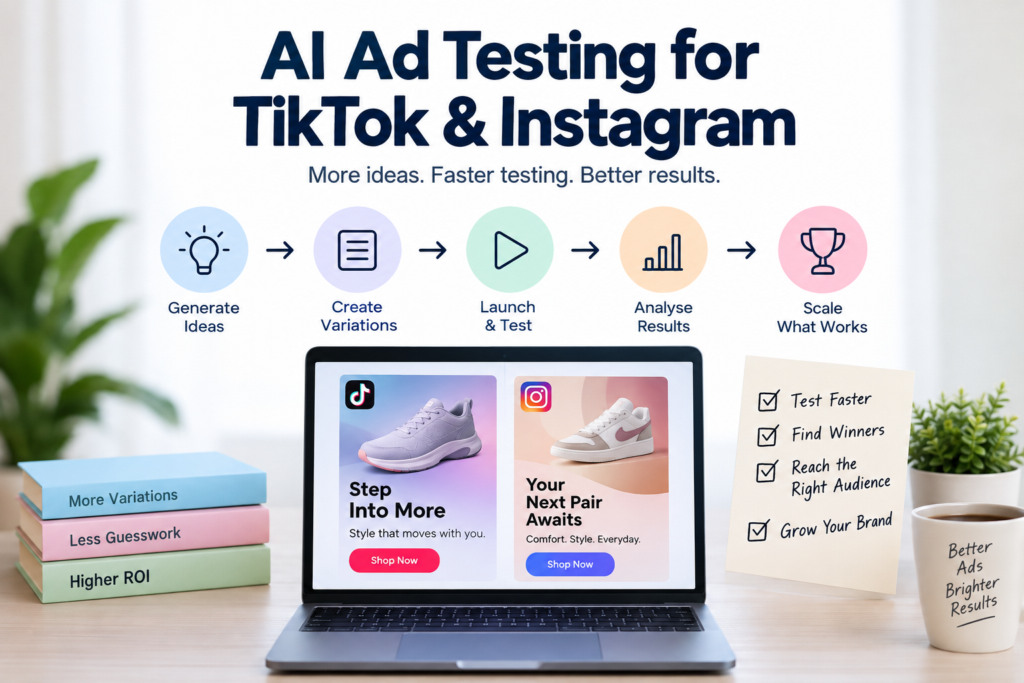
What used to be a slow, manual cycle now becomes a faster loop of idea, variation, launch, and read. The question is whether UK teams are using that speed wisely.
Why UK Marketers Are Moving Towards AI Advertising
AI advertising has shifted from a novelty to a practical tool for many UK marketing teams. The reason is not hype. It is the simple need to keep up with two platforms that reward volume and freshness.
Less manual work, more creative ground
Producing 20 versions of a TikTok ad used to take days. A designer or editor would tweak the hook, change the text, maybe adjust the crop. AI-assisted production removes some of that repetitive labour. Teams can now generate multiple hooks and captions, plus visual treatments, without starting every file from scratch.
That does not mean creative roles disappear. It means their time moves towards judgement and selection. A human still decides which variations feel on-brand. The software just does the heavy formatting and ideation. For smaller UK teams, that is a meaningful shift.
From guesswork to rapid experiments
Most creative decisions start as assumptions. Maybe you think a question-based hook will outperform a bold claim. Maybe you suspect a certain colour works better on Stories. AI advertising helps turn those assumptions into runnable experiments faster.
Instead of debating for a week, a team can launch several variations and let real audience behaviour provide the answer. The results are not always clean. Sometimes two ads perform similarly, and the data is noisy. But the direction of travel is better than endless internal opinion.
The rise of personalised ads
Personalisation is not just adding a first name to a subject line. On social platforms, it means adapting the hook and visual to a specific audience segment. Pace matters too. AI makes that adaptation more practical. Audience segmentation becomes more than a spreadsheet exercise.
A fashion brand might test one tone for Gen Z shoppers and another for millennial parents. AI can produce both versions from the same core concept without doubling the creative budget. The risk, broadly speaking, is producing variations that feel shallow. Personalisation does not mean relevant. Marketers still need to check the work.
Speed is becoming a competitive edge
TikTok rewards advertisers who spot a trend before it saturates. Instagram is not far behind. The faster a team can move from spotting a format to testing it, the better their chances of finding an ad that resonates before costs rise.
AI-assisted creative testing compresses that timeline. It lets a team react to a trending sound or visual style within hours, not days. The brands that do this consistently build a library of tested patterns. The ones that do not are left launching one guess at a time.
How AI Ad Testing Works Across TikTok & Instagram
AI ad testing is not one tool. It is a workflow. The process still starts with human judgement and ends with human decision-making. The middle is where automation does the heavy lifting.
Start with the core creative
Before any variation is generated, there has to be a clear control. That means a defined offer and audience. The campaign objective also needs to be clear. A strong control creative gives the test a reference point.
Without that reference, results are hard to read. If everything is a random variation, you cannot tell whether a change helped or hurt. The core creative might not be brilliant. It just needs to be good enough to benchmark against.
Multiply the variables
Once the control exists, the variables get broken down. Hooks, headlines, visuals, captions, CTAs, and formats can all be adjusted. AI helps generate combinations across those elements quickly.
Some teams change one variable at a time. Others test several variables together when they are hunting for a big lift. Both approaches have a place, as long as the test structure stays clear. A messy test with too many moving parts produces interesting ads and confusing lessons.
Test the combinations
AI can organise the resulting variations into a coherent test matrix. It can group hooks and pair them with visuals. It also flags duplicates. This part used to eat hours in a spreadsheet. Now the software handles much of the matching.
The human role is to review the output and remove anything off-brand or nonsensical. Some AI-generated ad copy still sounds like a corporate press release with emojis (you know the sort). Some variations will be unusable. That is normal and worth expecting.
Keep the winners, cut the weak links
Once performance data comes in, the job shifts. Some variations will clearly underperform. Others will show promise. The next step is iteration, not just celebration.
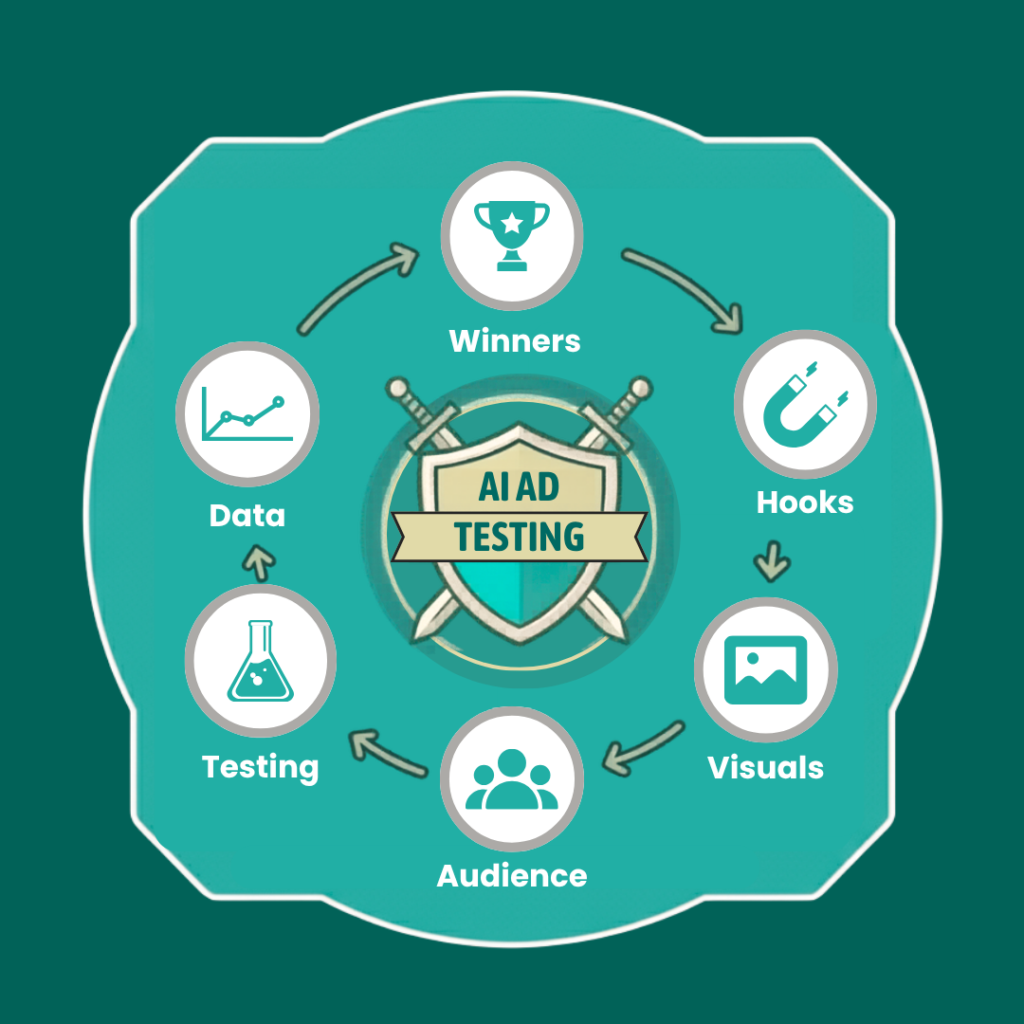
Winners get new variations built around their strongest elements. Weak links get cut or paused. The loop repeats. AI ad testing works best as a continuous cycle rather than a one-off campaign.
TikTok Ad Testing vs Instagram Ad Testing: What Changes?
The same creative idea rarely performs equally on both platforms. TikTok and Instagram each have their own rhythm and formats. Audience behaviour also differs.
Testing factor | TikTok | |
Creative style | Short-form, native-feeling video | Reels, Stories, Feed and visual formats |
Opening hook | Immediate attention in the first seconds | Strong visual and copy-led opening |
Creative variations | Hooks, pacing, sounds, formats | Visuals, copy, formats, CTAs |
Audience response | Watch time, engagement, conversions | Engagement, clicks, conversions |
Testing priority | Native creative and retention | Creative format, messaging and placement |
TikTok rewards native creativity
TikTok ad testing is heavily weighted towards hooks and pacing. A polished studio ad can flop if it feels like an interruption. A rough, native-style video can win if it holds attention in the first two seconds.
Viewer retention matters as much as click-through rate. TikTok users scroll fast, and they punish anything that smells like a traditional ad. Testing on this platform means prioritising content that looks like it belongs in the feed.
Instagram gives marketers more formats
Instagram ad testing has more placement variety. Reels behave differently from Stories. Feed ads allow more copy. Each format creates distinct testing opportunities. A visual that works in Feed may fail in Stories because the context shifts.
Marketers can run the same core idea across placements, but they should treat each one as a separate data point. The platform’s algorithm also rewards different signals depending on placement.
One creative idea, multiple executions
A campaign concept should not be copied verbatim from TikTok to Instagram. The pacing and captions often need adjustment. Visual framing matters too. AI can help produce platform-specific executions from one core asset.
That is where AI-powered social media advertising becomes genuinely useful. It speeds up adaptation without requiring a full redesign for each placement. But the adaptation has to respect the platform’s native feel.
Cross-platform data reveals patterns
If a hook works on both TikTok and Instagram, that is a strong signal. It probably means the message itself has power, not just the format. Marketers should look for repeatable signals like that.
Isolated winners are useful. Repeatable winners are more valuable. They tell you something about the audience, not just the algorithm.
Testing Hundreds of Ad Variations Without Losing Your Mind
The goal is not volume for its own sake. It is structured experimentation. More ad variations can help, but only if each one tests something meaningful.
Build a creative testing matrix
A testing matrix breaks a campaign into variables like hook, visual, message, CTA, and audience segment. Combining those variables creates a large testing pool.
For example, five hooks plus four visuals create a large testing pool. That is a lot to manage manually. AI helps generate and organise the matrix without losing track of what changed.
Prioritise high-impact variables
Not every variable deserves equal attention. A change in hook often matters more than a slight colour adjustment. Testing teams should focus on elements most likely to shift performance.
Wasting budget on near-identical variations is a common mistake. If two ads differ only by a shade of blue, the test rarely teaches anything useful. Better to spend that budget on a genuinely different hook or message. Honestly, that is where most of the wasted budget sits.
Let performance data guide iteration
Metrics like CTR and engagement should determine the next round. Conversion data adds the commercial context. AI-powered advertising can surface patterns quickly, but the marketer still has to interpret them.
If one hook consistently outperforms, the next test might explore variations of that hook. If a format underperforms across the board, it might be cut from the next cycle. The data should feed the next creative brief, not just a report.
Scale what actually works
Winning concepts deserve more variations, not fewer. A strong hook can be adapted to new audiences and new offers. A weak pattern should be retired.
This is where many teams stop. They find one winning ad and stop testing. The smarter move is to treat that winner as a new control and keep pushing variations around it.
The Metrics That Reveal Winning Ad Variations
Ad performance is not one number. It is a sequence of signals. Some arrive early. Others take longer to read.
Watch the first-response signals
Hook engagement, video retention, thumb-stop behaviour, and early engagement all matter. These signals tell you whether the creative stopped the scroll.
A high early drop-off usually means the hook did not land. A strong retention curve suggests the ad held attention. Those first-response signals are especially important on TikTok, where the feed moves fast.
Measure clicks and conversions
After attention comes action. CTR, CPC, conversion rate, and cost per acquisition reveal whether the ad drove the desired outcome. These are harder metrics. They connect creative performance to commercial results.
A video can have great watch time and still produce no conversions. That is not a failure of the metric. It is a reminder that attention and action are different things.
Look beyond a single metric
High engagement does not automatically mean high commercial performance. An ad can be entertaining and memorable without selling anything. The campaign objective matters.
For a conversion-focused campaign, cost per acquisition carries more weight than likes. For a brand awareness push, reach and recall might matter more. Marketers should read metrics in context, not in isolation.
Turn results into the next test
A winning ad is not the end. It is a clue. The next round of creative testing should build on what the data revealed.
If a direct CTA outperformed a soft one, test stronger variants of that CTA. If a specific visual style holds attention, explore that style further. The goal is a continuous testing cycle, not a single breakthrough.
Where AI Ad Testing Still Needs Human Strategy
Automation can produce and sort variations. It can also compare them. It cannot replace brand judgement or context. Creative instinct still matters too. That is not a limitation of the tools. It is just how marketing works.
AI cannot replace brand judgement
AI-generated creative can drift off-brand quickly. It might use the wrong tone or make an exaggerated claim. A visual might clash with the brand. A human has to recognise when the tool drifts off-brand and protect brand consistency.
The Advertising Standards Authority has clear guidance on recognisable ads, which still applies to AI-generated variations. Compliance remains a human responsibility, not an algorithmic one. Marketers should review every variation before it goes live.
More variations do not mean better results
Volume is not a strategy. Producing hundreds of near-identical ads without a hypothesis is just noise. What if the real problem was never production speed?
Meaningful experimentation means changing something that could genuinely shift behaviour. That might be a new hook or a different audience segment. It is not just the same ad with a slightly different background.
Performance data needs context
Budget, audience size, placement, and campaign objective all shape results. A winner in a small test might not hold up at scale. A loser might have been underfunded or placed badly, whilst a winner might be a fluke.
Declaring a winner from insufficient data is a common error. The sample size has to support the conclusion. Otherwise, the team optimises against random noise.
Creativity still needs a human spark
AI is useful for scale and iteration. The strategic concept and positioning should stay human-led. Creative direction needs the same human input. AI can remix an idea. It cannot tell you whether the idea is worth having.
A well-timed cultural reference or a genuine insight about the audience still comes from people. These are human contributions. They are the difference between an ad that performs and an ad that connects.
What UK Marketers Should Take From the AI Testing Shift
The tools are changing. The fundamentals are not.
Test more without losing focus
AI allows more experimentation. The risk is spreading attention too thin. Clear objectives keep the testing programme grounded.
A team should know what it is trying to learn before launching 50 variations. Otherwise, the data will not lead anywhere useful.
Build a repeatable testing system
A repeatable system means a process for creating, launching, measuring, and iterating creatives. It does not have to be complex. It just has to be consistent.
Some UK teams run a monthly testing sprint. Others run continuous small tests. The format matters less than the rhythm. Each round should feed the next one.
Combine speed with strategy
AI provides scale. Marketers provide judgement. That balance is the whole game. Speed without strategy creates clutter. Strategy without speed leaves opportunities on the table. The most effective teams treat AI as an assistant, not a decision-maker.
Make every test teach you something
The aim is not just to find winning ads. It is to understand why they win. That understanding compounds. A team that learns from every test gets smarter with each cycle. A team that just collects winners stays dependent on luck.
Turning More Ad Variations Into Better Decisions
AI has made large-scale social creative testing more achievable for UK marketers. The real advantage is not creating hundreds of ads. It is learning faster from controlled experimentation.
TikTok and Instagram still demand platform-specific creative thinking. AI can support that work, whilst marketers set the direction. The marketers who get the most from these tools combine speed with brand knowledge and performance analysis. Honest human judgement still matters.
For UK teams that want to tighten their current testing process, a paid social audit is a sensible next step. It helps identify where creative testing is leaking budget and where a repeatable system could help. Midland Marketing works with UK businesses that want clearer thinking and measurable results without unnecessary complexity.
Frequently Asked Questions
What is AI ad testing?
AI-powered ad testing uses machine learning and automation to create, organise, compare, and optimise multiple advertising variations. It speeds up the production and analysis stages. A human still sets the strategy and reviews the output.
Can AI test TikTok and Instagram ads at the same time?
Yes, but with platform-specific adjustments. AI-assisted workflows can run across both platforms. Marketers need to account for different creative formats and audience behaviours. Placement rules also differ.
How many ad variations should marketers test?
There is no universal number. Testing volume should depend on budget, audience size, campaign objective, and available data. A small brand might test five variations. A larger team might test 50. The point is to make each variation meaningful.
What should you test in an AI-generated ad?
Hooks, visuals, messaging, CTAs, formats, and audience segments are the main variables. Focus on elements that could genuinely shift performance. Minor cosmetic changes rarely teach much.
Can AI replace human creative testing?
No. AI can accelerate production and analysis. Human strategy remains essential for brand positioning and creative direction. Interpreting results also needs human judgement. The best setup is AI-assisted, human-led.

Written by - Lauren Davison
Introducing Lauren – one of our content writers who has a flair for SEO and creative strategy!
With a Master’s Degree in Creative Writing, Lauren has niched down into SEO and content writing.
Outside of work, she loves watching the darts, reading and the pub on the weekend.
Want some more?
Latest Insights & News
Types of Social Media Influencers: The Complete Guide to Nano, Micro, Macro and Mega Creators
Introduction Choosing an influencer looks easy from the outside. In real campaigns, it is not that simple. A creator with 7,000 followers can know their
How to Measure Marketing ROI: Data-Driven Analytics Frameworks for Success
Introduction Marketing ROI is the number that decides whether your next budget meeting is a comfortable one or an awkward one. Followers, impressions and website
How UK Marketers Use Powerful AI Ad Testing to Test Hundreds of TikTok & Instagram Ads
Introduction Most UK paid social teams are not short on ideas. They are short on the hours needed to test them. A creative concept can