


Introduction
Most marketing teams don’t lack ideas. They lack certainty.
A new layout appears cleaner. A subject line sounds much clearer, and the call to action is tweaked because it “just sounds better. ” These changes seem harmless, but actually, they come with a certain risk.
Because when performance changes, positive or negative, it’s rarely obvious why.
This is where A/B testing in marketing becomes useful. Not glamorous and not clever, but useful. It gives teams space to slow down decisions just enough to see what actually moves the needle. That replaces guessing with informed action.

Table of Contents
What Is A/B Testing in Marketing?
Definition and Core Purpose
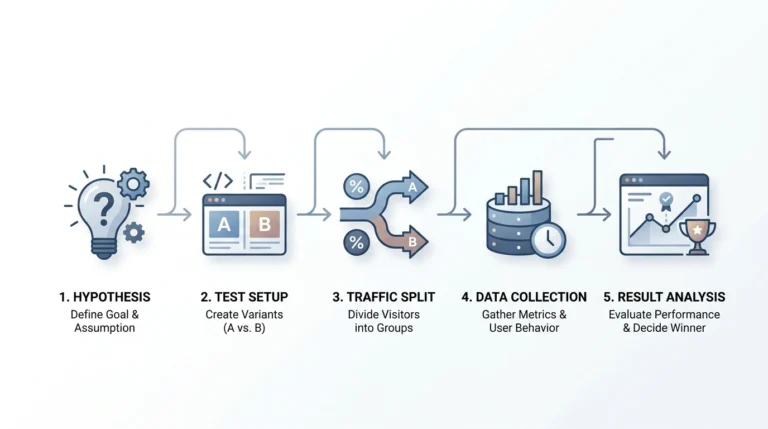
At its simplest, A/B testing is a comparison. Two versions of the same asset are shown to the same audience in the same conditions. One intentional change is made, and the response is observed.
The goal isn’t to experiment endlessly. It’s to replace assumptions with evidence. Over time, those small confirmations add up to better decisions across campaigns, websites, and messaging.
A/B testing exists because “it feels right” is not a metric.
How A/B Testing Differs from Guesswork
Without testing, optimisation quickly becomes a debate. Design versus copy, senior opinion versus junior insight, experience versus instinct.
None of those inputs is useless. But they’re incomplete.
Split testing introduces discipline by narrowing the question and removing noise. Debate over preferences gives way to measurement. Teams focus on what people click, what they ignore, and what they finish.
That shift alone changes how marketing decisions are made.
Why A/B Testing Matters for Business Decision-Makers
Reducing Risk in Marketing Changes
Every change introduces uncertainty. Even sensible ones.
A simplified page might remove friction, or it might remove reassurance. A punchier email might increase opens, or it might feel off-brand. When changes roll out everywhere at once, mistakes scale fast.
A/B testing limits exposure. Only a portion of users see the variant. If performance drops, the damage is contained. If it improves, the rollout is earned.
That’s not caution for caution’s sake. It’s risk management.
Supporting Budget and Resource Justification
Marketing budgets often come with scrutiny attached.
Testing helps teams move beyond opinion when defending decisions. Rather than telling why the method should work, they can demonstrate that it actually did work. Even a small improvement, if it is measured, is significant.
Data-backed outcomes change the tone of internal conversations. They make marketing feel less speculative and more accountable.
How A/B Testing Works in Practice
Control vs Variant Explained
Every test needs a baseline.
The control is the current version of the asset. The variant includes one intentional change. That change could be visual, structural, or written, but it must be isolated.
Traffic is routed equally between the two versions, hence the results may be compared without doubt. If there is no equal exposure, the conclusions become unreliable.
The discipline comes from restraint, focusing on one change, one question, and one answer.
Metrics That Matter
Not all numbers deserve equal attention. Effective marketing experimentation focuses on outcomes that align with real goals.
- Conversion rate.
- Click-through rate.
- Completion rate.
- Revenue per visitor.
Metrics such as impressions or dwell time can set the scene; however, they hardly ever serve as a sole justification for a decision. If a test is not related to a value, most likely it is just noise.
Common Use Cases for A/B Testing in Marketing
Website and Landing Page Optimisation
Website optimisation testing is often where testing delivers the clearest returns.
Headlines are tested for clarity, layouts for flow, calls-to-action for intent, and trust signals for reassurance. Small changes can alter how users interpret a page, even when nothing “major” changes.
Most high-performing pages evolve gradually. Rarely overnight.
Email Campaign Testing
Email A/B testing is popular for a reason. Results arrive quickly.
Subject lines, preview text, send times, and tone are common variables. These tests often surface insights that apply beyond email itself, especially around messaging and positioning.
They also allow improvement without increasing send volume, which matters as inboxes get noisier.
Paid Media and Ad Creative Testing
Paid media leaves little room for assumption.
Split testing ad creative allows teams to control spend while learning what resonates. Copy, visuals, and offers can all be validated before budgets are scaled.
This turns campaign optimisation into a feedback loop rather than a guessing game.
Building a Sound A/B Testing Strategy
Start with a Clear Hypothesis
Good tests start with a reason.
That reason might come from analytics, user behaviour, or observed friction.
- Reducing form fields will lower abandonment.
- Clarifying pricing will improve completion.
A hypothesis doesn’t need to be complex. It needs to be specific enough to learn from.
Test One Variable at a Time
Multiple changes at once blur results.
If the headline, layout, and CTA all change together, performance shifts become impossible to explain. Single-variable testing moves slowly, but the clarity it creates compounds over time.
Ensure Statistical Validity
Stopping tests early is tempting. It’s also dangerous.
Short-term spikes can mislead, especially with small samples. Tests need time to absorb natural variation. Otherwise, decisions are based on coincidence rather than pattern. Confidence should come from data, not impatience.
A/B Testing and Conversion Rate Optimisation (CRO)
How A/B Testing Supports CRO
Conversion rate optimisation without testing is guesswork dressed up as a process.
A/B testing anchors CRO to evidence. Each change earns its place. Each assumption is challenged. Over time, this creates steady improvement instead of dramatic swings.
It also makes CRO repeatable, which is where long-term value lives.
Continuous Improvement, Not One-Off Wins
The real benefit of A/B testing appears slowly.
Small gains accumulate. One insight informs the next test. Over a period of months, tiny changes can accumulate to significant performance growth without disruptive redesigns. That is optimisation as a continuous practice, not a one-off project.
Common Mistakes Businesses Make with A/B Testing
Testing Without Clear Goals
Tests without defined outcomes rarely teach anything useful. If success isn’t defined upfront, interpretation becomes subjective. Every test should map back to a business objective, not curiosity alone.
Over-Interpreting Short-Term Results
Early results are volatile. That’s normal. Decisions made too quickly often need reversing later. Waiting for sufficient data isn’t hesitation. It’s protection against false confidence.
Treating A/B Testing as a One-Time Activity
One winning test does not equal a strategy. Businesses that stop testing lose momentum. Those that continue build learning into their operations and adapt as behaviour changes.
When A/B Testing May Not Be Appropriate
Low Traffic or Limited Data Environments
Not every environment supports meaningful testing.
Low-traffic websites may have difficulties in accumulating enough data to be rigorous. In such situations, qualitative research, usability testing, or user feedback might provide a deeper understanding. Testing is a tool, not a duty.
Compliance or Brand-Sensitive Changes
Some changes should not be tested. Legal requirements, regulated messaging, and core brand commitments often demand consistency. Experimentation here can introduce unnecessary risk.
Conclusion: Using A/B Testing to Make Better Marketing Decisions
A/B testing in marketing helps teams make changes with less risk. The process replaces guesswork with evidence instead of opinion or habit. Eventually, the nature of decisions starts to transition. Suggestions become experiments, not arguments; on the other hand, the results count more than self-assurance. The change brings improved results and fewer surprises.
Frequently Asked Questions
- What does A/B testing mean for marketing?
A/B testing refers to a procedure where two versions of the same thing are compared, with only one feature deliberately changed. All other things remain the same, and the users’ behaviour determines which is the winner.
- How long is an A/B test supposed to be?
Tests should be long enough to show a genuine trend. Being too quick to finish a test risks false results; that is why most tests last a couple of days or weeks, depending on the amount of traffic.
- Are small businesses able to do A/B testing?
Certainly, and a lot of them already do it. Small businesses usually A/B test their emails, landing pages or even call, to, action wording. It is not a must to have great traffic. What you need is just a clear goal and patience.
- What is the first thing I should test?
Pick the first place where performance is deteriorating. Identify low-converting pages or emails with weak clicks. Remove the obstacles/fix the problems before making large changes somewhere else.
- Is A/B testing the same as conversion rate optimisation?
No, but they complement each other. A/B testing is a technique. Conversion rate optimisation refers to the broader process that incorporates those results.