


Introduction
Brand positioning has become one of those terms businesses hear constantly, yet struggle to apply with confidence. Many brands know they need to “stand out,” but can’t clearly explain how or why they should be chosen over others. The result is familiar: safe messaging, similar promises, and marketing that blends into the background. In crowded markets, that vagueness is costly.
Brand positioning is not about clever taglines or surface-level branding. It’s about owning a clear, credible place in your customer’s mind. One that makes sense the moment they encounter you. When positioning is weak or unclear, even strong products feel interchangeable. Price becomes the only lever left to pull.
Today, competition is sharper, buyers are more informed, and attention is limited. Businesses that invest time in defining their positioning don’t just sound better. They sell faster, defend their value, and build trust that lasts. This guide breaks down how effective positioning actually works in practice, and why it matters more now than ever.

Table of Contents
What Is Brand Positioning?
Defining Brand Positioning In Simple Terms
Brand positioning is a choice about how you want to be known. Not in an abstract, emotional sense, but in a practical one that holds up under pressure. It clarifies who the brand is for, the problem it solves, and why someone would pick it over a familiar alternative. When positioning is right, understanding comes quickly. There’s no pause, no need to decode.
Strong positioning doesn’t come from a mood board. It’s shaped by market insight, customer behaviour, and competitive reality. It sets boundaries around what the brand stands for and what it deliberately avoids. That restraint is what makes the position defensible.
How Brand Positioning Differs From Branding And Marketing
Branding and marketing are easy to spot. Positioning isn’t. Yet it quietly shapes both. Branding expresses identity. Marketing creates demand. Brand positioning sits beneath them, guiding choices long before anything goes live.
Think of it like this:
- Positioning sets the direction
- Branding gives it a visual and verbal identity
- Marketing carries it to the market
Without strong positioning, branding becomes decorative and marketing loses consistency. Messages change. Promises blur. Over time, trust erodes. Clear positioning prevents that drift by anchoring everything to a single, shared understanding of value.
Why Brand Positioning Matters In Competitive Markets
The Cost Of Weak Or Unclear Positioning
When brand positioning is vague, the damage shows up quietly at first. Sales conversations take longer. Prospects ask for comparisons. Price becomes the main point of discussion. People may understand what you do, yet struggle to explain why you are different. That gap creates hesitation.
Over time, weak positioning leads to:
- Inconsistent messaging across teams and channels
- Increased pressure to discount just to stay competitive
- Lower loyalty, because nothing feels distinctive or memorable
This isn’t a marketing failure. It’s a strategic one. Without a clear position, every competitor looks similar, and customers default to the safest or cheapest option.
How Strong Positioning Supports Business Growth
Strong positioning changes the dynamic. It gives buyers a reason to choose quickly and confidently. Sales teams spend less time explaining and more time closing. Marketing stops chasing attention and starts reinforcing a clear story.
Well-defined positioning also creates internal alignment. Teams make better decisions because they understand the value the business is meant to protect. That clarity supports:
- Faster conversion and shorter sales cycles
- Greater trust, especially in crowded or sceptical markets
- The ability to hold pricing without constant negotiation
In competitive environments, positioning isn’t a branding exercise. It’s a growth lever.
Core Elements Of An Effective Brand Positioning Strategy
Target Audience And Market Focus
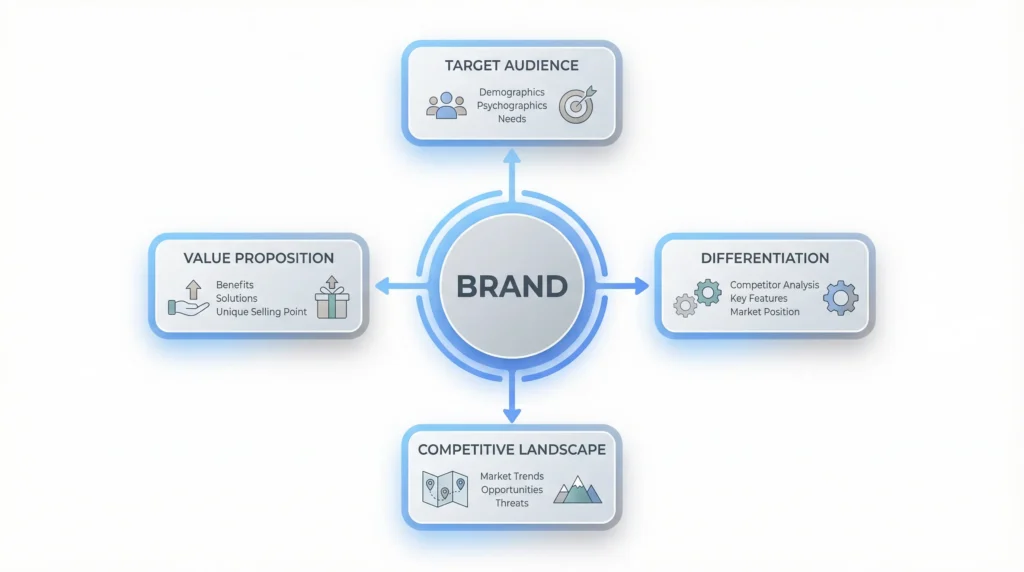
Strong positioning begins with restraint. Not everyone is your customer, and pretending otherwise weakens your message. A clear focus on who you serve, what they struggle with, and how they make decisions gives your positioning weight. It forces you to speak directly, not broadly. When brands take the time to understand buying context, pressure points, risk tolerance, and internal politics, their message feels relevant rather than promotional.
This kind of precision builds trust. People recognise when a brand understands their reality, not just their demographics.
Value Proposition And Differentiation
A value proposition explains the outcome you deliver. Differentiation explains why others can’t easily promise the same thing. One without the other falls flat. Features can be copied. Claims can be mimicked. Credible differentiation is rooted in experience, proof, and consistency.
Effective positioning answers three key questions buyers always ask:
- What do I gain?
- Why should I believe this?
- Why you, not someone else?
Competitive And Category Context
Positioning only works when it makes sense within its category. Ignore competitors, and you risk sounding unrealistic. Copy them too closely, and you disappear. Understanding category norms, common claims, and customer expectations helps you choose a position that stands out without confusing the market.
Popular Brand Positioning Frameworks Explained
The Positioning Statement Framework
The positioning statement framework is not meant for customers. It’s a thinking tool. A way to force clarity before anyone writes copy or designs a campaign. By clearly naming the audience, category, benefit, and proof, it exposes weak assumptions fast. If the statement feels generic, that’s the point. It tells you the positioning isn’t finished yet.
Used well, this framework keeps teams aligned. It becomes a reference point when messaging drifts or new ideas surface. Not exciting, perhaps. But effective.
Value-Based Brand Positioning
Value-based brand positioning shifts the focus away from features and toward outcomes. Buyers rarely care how something works. They care about what changes because it exists. Less risk. More confidence. Time saved. Fewer mistakes.
This approach works especially well in crowded markets where products look similar. By anchoring positioning in lived value, brands speak to real concerns rather than technical detail. It feels human because it is.
Competitive Differentiation Framework
This framework starts with an honest look at the competitive landscape. Where do others cluster? What claims sound the same? Differentiation comes from choosing a space others avoid or can’t credibly own.
Common differentiation levers include:
- Depth of expertise
- Quality of service
- Speed and responsiveness
- Trust built through consistency
The goal isn’t to be louder. It’s to be clearer, in a place that feels earned.
Brand Positioning Vs Market Positioning
Understanding The Strategic Difference
Market positioning answers a practical question: where does this sit in the market? It’s about category, price range, feature set, and who the offer is designed for. Useful, yes. But limited. Brand positioning goes further. It shapes how people feel about that offer and what it represents in their mind.
Two companies can occupy the same market position and still be perceived very differently. One feels safe. Another feels bold. One feels replaceable. The other earns trust. That difference isn’t accidental. It’s the result of deliberate brand positioning layered on top of functional choices.
How Both Work Together
The strongest brands don’t choose between the two. They align them. Market positioning sets the playing field. Brand positioning determines the advantage.
When they work together:
- Pricing makes sense because it reflects perceived value
- Messaging feels consistent across touchpoints
- Customer experience reinforces the same promise, again and again
When they don’t, confusion creeps in. Offers feel mispriced. Messages feel off. Growth slows. Alignment keeps everything moving in the same direction, with purpose rather than noise.
Translating Brand Positioning Into Brand Messaging
From Strategy To Messaging Clarity
Brand positioning tends to sit quietly in the background. You don’t see it on a slide or in a headline, but you feel it when a message lands without effort. The words don’t strain. The tone feels settled. Nothing needs over-explaining because the focus is already there.
When positioning is strong, it shapes how a brand speaks long before anyone writes copy. It influences language, the stories worth telling, and even what gets left unsaid. Some brands come across as calm and sure of themselves. Others sound busy or unsure. That gap rarely comes down to writing skill. More often, it’s the result of strategic clarity doing its work quietly in the background.
Aligning Messaging Across Channels
Inconsistent messaging erodes trust faster than most brands realise. A confident website, cautious sales deck, and overly promotional ads create friction. People sense it, even if they can’t name it.
Effective brand positioning keeps every channel aligned:
- Marketing campaigns reinforce the same promise
- Sales conversations focus on consistent value
- Customer support reflects the same priorities
Over time, this consistency compounds. Messages feel familiar. Trust builds quietly. And the brand becomes easier to believe, because it sounds like itself everywhere.
Common Brand Positioning Mistakes To Avoid
Trying To Appeal To Everyone
This mistake usually starts with good intentions. More audience means more opportunity, right? In practice, broad positioning blurs meaning. Messages soften. Promises become safe. Nothing feels specific enough to stick.
Strong brands make deliberate trade-offs. They choose relevance over reach. By focusing on a defined audience, their message feels sharper and more personal. Some people will opt out. That’s fine. The ones who stay are more likely to trust, engage, and buy. Positioning works best when it’s brave enough to exclude.
Confusing Features With Value
Features are easy to list. Value is harder to articulate. That’s why many brands lean too heavily on what they offer instead of why it matters. But features rarely change decisions on their own.
Buyers care about outcomes. Less risk. Better results. Confidence in the choice they’re making. When messaging becomes feature-heavy, differentiation weakens. Competitors can match specs. They can’t easily match meaning.
Clear positioning translates features into relevance. It connects what you do to why someone should care. Without that link, even good products become replaceable.
When And How To Revisit Your Brand Positioning
Signs Your Brand Positioning Needs Review
Brand positioning isn’t something you set once and forget. Markets move. Customer expectations shift. Competitors adapt. When positioning no longer reflects reality, the cracks start to show. Sales conversations feel harder. Messaging needs constant explanation. Price objections appear more often than they used to.
Common signals include:
- Increased pressure to discount
- Slower sales cycles or declining conversion rates
- Feedback that sounds polite but uncommitted
None of these means the brand is failing. They usually mean the positioning hasn’t kept pace with change.
Evolving Positioning Without Losing Brand Equity
Revisiting positioning doesn’t mean starting from scratch. In fact, sudden reinvention often does more harm than good. Strong brands evolve by sharpening what already works.
The focus should be on clarity. Tightening language. Reconfirming value. Updating relevance where the market has moved. When handled carefully, repositioning strengthens trust instead of unsettling it. The goal isn’t to look different for the sake of it. It’s to sound more like yourself, in a market that no longer stands still.
Measuring The Impact Of Brand Positioning
Business And Marketing Indicators
Brand positioning can feel abstract until you look at the numbers it quietly influences. When positioning is strong, momentum builds in places where teams don’t always connect back to strategy. Sales conversations move faster. Objections soften. Prospects arrive with clearer expectations.
You’ll often see impact through:
- Higher conversion rates, especially at decision points
- Shorter sales cycles with fewer back-and-forths
- Improved brand recall and repeat engagement
None of these happens overnight. They compound over time, which is why positioning rewards patience as much as precision.
Internal Alignment And Consistency
The effects aren’t just external. Internally, clear positioning removes guesswork. Teams stop debating what the brand should say and start focusing on how to deliver it well. Decisions become easier because there’s a shared reference point.
This clarity supports:
- Consistent messaging across departments
- Smarter partnerships that fit the brand’s direction
- Product and service decisions that reinforce, rather than dilute, value
When everyone understands the position the brand is meant to hold, consistency becomes natural, not forced.
Conclusion
Brand positioning isn’t something brands have; it’s something they prove over time. It shows up in how clearly you’re understood, how confidently you’re chosen, and how often price stops being the main conversation. When positioning is right, decisions feel easier on both sides of the table.
The challenge is getting there with honesty. Real positioning work asks uncomfortable questions about focus, relevance, and trade-offs. That’s where experience matters.
At Midland Marketing, we help businesses define brand positioning that’s grounded in market reality, not theory. The goal isn’t to sound different. It’s to mean something clear, consistent, and defensible, long after the first impression fades.
Frequently Asked Questions
What Is Brand Positioning?
Brand positioning is the clear niche your brand owns in customers’ minds, the promise you keep and the difference people notice. It underpins brand differentiation.
How Do I Build A Brand Positioning Strategy?
Start with evidence: customer insight and competitor mapping, then craft a tight value proposition. Use a brand positioning framework to test claims, align teams, and apply MUVERA and E-E-A-T for credibility.
Can You Share Brand Positioning Examples?
Yes. A SaaS that sells predictability (not features). A retailer that sells traceable, ethical sourcing. These show how value proposition positioning outperforms a specs list.
How Is Brand Positioning Different From Market Or Competitive Positioning?
Market positioning picks your lane; competitive positioning maps rivals. Brand positioning adds meaning, why customers choose you.
How Do I Measure Effectiveness And Tune Messaging?
Track conversions, recall and churn, plus customer feedback. Use those signals to refine your brand messaging strategy and keep your positioning honest.