


Introduction
For years, digital advertising has relied heavily on tracking signals to help advertisers understand who is interested in a product, where they have been and what they might do next. That model is changing.
Privacy expectations are higher. Browsers and platforms have introduced tighter controls around tracking. In the UK, businesses also need to consider the rules that apply to cookies and other technologies used for online advertising. The Information Commissioner’s Office (ICO) states that storage and access technologies used for online advertising require consent, including technologies used for tracking and profiling.
That does not mean effective social advertising has disappeared. It means advertisers need to be more deliberate about the audiences they build.
Custom audience targeting can help businesses use meaningful signals from people who have already interacted with their brand, rather than treating every potential customer as an anonymous click. The challenge is knowing which signals matter, how they should be grouped and what message should follow.
The strongest approach is not to build the biggest audience possible. The goal is to create an audience that fits the campaign’s purpose.
Table of Contents
What Has Changed About Audience Building?
The post-cookie landscape is not simply a story about cookies disappearing. It is about a wider shift towards privacy, consent and greater control over how personal information is collected and used.
For social advertisers, that changes the way audience planning needs to work.
The cookie shift
Third-party cookies have traditionally helped websites and advertising systems connect activity across different online environments. Their declining availability has made some forms of cross-site tracking less dependable.
But there is an important distinction here: a post-cookie strategy does not mean abandoning measurement or personalisation altogether.
Advertisers can still work with information generated through legitimate customer interactions, platform engagement and their own marketing channels. The difference is that the quality and provenance of that information matter more.
Privacy changes matter
Audience data is not simply a marketing asset. It can also involve personal information.
The ICO’s current guidance makes clear that organisations using cookies and similar storage or access technologies need to explain what they do and, where required, obtain appropriate consent. For online advertising, consent requirements apply to technologies used for tracking and profiling.
Own the useful signals
A customer who has bought from you, subscribed to your marketing, visited a product page or interacted meaningfully with your content can provide a more useful signal than a broad demographic assumption.
That information needs to be handled responsibly, of course. But it can help advertisers understand intent without relying entirely on third-party tracking. The result is a more considered approach to audience building.
Build Better Audiences With First-Party Data for Custom Audience Targeting
First-party data is information a business collects directly through its own relationship with customers or prospects.
That might include information from purchases, account registrations, enquiries, subscriptions or interactions with a company’s website and marketing channels.
Used properly, this information can become a valuable foundation for social advertising.
Start with real customers
Customer records can tell you things that broad targeting categories cannot. A retailer might know which customers have purchased a particular product. A software company might know which users signed up for a free trial but never upgraded. A service business might know which prospects requested a consultation but did not proceed.
These are not interchangeable audiences. They represent different stages of a customer relationship, and they may need very different advertising.
A customer who has already bought something should not necessarily receive the same message as someone who has only looked at a product once.
Turn behaviour into signals
Not every interaction deserves the same weight. Someone who spends several minutes exploring a product category may show more interest than someone who accidentally lands on a page and leaves immediately. Someone who adds a product to their basket has demonstrated another level of intent altogether.
This is where purchase behaviour and other meaningful actions can help advertisers build more useful groups.
The point is not to assign a score to every tiny movement a person makes. It is to recognise the actions that genuinely tell you something about where that person is in the buying journey.
Keep consent in focus
Better audience data does not mean fewer responsibilities. Businesses should explain what data they collect, why it is needed and how they plan to use it. Where consent is required, it needs to be obtained appropriately.
The ICO’s guidance states that consent must involve a clear positive action and that people should have meaningful control over relevant tracking technologies.
That makes privacy part of audience strategy, not an administrative task to deal with after the campaign has been planned.
Turn Customer Information Into Useful Segments
Good audience segmentation starts with a useful distinction: not everyone who knows your brand is ready for the same conversation.
Putting all prospects into one group can make campaign management easier, but it can also flatten important differences in intent.

Segment by intent
- Video viewers: May still be learning about the product.
- Pricing-page visitors: May be comparing options before deciding.
- Checkout visitors: May only need a reason to complete the purchase.
Separate new and returning users
Returning visitors already have some familiarity with the brand. That changes the conversation. A new prospect may need an introduction to the product, while someone who has visited several times may respond better to a product demonstration, customer review or clearer explanation of value.
Existing customers are different again. Their next interaction might be about retention, another purchase or a complementary product. Audience structure should reflect those differences.
Match the message
Audience planning and creative planning should work together. If an audience has already shown strong product interest, showing the same introductory advert again may achieve very little.
Instead, consider what the person is likely to need next. That could be reassurance, product information, social proof, a demonstration or a straightforward route back to the purchase.
The audience determines who sees the message. The creative determines whether that message gives them a reason to act.
Create Custom Audiences That Reflect Buyer Intent
Custom audience targeting becomes more useful when the audience is connected to a clear campaign objective.An audience should exist for a reason.
Start with the objective
Before creating an audience, decide what the campaign needs to achieve.
Is it trying to:
- Introducing a product?
- Generate consideration?
- Recover potential purchases?
- Drive registrations?
- Encourage repeat purchases?
- Re-engage previous customers?
The objective should influence the audience. For example, an awareness campaign may benefit from a broader group, while a conversion campaign may need a much more specific signal.
Build around meaningful actions
Useful audience sources can include website visitors, customer lists, social engagement and previous purchasers, depending on the platform, available data and the relevant permissions.
The important point is not simply having access to these sources. It is understanding what they mean.
A person who is engaged with a social post has shown interest. A person who purchased has demonstrated commercial intent. A person who visited a specific product page has provided another useful clue. Those signals should not automatically be treated as equal.
Exclude before you expand
Audience exclusions are often overlooked. Suppose a campaign is designed to encourage people to make their first purchase. Continuing to show the same advert to customers who have already bought the product wastes part of the budget and can make the campaign feel careless.
Exclusions can also help separate different stages of the customer journey. The goal is simple: show people something that makes sense for where they are now.
Compare Audience Sources Before Launch
Not all custom audiences are equally useful for every campaign. The right source depends on what you want people to do next.
Audience source | Useful for | Strength | Limitation |
Website visitors | Retargeting | Shows recent interest | Requires sufficient traffic |
Customer lists | Existing customer campaigns | Uses known customer relationships | Requires appropriate data handling |
Social engagement | Re-engagement | Captures platform interaction | Intent can vary |
Purchasers | Retention and upselling | Strong buying signal | Smaller audience size |
The table highlights an important point: audience quality is contextual. A small purchaser audience may be far more valuable for a retention campaign than a large group of casual website visitors. Equally, website visitors might be more appropriate when the objective is to bring interested prospects back to a product page.
Match source to intent
Start with the action you want.If the objective is repeat purchasing, previous customers may be a logical starting point. If the objective is recovering interest from potential buyers, recent website activity could be more relevant. There is no prize for choosing the biggest audience.
Watch audience size
A very narrow audience can be highly relevant but difficult to scale.A very broad audience can provide reach but dilute the signals that make the campaign useful.
Finding the balance takes testing. It can also change over time. A seasonal campaign, for example, may naturally produce different audience volumes from an evergreen campaign.
Test before scaling
Do not increase the budget simply because an audience looks promising on paper. Run a controlled test. Look at the quality of the resulting traffic and conversions, not just the number of impressions.
If the audience produces strong results, scale carefully. If it does not, investigate whether the problem is the audience, creative, offer, landing page or campaign objective before assuming the entire strategy has failed.
Turn Audiences Into Better Retargeting Campaigns
Strong audience construction is only half the job. The next question is what happens once people enter the campaign.
Well-planned retargeting campaigns should reflect the user’s previous interaction rather than repeatedly showing the same advert.
Don't repeat the same ad
Someone who has already seen an advert several times does not necessarily need another version of the same message.
They may need something different. Try changing the angle rather than simply changing the colour or headline.
For a product campaign, that could mean moving from product benefits to reviews, demonstrations or answers to common objections. The audience has already given you a clue about what they are interested in. Use it.
Make timing count
Recency can be useful when interpreting intent. Someone who visited a product page yesterday may be in a different position from someone who visited it six weeks ago.
That does not mean older audiences are worthless. It means they may require a different approach.
Recent activity can support more direct messaging. Older activity may call for a softer reminder or a broader piece of content.
Measure what matters
Reach and impressions can tell you how widely an advert was shown. They do not necessarily tell you whether the audience was commercially useful.
Depending on the campaign, consider metrics such as:
- Conversion rate
- Cost per acquisition
- Return on ad spend
- Revenue generated
- Engagement quality
- Landing-page behaviour
Look for patterns. If an audience produces lots of clicks but very few meaningful actions, increasing the budget may simply make an inefficient campaign more expensive.
Conclusion — Make Audience Data Work Harder
The post-cookie era has not made audience strategy less important. It has made the quality of the data and decisions behind it more important. Businesses need to understand which signals are useful, how they can be used responsibly and what they reveal about a customer’s position in the buying journey.
Custom audience targeting works best when it is built around meaningful customer actions rather than audience size alone. Using relevant first-party signals, separating audiences by intent, applying sensible exclusions, and testing before scaling can help create more focused social media campaigns.
There is no single audience formula that will work for every business. The right approach depends on the customer journey, campaign objective and information available. What matters is turning those insights into advertising that feels relevant rather than repetitive.
If you want to turn your audience insights into a more focused social media advertising strategy, work with Midland Marketing about your campaign goals and approach.
Frequently Asked Questions
What is custom audience targeting?
Custom audience targeting reaches people using relevant customer information or interactions, such as website activity, customer records, purchases or engagement with marketing content.
How can businesses build audiences without relying on third-party cookies?
Businesses can use first-party data from customer relationships, website activity, purchases, subscriptions and permitted platform engagement, provided the information is collected and used appropriately.
What is the difference between an audience and an audience segment?
An audience is a broader campaign group, while an audience segment is a specific group separated by meaningful behaviour, characteristics, customer stage or purchase intent.
How can advertisers improve retargeting campaign performance?
Advertisers can improve retargeting by considering audience recency, exclusions, creative variation, previous interactions and the next logical step in the customer’s buying journey.
How should businesses measure audience performance?
Businesses should measure audience performance using relevant metrics such as conversion rate, cost per acquisition, return on ad spend, revenue and resulting customer actions.

Written by - Lauren Davison
Introducing Lauren – one of our content writers who has a flair for SEO and creative strategy!
With a Master’s Degree in Creative Writing, Lauren has niched down into SEO and content writing.
Outside of work, she loves watching the darts, reading and the pub on the weekend.
Want some more?
Latest Insights & News
Online Reputation Crisis: How UK Brands Can Recover From Viral Backlash
Introduction An Online Reputation Crisis can put a UK brand under intense public attention within hours. The right response is not to panic, argue with
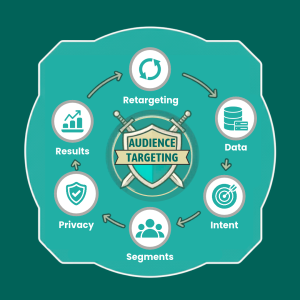
Custom Audience Targeting: How to Build High-Converting Audiences in the Post-Cookie Era
Introduction For years, digital advertising has relied heavily on tracking signals to help advertisers understand who is interested in a product, where they have been
Multi-Location Local SEO: How UK High-Street Brands Win Regional Map Packs
Introduction Running a local search for a single shop on a bustling high street is straightforward enough. Managing it across 50, 100, or several hundred