


Introduction
Many firms run ads, post content and send emails, yet these efforts do not always lead to new business. Campaign architectures bring these parts together. They define who to reach, what to say, which channels to use and how to guide prospects towards a sale. For UK professional services firms, trust and proof matter. For enterprise SaaS firms, campaigns may need to reach several people in the buying process. A plan links each step to a goal and tracks results.
Table of Contents
What Are Campaign Architecture in B2B Marketing?
Campaign architectures are plans that link marketing activities to a clear business goal. They help firms reach the right people, share useful information and turn interest into sales leads. A strong B2B marketing campaign strategy has five key parts.
The Components of a Working Campaign Architecture
- Target audience: Know who you want to reach and what they need.
- Message and offer: Show how you can help.
- Channels and timing: Choose where and when to reach them.
- Lead nurturing and sales handover: Follow up with interested buyers.
- Measurement: Track results and improve the plan.
Campaign Architecture vs Marketing Tactics
LinkedIn ads are one tactic. A multi-channel B2B marketing strategy connects ads, useful content, email follow-ups and sales activity. Each step has a clear role and helps move buyers towards a decision.
Which Campaign Architecture Works for UK Professional Services Firms?
A strong professional services marketing strategy helps firms show their value before asking clients to make contact. People need to know that a firm understands their needs and can offer the right help.
Expertise-Led Campaigns That Build Trust
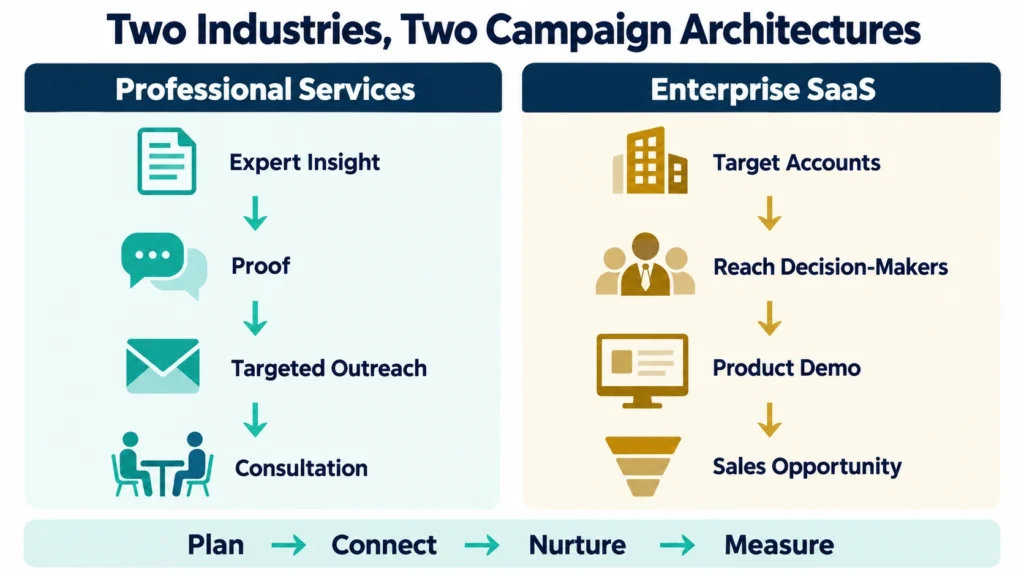
Share expert articles, research, clear advice and case studies. These show what the firm knows and how it can help. The campaign follows a clear path: expert insight, proof, targeted promotion, follow-up and a qualified consultation.
Sector-Led Campaigns Built Around Business Problems
Choose one sector and learn about its key needs. For example, an accountancy firm could create a guide for small firms that need help with tax planning. It could share the guide through LinkedIn, email and industry events. This helps the firm reach people who may need its services.
Turning Interest Into a Qualified Consultation
When a prospect shows interest, offer a clear next step, such as a call to discuss their needs. Share relevant proof and answer their questions before the meeting. This makes a B2B lead generation strategy more focused on suitable clients, not just a high number of leads.
Which Campaign Architecture Works for Enterprise SaaS Firms?
An effective enterprise SaaS marketing strategy must reach the right companies and help buyers see the value of the software. Large software deals may involve several people, so one message may not answer every concern.
Account-Based Marketing for High-Value Accounts
Account-based marketing (ABM) focuses on a chosen list of companies that fit the ideal customer profile. Marketing and sales teams research these accounts and tailor messages to the people involved. A marketing director may want better results, while an IT lead needs to check security and setup. Finance may focus on costs and business value.
Demand Generation Connected to Sales Opportunities
Demand generation builds interest before buyers are ready to act. Guides, paid search, LinkedIn ads and email can help them learn about a problem and compare options. Demand capture targets people who already show interest, such as those searching for a product or asking for a demo. Both approaches should support the same sales goal.
Supporting Enterprise Software Evaluation
Give buyers clear demos, customer case studies, pricing details and technical documents. These help each person assess the product. For targeted outreach, LinkedIn advertising can help reach relevant companies and job roles.
Comparing Campaign Architectures for Professional Services and Enterprise SaaS
Both sectors need a clear plan, but they must meet different buyer needs. A strong B2B marketing campaign strategy fits the way each business wins clients.
Element | Professional Services | Enterprise SaaS |
Main challenge | Build trust and show expertise | Prove software value |
Audience | Firms with a clear need | Companies that fit the product |
Key proof | Expert advice and client results | Demos, case studies and technical proof |
Main channels | Articles, email, events and outreach | ABM, ads, content and email |
Conversion goal | Qualified consultation | Demo or product review |
Key measures | Suitable leads and new clients | Qualified pipeline and sales progress |
What Both Architectures Have in Common
Both need the right audience, a clear message and useful proof. They also need channels that work together and follow-up that helps buyers take the next step. Teams should track results and use what they learn to improve future campaigns.
The key is to match the plan to the buyer. Professional services marketing firms must show why their expertise matters. SaaS firms must help each stakeholder judge if the product meets their needs.
What Should UK Businesses Consider When Planning Campaigns?
Strong campaign architectures start with the right audience. Use clear words, address real needs and share proof that fits each sector. A good UK B2B marketing plan must also follow privacy and direct marketing rules.
Under PECR, email rules can differ for limited companies and sole traders or some partnerships. Check who you are contacting and how you plan to reach them. The ICO’s guidance on business-to-business marketing explains the key rules. Check it before launching your B2B demand generation strategy.
How Should Businesses Choose a Campaign Architecture?
The right B2B marketing campaign strategy depends on five factors:
- Sales value: Is a high-value deal worth a tailored campaign?
- Buying process: How many people help make the choice?
- Audience: Can you name the firms you want to reach?
- Resources: Can your team manage the work and follow-up?
- Goal: Do you need more leads, new clients or sales?
For example, a consultancy may use expert content to win more client meetings. A software firm may use an account-based marketing strategy to reach a set list of high-value firms.
A clear plan helps teams use time and money well. Explore marketing strategy consulting for support with campaign planning.
How Should Businesses Measure Campaign Architecture Performance?
Good B2B campaign measurement looks beyond clicks and views. Track qualified leads, booked meetings, sales progress, win rates, revenue and costs.
A qualified pipeline is the total value of sales deals that meet set rules for fit and buyer interest. It shows whether marketing helps create real sales chances.
A strong B2B lead generation strategy tracks what happens after someone shows interest, not just how many people fill in a form. Use CRM and analytics data for campaign attribution, while noting that several channels may help win a sale.
Conclusion
Good campaign architectures start with how buyers make choices. Professional services firms need to show their skills and build trust. Enterprise SaaS firms must help several people review the product and its value. Each channel should support a clear goal, and results should be tracked. Explore the best marketing strategy consulting to plan campaigns around business needs.
Frequently Asked Questions
What Is Campaign Architecture in B2B Marketing?
Campaign architecture is a plan that links the target audience, message, marketing channels, follow-up and results. It helps teams work towards one clear business goal.
Which Campaign Architecture Works Best for Professional Services Firms?
Expertise-led campaigns often suit professional services firms. Helpful articles, client stories and expert advice can build trust and show buyers why a firm may be right for their needs.
How Does Account-Based Marketing Work for Enterprise SaaS?
Account-based marketing focuses on selected companies. Sales and marketing teams work together to reach the right people in each firm with useful content, relevant messages and tailored follow-up.
What Is the Difference Between Demand Generation and Lead Generation?
Demand generation builds awareness and interest in a product or service. Lead generation aims to find potential buyers and gain their details so sales teams can follow up.
How Do You Measure B2B Campaign Success?
Track qualified leads, sales meetings, deal progress, win rates and revenue. Clicks and views show activity, but sales data helps reveal whether campaigns create real business opportunities.

Written by - Lauren Davison
Introducing Lauren – one of our content writers who has a flair for SEO and creative strategy!
With a Master’s Degree in Creative Writing, Lauren has niched down into SEO and content writing.
Outside of work, she loves watching the darts, reading and the pub on the weekend.