


Introduction
There’s a persistent belief in SEO circles that publishing more automatically leads to more traffic. More blogs, more landing pages and more indexed URLs. On paper, it sounds logical, but in practice? It rarely works that cleanly.
At the national level, scale alone doesn’t win, but structure does. What many brands miss is this: format choice carries as much weight as keyword targeting.
You can map the perfect query set and still struggle if the delivery mechanism is wrong. That’s where National SEO content formats become a strategic lever rather than a publishing afterthought.
The shape of the content is how it’s built, layered, and surfaced. This directly influences visibility across an increasingly complex SERP landscape.
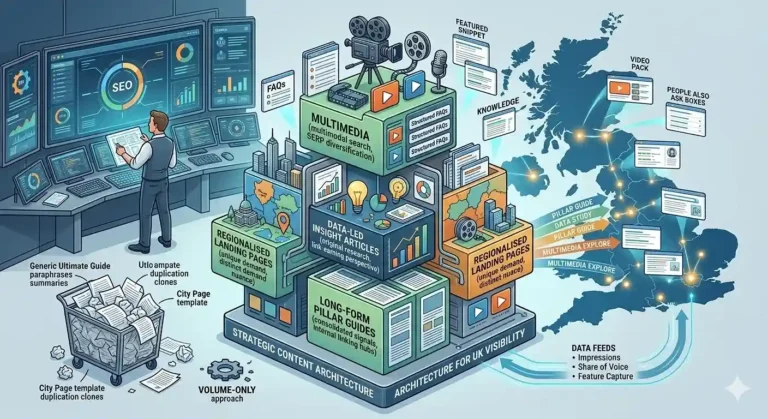
And that landscape has changed. UK organic visibility strategies now have to account for featured snippets, video panels, People Also Ask boxes, and blended results. Nationwide reach isn’t about volume. It’s about choosing the right content architecture.
Table of Contents
Why Format Choice Matters More In National SEO Than Local Campaigns
Local SEO can be surgical. You optimise for a town, tighten relevance signals, build a few strong citations, and you are in the game. But national SEO is different from your method. The room is louder, the brands are older, and the domains have history.
Competition at the national level is denser and more authoritative. You are not just outranking nearby businesses. You are challenging publishers, aggregators, and enterprise players with years of content equity behind them.
Search intent clusters are broader, too. A single national query often carries informational, comparative, and transactional layers all at once. That changes how content must be structured.
And then there’s the SERP itself. It’s richer featured snippets, video packs, and People Also Ask boxes. Format directly affects eligibility for these placements. The right National SEO content types enable SERP feature diversification and stronger multimodal search visibility.
At the national scale, you are not competing for one blue link. You are competing for surface area across formats, placements, and entry points. That’s why scalability isn’t about publishing more pages. It’s about choosing formats that can expand without diluting authority.
The Core National SEO Content Formats That Actually Scale
Not all content expands safely. Some formats stretch. Others split and cannibalise your own rankings. At the national level, that mistake is expensive.
Long-Form Pillar Guides Built Around Topic Authority
The strongest performers tend to be deep, 2,000 to 4,000-word pillar assets built around intent clusters rather than single keywords. They act as internal linking hubs. They consolidate signals instead of scattering them. This approach is often central to high-performing content strategies because it establishes a site as a definitive source for a specific topic.
Done properly, these guides lift Information gain scores. Because they introduce original data, opinionated commentary, or practical frameworks, not recycled summaries. That’s the difference between a true authority piece and a generic ultimate guide.
One synthesises insight. The other paraphrases what’s already ranking. Among all National SEO content formats, this is usually the structural backbone.
Regionalised Landing Pages Without Duplication
Scaling UK-wide pages doesn’t mean cloning templates and swapping place names. That’s how you create doorway pages: thin, repetitive, algorithm bait.
National intent segmentation is different. Each page reflects distinct regional signals: demand nuance, sector focus, service emphasis. When built this way, they strengthen UK organic visibility strategies rather than dilute them.
Data-Led Insight Articles That Earn Links Naturally
Proprietary research, market commentary and sector breakdowns. These pieces boost information-gain scores because they offer something quotable. Journalists and industry blogs don’t link to reworded advice; they link to perspective. This is where most brands hesitate because it requires original thinking.
Multimedia Content Designed For Multimodal Search Visibility
Video explainers, infographics, structured FAQs and even podcast clips. Google surfaces these in different ways, fuelling SERP feature diversification and expanding multimodal search visibility. The advantage? More surface area without inflating keyword density. You’re not repeating phrases. You’re multiplying formats.
Matching Format To Intent Clusters Across The Funnel
Not every searcher is ready to buy. Some are circling the problem. Others are comparing options. A few are poised to act. The mistake is treating them all the same.
National SEO content formats should mirror decision depth. Because intent shifts as confidence builds.
- Informational stage: In-depth guides, practical explainers, definition-led content. This is curiosity territory. Broad queries. Early exploration.
- Comparative stage: Breakdown articles, side-by-side evaluations, “best vs alternative” formats. Here, doubt creeps in. People weigh risk.
- Transactional stage: Structured landing pages aligned to clear service intent. Fewer words. More clarity.
- Authority stage: Thought leadership commentary, perspective pieces and industry predictions. This builds trust beyond keywords.
When format matches mindset, momentum builds naturally. When it doesn’t, friction shows up quietly, but measurably.
What Doesn’t Work At National Scale and Brands Still Do It
Let’s be honest in here, some tactics look productive on a spreadsheet. But they fall apart in the SERPs. Mass-producing thin city pages is the classic example. Fifty near-identical URLs. Slightly tweaked headings. No real differentiation. It might inflate your page count, but it won’t build authority.
Then there’s over-optimised keyword repetition. Cramming phrases into subheadings. Forcing awkward matches. Google’s moved on. Readers definitely have.
Blog spam is another quiet killer, random articles published without thematic clustering, no internal logic tying them together. It feels busy. It isn’t strategic.
Ignoring SERP feature diversification is equally costly. If you are only aiming for blue links, you’re leaving visibility on the table.
And copying competitor structure will be tempting, safe and completely average. But at the national scale, the average disappears. Structure has to be deliberate, not duplicated.
Building A Content Mix That Drives Sustainable UK Organic Visibility
Sustainable growth rarely comes from one breakout page. It comes from balance. A portfolio, not a spike. Strong UK organic visibility strategies tend to combine stability with responsiveness:
Evergreen pillar assets that anchor authority, deep resources built to last, updated, not replaced.
Reactive commentary that responds to market shifts, algorithm changes, or industry news. Timely. Sharp. Occasionally opinionated.
Blended National SEO content types: guides, landing pages, data studies, multimedia work together rather than competing.
Clear topic clusters that reinforce each other instead of scattering relevance across disconnected posts.
Performance tracking beyond rankings visibility, share, feature capture, snippet inclusion, and video placements.
Because here’s the quiet shift: organic visibility today is about presence, not just position one.
Measuring The Impact Of Your National SEO Content Formats
Publishing is easy, and measurement is where clarity lives. If you want to understand whether your National SEO content formats are actually compounding authority, look beyond surface rankings:
- Impression share growth: Are you appearing more often across related queries, even when you are not in position one? Rising impressions usually signal expanding topic ownership.
- SERP feature appearances: Track snippets, People Also Ask placements, video packs. Feature visibility often moves before rankings stabilise.
- Information gain signals: Deeper engagement time, scroll depth, natural backlinks. If others cite you, that’s a strong indicator you’ve added something new.
- Content cannibalisation checks: Multiple pages competing for the same cluster? That’s dilution, not growth.
- Multimodal inclusion: Are your videos, visuals, or FAQs being surfaced independently?
Numbers tell part of the story. Pattern shifts tell the rest. When formats are aligned correctly, visibility expands sideways, not just upwards.
Conclusion
It’s tempting to believe scale is a numbers game. More URLs, more posts. More output. For a while, that illusion feels productive. But national visibility doesn’t bend to volume alone.
Format beats volume because structure determines how authority compounds. Strategy beats a publishing calendar because momentum doesn’t come from consistency in isolation; it comes from cohesion. When every piece reinforces a wider architecture, growth stops being fragile.
National SEO content formats require architectural thinking. You are not filling space; you are designing pathways. Intent clusters connect. Internal links distribute weight. Multimedia expands surface area. Data-led insights earn trust. It’s engineered, even if it doesn’t look mechanical on the surface.
And here’s the quiet truth: the brands that dominate nationally aren’t the loudest publishers. They’re the most deliberate ones. They understand that visibility is constructed. The brands that win nationally don’t just publish more.
Frequently Asked Questions
1. What are the most effective National SEO content formats?
There isn’t one winner. Pillar guides build depth. Regional landing pages capture intent. Data-led pieces attract links. Multimedia earns extra SERP real estate. The strength comes from how they work together, not from overusing one format.
2. How do National SEO content types differ from local content?
Local content targets proximity. National content targets breadth and layered intent. It has to support multiple search variations and compete with stronger domains. The structure needs to scale without overlapping itself.
3. Why does SERP feature visibility matter so much?
Because rankings alone don’t reflect dominance. Snippets, video packs, and People Also Ask entries expand your footprint. More surface area means more entry points.
4. What improves Information gain signals?
Original thinking, fresh data and clear frameworks. If others reference your work, you’re adding something new.
5. Can multimedia really impact organic growth?
Absolutely. Different formats surface in different ways. That diversity compounds visibility quietly but powerfully.