


Introduction
Scaling across the UK is a different game. Competing in one town is hard enough; competing nationwide is something else entirely. If you want to build an effective national SEO keyword strategy for UK businesses, you cannot rely on guesswork or a handful of high-volume phrases pulled from a tool. That approach might work locally. But nationally? It falls apart fast.
Local SEO is often about proximity, map visibility and hyper-specific intent. National SEO removes that safety net. You are competing on authority, relevance and depth sometimes against brands with entire teams behind their search presence. That’s why structure matters. Real structure.
It starts with solid UK market research, not assumptions. Then comes proper search intent mapping, so you understand what people actually want, not just what they type. From there, smart keyword clustering builds reach without cannibalising your own pages. Over time, this develops topic authority, which search engines reward.
And none of it works without credibility. Strong signals aligned with E-E-A-T, and content shaped around entities recognised by the Google Knowledge Graph, help search engines trust you at scale. That trust is what turns rankings into growth.
Table of Contents
Understanding The Foundations Of A National SEO Keyword Strategy
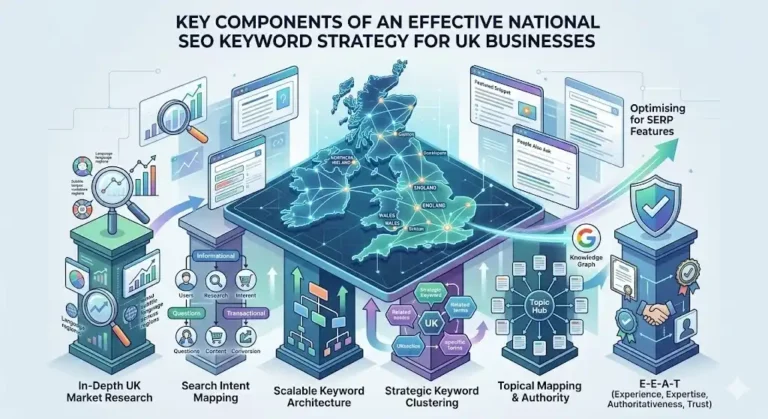
Before anything gets published, mapped, or optimised, the groundwork has to be right. Many businesses rush into keyword targeting and only later realise their strategy cannot scale beyond a handful of pages.
A national campaign needs a wider lens. You must define who you want to reach, how broad that reach should be, and whether your structure can grow without collapsing under its own weight.
That means planning for expansion from day one, not patching gaps later. The brands that succeed nationally are rarely the loudest. They are the most organised.
Conducting In-Depth UK Market Research Before Keyword Selection
Proper UK market research reveals what people actually search for across the country. It’s not just what seems logical internally. Language shifts subtly between regions. Such as wording in Glasgow may differ from Cardiff or Birmingham.
These nuances matter. National demand also behaves differently from city-level trends. Some terms spike only in specific locations, while others dominate nationwide. Looking at competitors helps too.
Especially those already visible across the UK. Study how they position topics, what themes repeat, and where gaps appear. Reliable insights can come from analytics data, industry reports, customer enquiries, and search trend datasets. All pointing toward real demand rather than assumptions.
Defining Commercial Goals And Search Intent Mapping
Search intent mapping is where strategy stops being theoretical and starts driving results. Not every keyword deserves attention. Some attract curiosity, others signal buying readiness.
The difference is everything. Informational searches sit at the top of the funnel. And the transactional ones sit near the bottom. Aligning keywords with those stages keeps the content purposeful.
Chasing high-volume phrases without conversion potential wastes time and budget. Smart teams also study SERP features before committing to targets. If results are dominated by answer boxes or instant summaries, clicks may be limited.
That’s where zero-click optimisation comes in, shaping content so your brand still gains visibility, authority, and recognition even when users never visit the page.
Effective National SEO Keyword Strategy Architecture
Here’s where many national campaigns quietly fall apart. Not because the keywords were wrong. But because the structure holding them was weak. Small SEO efforts can survive on scattered pages and isolated terms. But it’s different to national ones, as they cannot.
If you want to build an effective keyword strategy for UK businesses, architecture has to come first, content second. Think of it like laying foundations before walls. Without a clear framework, growth creates confusion and overlap.
Then the pages compete against each other. With the right structure, though, every new page strengthens the whole domain instead of diluting it.
Implementing Strategic Keyword Clustering For National Reach
Keyword clustering simply means grouping related search terms. So one page ranks for many variations instead of just one. Yet many sites still chase single phrases, which work locally.
But struggle nationally where competition is deeper, and search behaviour is more varied. Clusters should be organised by theme, service type, and buyer stage, not just synonyms. Done well, this prevents keyword cannibalisation and clarifies page purpose.
Internal linking then reinforces those relationships. Nothing gets too complicated. Just a logical path that helps search engines understand which pages lead and which support.
Developing Topical Mapping To Strengthen Topic Authority
Topical mapping takes clustering further. Instead of grouping keywords, it maps entire subject territories. Clusters focus on phrases and map the focus on expertise.
The distinction matters. Strong maps create content hubs that show depth, context, and consistency, all signals that build topic authority over time. Search engines increasingly rely on entity understanding. This is where alignment with the Google Knowledge Graph becomes valuable.
When your content consistently connects related concepts, services, and terminology. You are not just targeting searches. You are demonstrating subject ownership. And that is what earns long-term visibility, not short bursts of rankings.
Optimising For National Visibility And Trust Signals
Ranking nationally is not just a keyword exercise. It is a credibility test. Search engines are not only scanning for relevance anymore. They are evaluating whether your site deserves to appear at scale.
That means your keyword strategy has to line up with the same frameworks as search systems. And this is used to judge quality, reliability, and authority. Skip that alignment, and even well-researched keywords can stall.
Build it in from the start, though, and your visibility compounds. The difference is subtle on the surface but massive in outcomes.
Integrating E-E-A-T Into Keyword Targeting Strategy
E-E-A-T quietly shapes which sites win in competitive terms. Two pages may target the same phrase. Yet the one backed by stronger experience, expertise, authority, and trust signals almost always edges ahead.
For UK businesses, those signals might include various things. Such as industry credentials, author transparency, real case studies, or evidence of sector knowledge. Depth also matters.
Thin pages rarely rank nationally because they do not prove understanding. Detailed content, on the other hand, shows confidence and clarity. It tells search engines, “this site knows its subject.” That perception directly affects how ambitious your keyword targets can be.
Adapting Keyword Strategy To SERP Features And Algorithm Behaviour
Modern results pages are crowded. Classic blue links now sit beside SERP features. Such as Featured snippets, People Also Ask boxes, AI overviews, and knowledge panels. Each changes how users interact with results.
Some searches end without a click at all, which is why zero-click optimisation has become part of national strategy. Visibility still counts, even when traffic does not follow immediately.
Smart keyword targeting considers which result formats appear, how dominant they are, and whether your content can realistically win space within them. Optimising for multiple result types does not just improve rankings, it expands presence across the entire search landscape.
Measuring And Refining A National Keyword Strategy Over Time
No national strategy stays perfect for long. Search shifts. Competitors adapt. Markets change mood without warning. That is why teams that successfully build an effective national SEO keyword strategy for UK businesses treat it as a living system, not a finished document. What works this quarter might fade next. The real advantage comes from watching, adjusting, testing, and then tightening the structure again. Iteration is not a fix. It is the process.
Tracking Performance Beyond Rankings
Rankings are useful, but they are only one signal. Conversions and revenue show whether traffic actually matters. Visibility metrics reveal how often you appear, even when clicks do not happen. Share of voice indicates how dominant you are within a topic space. Engagement signals time on page, return visits, and interaction depth quietly reveal whether your content satisfies intent or just attracts curiosity.
Expanding Keyword Opportunities Without Diluting Focus
Growth should feel deliberate, not chaotic. Scale clusters only when existing ones are stable. Watch emerging patterns in UK market research for new demand pockets. Refresh topical mapping as industries evolve. The aim is simple: expand reach while protecting topic authority. Bigger presence, same clarity.
Conclusion
National growth does not happen by accident. It is built in layers. To build an effective national SEO keyword strategy for UK businesses, you start with real UK market research. Not guesses. Not copied competitor lists. Real demand. Then you apply search intent mapping so every keyword has a purpose.
After that comes keyword clustering, giving structure instead of scattered pages. Topical mapping expands that structure and builds depth. Add E-E-A-T signals to strengthen trust. Align with SERP feature opportunities to maximise visibility.
This is not about quick traffic spikes. It is about authority. Long-term presence. Sustainable reach.
Frequently Asked Questions
1. How Is A National SEO Keyword Strategy Different From Local SEO?
We treat national SEO as a much bigger playing field. Local rankings often lean on location signals. National ones do not. We have to look at wider UK market research, tougher competitors, and broader search behaviour. It is less about where a business sits and more about how strong its authority is across the whole country.
2. Why Is Keyword Clustering Important For National Campaigns?
We rely on keyword clustering to keep pages from clashing with each other. Without it, two posts might chase the same term and split their strength. When I group related phrases under one clear theme, they reinforce one another and gradually build topic authority instead of dilution.
3. How Does Search Intent Mapping Improve Conversions?
We always check intent before targeting a keyword. Some searches mean “just curious.” Others mean “ready now.” When I match content to those moments, results improve. It also helps me respond to changing SERP features that can affect how and when people click.
4. What Role Does E-E-A-T Play In National Keyword Rankings?
From what we have seen, E-E-A-T acts like a credibility test. In competitive sectors, search engines look for signs that a site actually knows its field. Real expertise, proof of experience, and trustworthy information make it far easier for me to compete nationally.
5. How Long Does It Take To Build Topic Authority Nationally?
Honestly, it is never instant. We usually see progress slowly build as content expands, links connect logically, and coverage deepens. Consistency matters more than speed. When we keep reinforcing the same topic area, authority starts to compound, and rankings follow.