

Introduction
“No keywords” doesn’t mean people have stopped searching for things. It means they’ve stopped typing fragments and started asking full questions out loud.
Where someone typing into Google might search “plumber Wolverhampton,” the same person speaking to a voice assistant is more likely to ask “who can fix a leaking pipe near me right now.”
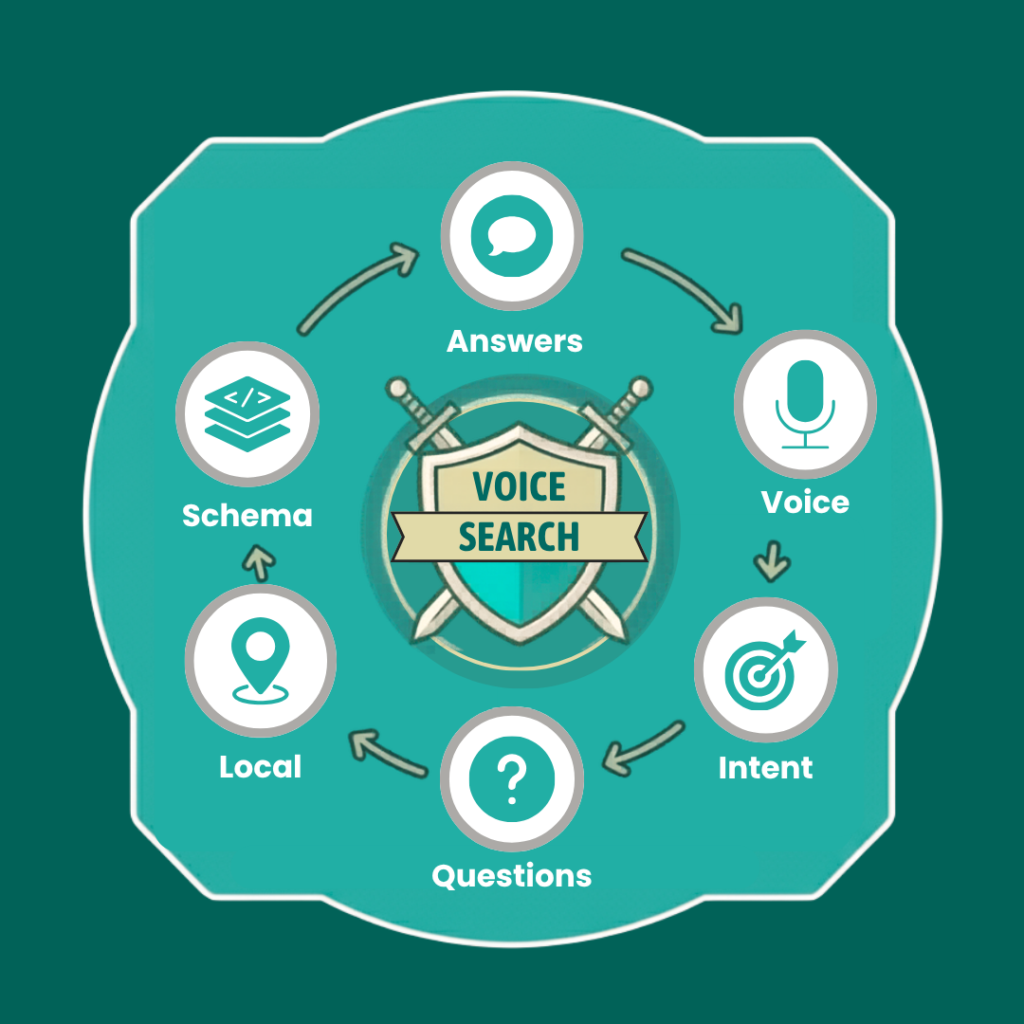
That shift, from fragment to full sentence, is what’s driving the change in Voice Search SEO for 2026, and it’s reshaping how businesses need to think about being found online.
Table of Contents
What does "no keywords" actually mean in voice search?
It doesn’t mean queries have no words worth targeting. It means the words arrive differently, as complete, natural questions rather than the clipped phrases people type into a search box.
Keyword search vs. conversational search: the actual difference
Typing a search takes effort. Every extra word is another few seconds of tapping, so people compress. “Plumber Wolverhampton” gets the job done without wasting keystrokes.
Speaking removes that friction. Nobody says single words out loud to a phone; it feels unnatural. So the same person, asking the same question by voice, says something closer to “who’s a good emergency plumber near me that’s open now.” Same intent, completely different shape.
This matters for a UK trades business in a very concrete way. A page built to rank for “plumber Wolverhampton” as an exact phrase might never get picked up as an answer to “who can I call for a burst pipe tonight,” even though it’s the right business for the job. The content has to answer the question, not just contain the keyword.
Why AI assistants "hear" queries differently to search engines
Voice assistants and AI search tools don’t match text strings the way older search engines did. They’re built to interpret intent, working out what the person actually wants, even when the phrasing is loose, informal, or full of filler words.
That means keyword density, the old habit of repeating a target phrase enough times to signal relevance, carries far less weight now. What matters more is whether the content clearly and directly answers the underlying question, in language that sounds like something a person would actually say.
How has voice search changed by 2026?
Voice search has grown well beyond smart speakers, and more people are using it, though exact figures vary depending on the source and how “voice search” is defined.
From smart speakers to AI chat assistants
A few years ago, “voice search” mostly meant asking Alexa or Google Home a question. In 2026, it’s broader. Voice input is built into AI chat tools themselves.
People speak questions into ChatGPT, Gemini, and similar assistants, not just smart speakers on the kitchen counter. The line between “voice search” and “AI search” has blurred, because increasingly they’re the same interaction.
How many people are actually using voice search in 2026?
Industry estimates place voice search SEO at somewhere around a quarter to a third of all search queries in 2026, with growth expected to continue. Some forecasts put it passing 40% of queries by around 2028.
These figures shift depending on the study and the definition used, so treat any single number as a snapshot rather than a fixed statistic, and expect it to keep climbing.
Why does this matter for SEO and AI search visibility?
Because the same content decisions that help a page get read aloud by a voice assistant are, in large part, the same ones that help it get pulled into an AI Overview or chatbot answer. This isn’t two separate jobs.
Voice search and AI Overviews are converging
Google’s AI Overviews, ChatGPT’s answers, Gemini, Copilot, all of them are drawing from the same underlying signals: clear, well-structured content that directly answers a specific question.
A page optimised to be spoken aloud by a voice assistant tends to already tick the boxes an AI Overview is looking for, and vice versa. Building separate strategies for “voice SEO” and “AI search visibility” is largely wasted effort now; it’s one job with two output channels
What AI systems look for before citing a source
Before an AI system decides to cite or read out a piece of content, it’s typically weighing a few things: how clearly the brand and its expertise are defined (what’s known as entity clarity), whether the page uses structured data to make that meaning explicit to machines, whether the site has built up topical authority in that area, and whether there are trust signals, consistent information, and credible mentions elsewhere backing it up.
This is genuinely where most generic voice SEO content falls short. A lot of advice still treats “voice search optimisation” and “Generative Engine Optimisation” (GEO) as separate disciplines with separate checklists. They’re not.
Getting a business ready to be understood and cited by AI systems, clarifying who you are, what you do, and why you’re credible, is the same underlying work whether the eventual output is a spoken voice answer or a written AI Overview summary.
How do UK businesses optimise content for keyword-less voice queries?
- Three things matter most: structure content as answers to re al questions, use natural long-tail phrasing instead of short fragments, and format for snippet extraction. Practically, that looks like this:
- Answer the question in the first sentence. Don’t build up to it; state the answer, then explain.
- Use headings phrased as actual questions. This mirrors how people speak and gives AI systems a clean, extractable chunk of text.
- Write in full, natural sentences. Avoid keyword-stuffed phrasing that reads oddly out loud.
- Keep answers concise near the top of each section, then expand with detail afterwards for readers who want more.
- Use lists and tables where they genuinely help scannability, not decoratively, but where the information is naturally list-shaped.
Write in question-and-answer format
Structure each section heading as a question a real customer might actually ask, then answer it directly in the sentence immediately below.
This is the single easiest change most businesses can make, and it does double duty: it helps human readers scan the page, and it gives voice assistants and AI Overviews a self-contained passage they can lift cleanly.
Target long-tail, conversational phrases
Traditional keyword research tools are still useful, but they need supplementing. Instead of researching short, high-volume phrases, look for the full questions customers are actually asking, the kind you’d hear in a phone enquiry or a customer email.
Tools that surface “People Also Ask” questions or common customer queries tend to be more useful here than pure keyword-volume tools.
Structure content to win featured snippets voice search
Widely cited historical research suggests a large share of voice search answers are pulled from featured snippets, the boxed answer that sometimes appears above standard results.
That data is now several years old, and snippet mechanics have continued to evolve since, but the underlying principle still holds: a concise, well-formatted direct answer near the top of a page remains one of the strongest ways to get selected as a spoken or AI-generated response.
Here’s a quick illustration of the shift in how these queries actually look:
Typed search | Voice search |
plumber Wolverhampton | who can fix a leaking pipe near me right now |
best SEO agency UK | what’s the best SEO agency for a small business in the UK |
web design cost | how much does it usually cost to get a small business website built |
Does local voice search still matter in the AI search era?
Yes, and for most UK small businesses it’s still where voice search delivers the most practical value. Local intent hasn’t gone anywhere.
Why "near me" queries are still voice search's biggest use case
A large proportion of voice searches are still tied to immediate, local needs: finding a business that’s open now, getting directions, checking opening hours, or working out who’s nearby and available.
This is the kind of query voice assistants were built to handle well, and it remains one of the highest-value areas for local businesses to get right.
What local UK businesses should have in place
A few fundamentals still do most of the work here:
- An accurate, fully completed Google Business Profile, with correct hours and service areas
- Consistent name, address, and phone number (NAP) details across the website and all directory listings
- Local schema markup so search engines and AI systems can confirm location and service details unambiguously
- Genuine, specific service-area content rather than a single generic “we cover everywhere” page
This is an area a lot of generic voice SEO content skips over entirely, usually because it’s written with e-commerce or national brands in mind. For local UK service businesses, trades, healthcare providers, and retailers, it’s often the highest-impact place to start.
What should you prioritise first?
Not everything needs doing at once. Split the work into what delivers quick results and what builds longer-term visibility.
Quick wins (low effort, fast impact)
- Add a genuine FAQ section to key service pages, phrased as real customer questions
- Rewrite existing headings as natural-language questions where it makes sense
- Check and update your Google Business Profile for accuracy
Longer-term investments (higher effort, compounding impact)
- Roll out structured data (schema markup) across key pages
- Build topical authority through consistent, well-connected content over time
- Strengthen entity signals: how clearly your brand, services, and expertise are defined across the web
What Voice Search SEO Means for UK Businesses in 2026
The underlying shift is this: ranking for isolated phrases matters less than being the clearest, most directly useful answer to a customer’s actual question. That’s a change in emphasis, not a demolition of everything that came before.
Traditional SEO fundamentals still matter. Fast-loading pages, clear site structure, genuinely useful content, and strong local visibility remain the foundation everything else sits on.
Voice search SEO hasn’t replaced that groundwork; it’s added a layer on top of it that rewards clarity and directness even more than before. For most UK small and medium-sized businesses, the practical next step isn’t a full content rebuild.
It’s picking two or three of your highest-traffic service pages, checking whether they answer real customer questions in plain language near the top, and fixing the ones that don’t.
If you want a second pair of eyes on how your site currently performs in AI and voice search, Midland Marketing’s Generative Engine Optimisation services are built around exactly this kind of review.
Frequently Asked Questions
Is voice search the same as AI search?
Not quite, though they overlap heavily. Voice search refers to how a query is entered, spoken rather than typed. AI search answer engines, or Answer Engine Optimisation (AEO), is about how those answers get generated and surfaced by systems like AI Overviews or chatbots. In practice, a growing share of voice queries are now processed by AI-driven systems, which is why the two are increasingly discussed together.
Do I need to change my keyword strategy for voice search?
Not replace it, but supplement it. Traditional keyword research still has value for understanding what people search for and how often. What’s changed is the need to also plan around conversational, question-based phrases and structure content in natural language, rather than relying on short-tail keywords alone.
How do I optimise for featured snippets?
Keep the direct answer to a question concise and near the top of the relevant section, phrase headings as clear questions, and use lists or tables where the information genuinely fits that format. Snippet selection mechanics can shift as Google updates its systems, so treat this as an ongoing practice rather than a one-off fix.
Does voice search work differently for local UK businesses?
Not fundamentally, but local intent still makes up a substantial share of voice queries, people asking for nearby, available, or currently open businesses. Structured local signals, particularly an accurate Google Business Profile and local schema markup, remain genuinely important for this kind of query.
What’s the single biggest mistake businesses make with voice search SEO?
Treating voice as a bolt-on to existing SEO rather than restructuring content around natural questions. A page can rank well for short-tail typed keywords and still be invisible to voice and AI search if it never actually states a clear, direct answer anywhere on the page.

Written by - Lauren Davison
Introducing Lauren – one of our content writers who has a flair for SEO and creative strategy!
With a Master’s Degree in Creative Writing, Lauren has niched down into SEO and content writing.
Outside of work, she loves watching the darts, reading and the pub on the weekend.
Want some more?
Latest Insights & News
Voice Search SEO 2026: Why 40% of Queries Now Have No Keywords
Introduction “No keywords” doesn’t mean people have stopped searching for things. It means they’ve stopped typing fragments and started asking full questions out loud. Where
How Are ChatGPT & Perplexity Changing SEO Through AI Search Optimisation?
Introduction Search behaviour has started to shift beneath the surface of traditional SEO. Instead of opening several Google results, users can now describe a problem
Why Basic Templates Can Limit Local Lead Generation
Introduction A website can look neat and still miss the people most likely to buy. This is a common issue for a growing firm. A