


Introduction
UK advertising spend is forecast to reach £50.5 billion in 2026, but growth is uneven across channels. Search remains the largest category, while social media, retail media, online radio, digital out-of-home and addressable TV are growing quickly. UK businesses should use these figures as market context, then choose channels based on their own customers, objectives and conversion data.
UK advertising is on course for another record year. The latest Advertising Association/WARC figures put total investment at £50.5 billion in 2026, following growth of 8.2%. In the first quarter alone, advertisers spent £11.7 billion, 9.3% more than in Q1 2025.
That sounds like a simple growth story. But it is not. The interesting part of UK advertising spend is where the extra money is ending up. Search remains the biggest single category.
Social media and retail media are growing at much faster rates, while online radio, digital out-of-home and addressable TV are also gaining ground. Some other formats are moving in the opposite direction.
For businesses planning their budgets, that split matters far more than the £50.5 billion headline.
Table of Contents
How Large Is the UK Advertising Market in 2026?
There is an important change to the numbers published earlier in 2026.
Year | Earlier AA/WARC forecast | Latest AA/WARC forecast | Latest growth |
2026 | £49.8bn | £50.5bn | 8.2% |
2027 | £52.6bn | £53.5bn | 5.9% |
The latest figures were published in July 2026. The next quarterly update, covering Q2, is scheduled for October. That means the UK advertising market is not only growing; its near-term outlook has improved since the previous forecast.
What Does the Growth Actually Tell Us?
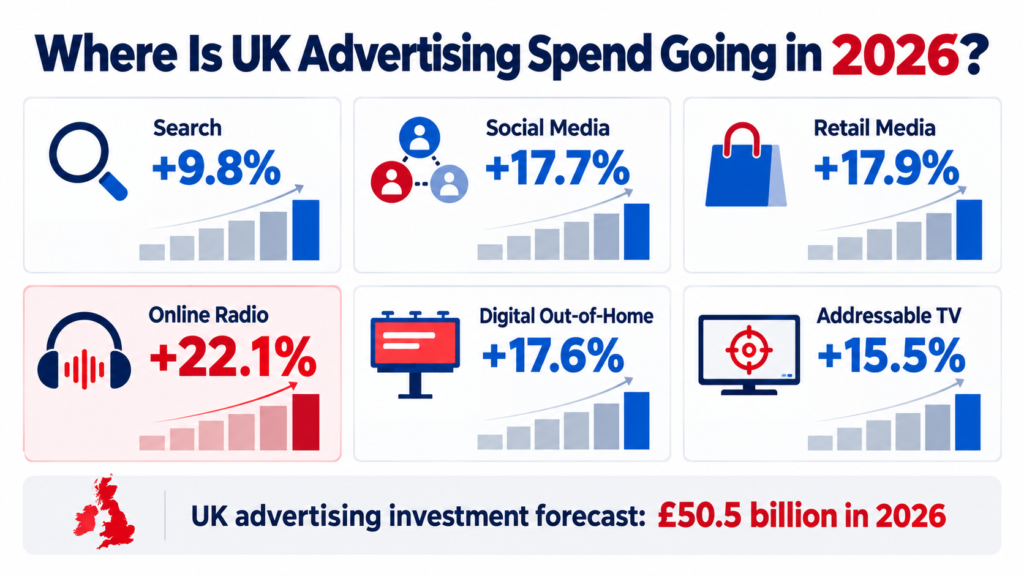
A rising total does not mean every medium is benefiting. Search grew 9.8% in Q1. Social media was up 17.7%, retail media rose 17.9%, and online radio climbed 22.1%. By comparison, published media fell 5.9%.
So the useful story is not ‘more companies are advertising.’ It is that businesses are moving money towards particular types of media.
Where Is UK Advertising Spend Going in 2026?
Social Media Is Moving Faster
Social media investment rose 17.7% in Q1, and is expected to grow 16.5% across the full year.
There is a practical reason behind that rise. Social advertising is no longer used only to build awareness. Brands use it to launch products, generate enquiries, retarget site visitors and drive online sales.
Creative is becoming just as important as audience targeting. A campaign can reach the right people and still fail if the advert does not give them a reason to care.
That is one of the clearest shifts in UK digital advertising: speed of testing matters. Businesses can try different messages, images, audiences and offers without waiting for a long media cycle.
For businesses looking at paid social, the social media advertising service provides a relevant starting point.
Retail Media Is Pulling in More Budget
Retail media grew 17.9% in Q1 2026 and is forecast to rise 15.9% across the year.
Its appeal is easy to see. The advert can appear inside an environment where someone is already comparing products or preparing to buy. That makes the distance between advertising and purchase much shorter.
This is a good example of how advertising spend UK 2026 is becoming increasingly tied to measurable customer journeys.
For ecommerce brands, retail media can work alongside paid search, Shopping and paid social instead of replacing them.
Digital Formats Are Also Changing Traditional Media
Online radio grew 22.1% in Q1, while digital out-of-home rose 17.6%. Total out-of-home increased 15%. Addressable TV was up 15.5%, even though total TV grew only 0.8%.
That makes the old ‘digital versus traditional’ argument less useful.
A digital screen at a train station is still out-of-home. Streaming audio is still audio advertising. Addressable TV still sits within television.
The difference is that these formats can now offer more precise targeting, flexible buying and better measurement.
Which Channels Are Under Pressure?
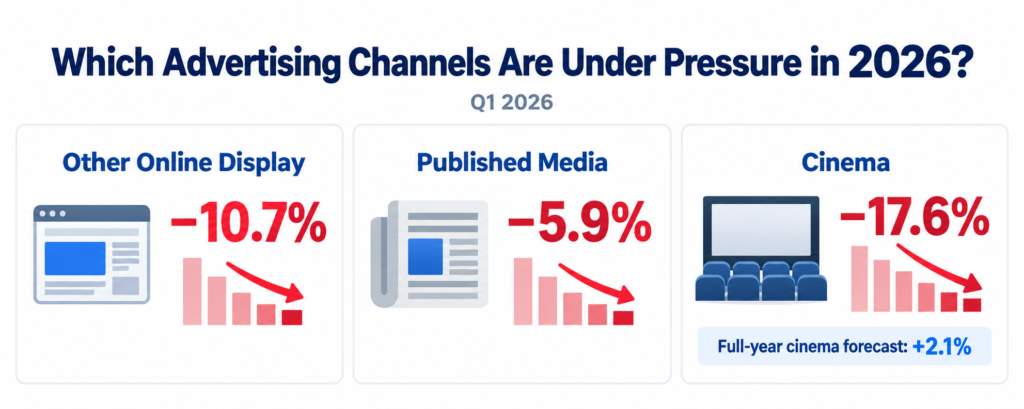
Not every digital format is sharing the growth. Other online display declined 10.7% in Q1, and the full-year forecast calls for a 19.7% fall.
That is worth paying attention to because it cuts through a common assumption: digital growth does not mean every online format is becoming more valuable.
Advertisers appear to be favouring environments where they can link spend to audiences, intent or outcomes more clearly.
Businesses reviewing paid search can also see how PPC services fit across Search, Shopping, Display and Video campaigns.
Published Media and Cinema Had a Difficult Quarter
Published media fell 5.9% in Q1. Regional news brands dropped 9.7%, while national news brands fell 3.7%. Cinema investment also fell sharply, down 17.6% in Q1.
There is a small but important detail here. A weak quarter is not the same as a full-year collapse. AA/WARC still forecasts cinema growth of 2.1% for 2026.
That is why quarterly figures need to be read alongside the full-year forecast.
What Does This Mean for Small UK Businesses?
The UK counted 5.7 million private-sector businesses at the start of 2025. Small businesses accounted for 5.64 million, or 99.18% of the total.
That puts the advertising figures into perspective.
Most UK businesses are not national brands with large media budgets. Many have a much smaller amount to work with and cannot afford to test every platform at once.
Bigger Budgets Are Not Automatically Better Budgets
A local trades company may get more value from high-intent search than a broad awareness campaign.
An ecommerce company might need Shopping, social and remarketing. A B2B business may care more about qualified leads than a high number of clicks.
That is why advertising spend UK 2026 should be treated as market context, not as a template for every company.
A sensible PPC strategy starts with the business goal, then works backwards to the audience, channel and budget.
Organic Search Still Matters
Paid advertising can bring traffic quickly, but it does not have to do everything.
SEO can build visibility around searches that customers make during research, comparison and buying. It can also help businesses make better use of the data they collect from paid campaigns.
That makes SEO and paid media useful as two parts of the same search strategy rather than rival activities.
How Should Businesses Use Their Advertising Budgets in 2026?
Start With the Result
Before opening an advertising account, decide what needs to happen.
Is the goal more enquiries, online sales, local customers, product awareness, or repeat purchases?
That answer should influence the channel choice.
Test Before Increasing Spend
A modest campaign can reveal whether an offer, audience or message has potential.
Test the creative. Watch the landing page. Check the conversion data. Then make a decision based on what actually happened.
This is especially important as UK digital ad spend continues to grow across several different channels. More choice does not make budget decisions easier.
Follow the Customer Journey
Search is often useful when demand already exists. Social can introduce the product earlier. Retargeting can reconnect with someone who left the website.
Retail media can put products closer to a purchase. Video can explain something before a customer is ready to act.
The best mix depends on how people buy, not on which platform has the loudest industry headlines.
Where Should UK Businesses Focus in 2026?
Businesses Looking for Immediate Demand
High-intent search is worth considering when customers actively look for a service or product. This can work particularly well for local and service-led companies.
Businesses Building Awareness
Paid social and video can help reach people before they start searching. The creative needs to earn attention rather than assume it.
Ecommerce Businesses
Shopping, paid social, remarketing and retail media can each do a different job. The goal is to understand which activity creates interest and which one closes the sale.
B2B Businesses
B2B campaigns often need a longer view. A click today might become a sales opportunity several weeks later.
That means lead quality and pipeline value can matter more than the lowest possible cost per click.
This guide offers a useful comparison of channel roles for different marketing goals.
Conclusion
The latest UK advertising spend forecast puts the market at £50.5 billion in 2026, with a further rise to £53.5 billion expected in 2027. But the headline total is only half the story.
Search remains the largest individual category. Social and retail media are growing quickly. Online radio, digital out-of-home and addressable TV are also attracting more money, while several publishing and display categories are under pressure.
For businesses, that does not mean ‘spend more everywhere.’It means being selective.
Know what the customer is trying to do. Pick the channel that fits that behaviour. Test the campaign. Track the result. Then put more money into what proves useful.
Frequently Asked Questions
Is UK digital advertising still growing?
Yes, although growth differs sharply between formats. Search, social media, retail media and several digital formats are expanding, while some other online display categories are declining.
What is the UK advertising spend forecast for 2026?
AA/WARC currently forecasts total UK advertising investment of £50.5 billion in 2026, representing 8.2% growth.
Which UK advertising channel is growing fastest?
Online radio recorded the fastest Q1 growth at 22.1%, followed by retail media at 17.9%, social media at 17.7% and digital out-of-home at 17.6%.
How important is the UK advertising market for small businesses?
It shows where ad money is going. Small firms make up 99.18% of UK private-sector businesses, so their ad choices matter to the wider market.
Will advertising investment continue to grow in 2027?
Yes. The latest AA/WARC forecast expects investment to reach £53.5 billion in 2027, an increase of 5.9%.

Written by - Lauren Davison
Introducing Lauren – one of our content writers who has a flair for SEO and creative strategy!
With a Master’s Degree in Creative Writing, Lauren has niched down into SEO and content writing.
Outside of work, she loves watching the darts, reading and the pub on the weekend.
Want some more?
Latest Insights & News
UK Advertising Spend 2026: Where the £50.5 Billion Is Going
Introduction UK advertising spend is forecast to reach £50.5 billion in 2026, but growth is uneven across channels. Search remains the largest category, while social
Integrated Marketing Agency Model: How Top UK Advertisers Coordinate Specialists
Introduction An integrated marketing agency model connects specialist agencies, in-house teams and external partners around one shared strategy. Rather than placing every marketing function under
LinkedIn Thought Leadership for UK Tech Founders: How to Win Enterprise Deals
Introduction Buying software is no longer just about a sales call. Before they speak to a vendor, many UK business leaders look at the company,