


Introduction
Choosing an ecommerce CMS used to be largely about design, product management and how easy it was to update a website. For businesses selling across borders, that is no longer enough. Post-Brexit shipping and VAT can affect what customers see at checkout, how delivery charges are calculated and how order information moves between the website and other systems.
A site can look excellent and still create headaches behind the scenes. That is why you should consider shipping and VAT when choosing a CMS, rather than bolting them on after the website is built. The right platform should give a business enough control over its checkout, product data, shipping rules, and integrations to support how it actually sells.
Table of Contents
Why Post-Brexit Shipping and VAT Should Influence Your CMS Choice
Brexit changed the way goods moving between Great Britain and the EU are treated for VAT purposes. HMRC explains that, from 1 January 2021, movements of goods between Great Britain and EU member states generally became subject to rules applying to transactions with countries outside the EU, with separate arrangements applying to Northern Ireland.
For an ecommerce business, that is more than a tax question. It can become a website question.
A customer may order from a different country, buy a particular type of product, select a particular delivery method, and see different VAT or shipping treatment than another customer. The website has to collect enough information to support those decisions.
This is where the CMS matters.
A platform that gives developers and administrators flexible control over tax settings, shipping zones, customer locations and third-party integrations is much easier to adapt than one that relies heavily on fixed settings or manual workarounds.
There is also the customer-facing side. UK government guidance on online selling says businesses should clearly display delivery options and costs before an order is placed. If shipping information only becomes clear at the final stage of checkout, customers may wonder why the price changed.
Good ecommerce design should prevent that surprise.
What Should an Ecommerce CMS Be Able to Handle?
An ecommerce CMS should do more than publish product pages. It should provide a workable foundation for the commercial systems connected to the website.
At a minimum, consider whether the platform can support:
- Different shipping zones and delivery destinations
- Flexible shipping rates
- VAT configuration
- Customer location data
- Product and order information
- Payment and checkout systems
- Accounting integrations
- Fulfilment systems
- Shipping providers
- Third-party applications
- API connections
- Reporting and administration
The important question is not simply, “Does this CMS have a VAT feature?”
Ask instead: What happens when the VAT information needs to interact with the rest of the order?
For example, a product page may show one price, the customer may enter a delivery address in another country, a shipping provider may return a different delivery charge, and the final order may then need to pass accurate information to an accounting or fulfilment system.
Those pieces have to agree.
An ecommerce CMS with strong integration options can make that process considerably easier to manage. It also gives a development team more room to adapt the website if the business changes its markets, delivery model or product range.
Why Ecommerce Shipping Integration Matters
Shipping is one of the easiest parts of an ecommerce website to underestimate.
It can look like a simple dropdown on the checkout page: Standard delivery. Express delivery. Collection.
Behind that small interface, several rules may determine what the customer can actually select.
An ecommerce shipping integration may need to consider the destination, parcel size, delivery service, product restrictions, carrier availability and the business’s own pricing rules. For an international order, customs and import considerations may also need to be reflected in the wider fulfilment process.
The CMS therefore needs to pass reliable information between the storefront and the systems handling the order.
A good shipping integration can help with:
- Calculating or retrieving delivery charges
- Assigning orders to the correct delivery zone
- Connecting with carriers
- Sending order details for fulfilment
- Returning tracking information
- Offering different delivery methods
- Keeping shipping information consistent across the website
The customer doesn’t need to see all this machinery. In fact, they probably should not.
They simply need a checkout that tells them what they are paying, where the order is going and what delivery option they have selected.
That is good web design: complicated processes kept behind a straightforward customer experience.
How VAT Integration Affects the Ecommerce Checkout
VAT becomes particularly important when the website has to distinguish between different types of transactions.
The treatment can depend on factors such as where the goods are located, where they are being sold, the type and value of the goods, whether the buyer is a business or consumer, and whether an online marketplace is involved. HMRC’s current guidance sets out different rules for goods sold directly to UK customers and goods sold through online marketplaces.
That makes VAT integration a website consideration as well as an accounting consideration.
A CMS may need to work with information such as:
- Customer location
- Delivery address
- Product category
- Product price
- VAT treatment
- Order value
- Customer type
- Invoice information
The business’s accountant or tax adviser should agree on the exact setup. The website should then be built to support that agreed approach.
This distinction is important. A web developer should not be guessing what VAT treatment applies to a particular transaction. The website’s role is to implement the appropriate rules reliably once those requirements are established.
For businesses exporting goods from Great Britain, HMRC states that most exports can be zero-rated when the relevant conditions are met, and the required evidence of export is retained.
That’s why the underlying data matters. If the website doesn’t capture the information needed for the wider order and accounting process, fixing the problem later can be far more difficult.
What to Look for in Shipping and VAT Integration
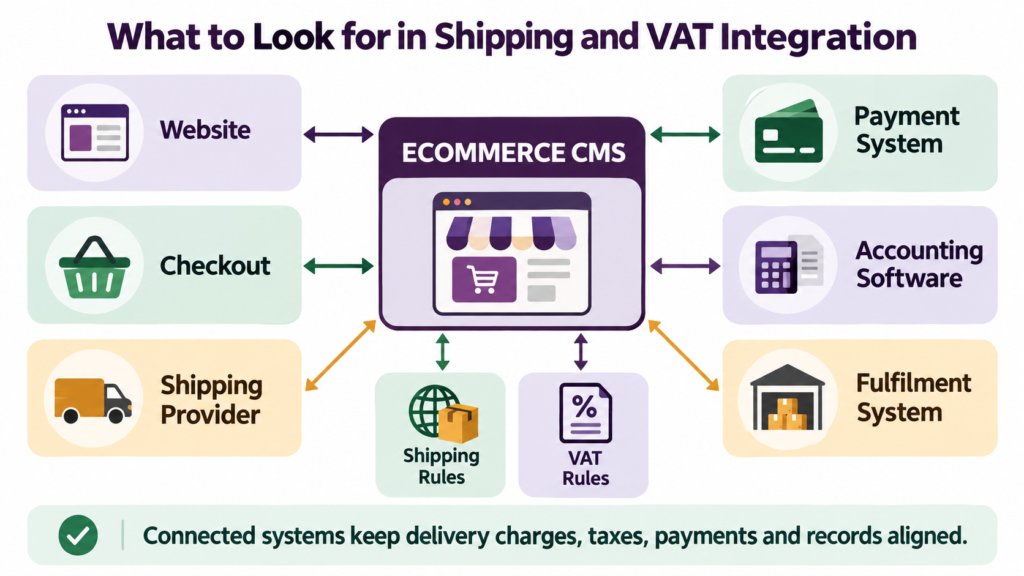
When comparing CMS platforms, look beyond the list of built-in features. The more useful question is whether the platform can connect properly with the systems your business already uses.
Post-Brexit shipping and VAT can involve several connected processes, so the CMS needs to keep information moving accurately between the website, payment system, shipping provider and accounting software. When these systems work together properly, businesses can reduce manual checks and give customers clearer information at checkout.
API and integration support
An API lets the website exchange information with external services. That might include shipping providers, accounting software, stock systems, payment services or other business applications.
You do not necessarily need a website connected to dozens of platforms. You need the right connections.
Flexible rules
Shipping and VAT requirements can change by order. A rigid setup can quickly become difficult to manage when you introduce new products, destinations, or delivery options.
Look for a CMS that lets you configure rules without requiring developers to rebuild the checkout every time something changes.
Accurate data
Integration is only useful when the information being passed between systems is accurate.
Product information, prices, customer details, delivery addresses and order values should remain consistent from the initial purchase through to fulfilment and accounting.
Administration
Consider who will manage the website six months after launch.
If every small change requires technical intervention, the platform may become expensive and frustrating to operate. A good CMS should give the relevant team enough control to manage routine tasks safely.
Scalability
A website that handles 50 orders a month may have very different requirements from one handling 5,000.
Think about where the business is going, not just where it is today.
Common CMS Mistakes That Create Shipping and VAT Problems
One of the biggest mistakes is choosing a CMS because the front end looks good.
Design matters. Of course it does. But a polished homepage will not fix a checkout that cannot handle the business’s shipping rules.
Another common mistake is leaving integrations until the end of development. By then, the checkout structure, product data, and order workflow may already be built around assumptions that are hard to change.
Other problems include:
Treating shipping as an afterthought
Shipping affects price, delivery expectations and checkout behaviour. Consider it during the planning stage, not after the rest of the website is finished.
Relying on manual VAT calculations
Manual work creates more opportunities for inconsistent information. Where calculations or classifications are required, design the website around an agreed, well-maintained process.
Failing to test different destinations
Test checkout with realistic scenarios. Change the customer’s location. Change the product. Change the order value. Change the delivery method. That is where hidden problems tend to appear.
Connecting systems without mapping the data
Adding another plugin or integration does not automatically solve a problem. Before connecting systems, define what information needs to move between them and where it comes from.
Building around today's requirements only
Ecommerce businesses change. New countries may be added. Delivery providers change. Product ranges grow. The CMS should leave enough room for those changes.
How to Compare CMS Options Before You Commit
No universal “best” ecommerce CMS exists. The right choice depends on the business, its products, sales channels, markets and internal systems.
A useful comparison should therefore cover more than templates and page-building tools.
1. VAT functionality
Can the platform support the VAT approach your business has been advised to use?
2. Shipping integration
Can it connect with the shipping providers and fulfilment systems you actually need?
3. API access
Can developers connect the CMS with other systems without relying on awkward workarounds?
4. Checkout flexibility
Can the checkout collect and display the information customers need?
5. Product and order data
Can the checkout collect and display the information customers need?
6. Ease of management
Can your team update routine settings without needing a developer for every change?
7. Scalability
Will the platform still make sense if order volumes, product ranges or markets grow?
8. Performance and security
Integrations should not come at the expense of a fast, stable and secure website
9. Ongoing maintenance
Every integration needs maintenance. Check who will manage updates, compatibility and troubleshooting after launch.
That last point is often overlooked. A website isn’t finished just because it’s live.
Build Shipping and VAT Into the Website From the Beginning
The strongest approach is to consider Post-Brexit shipping and VAT during the web design process, rather than treating shipping and VAT as separate technical jobs.
Start by mapping the customer journey. What happens when someone lands on a product page? What information is shown? What happens when they add the item to their basket? Which details are collected at checkout? Where does the order go afterwards?
Businesses planning a new online store can explore Midland Marketing’s e-commerce web design services to help align website design, checkout functionality and integrations with their operational needs.
Then map the data behind that journey. This is where UX design, information architecture and technical planning meet.
For example, a checkout may need to collect a delivery country because that information affects shipping options. The same information may then need to be passed to another system. The product data may also need to identify information relevant to the VAT calculation.
The customer should experience a simple process. The architecture underneath can be much more sophisticated.
This is also where testing becomes important. Do not test only the “happy path” the straightforward order that works exactly as expected. Test different locations, products, delivery options and order values.
If the website behaves differently from what the business expects, find out why before customers encounter the problem.
A Practical CMS Checklist for Ecommerce Businesses
Before choosing a platform, ask the following:
- Does the CMS support the required VAT configuration?
- Can it connect with the shipping providers we use?
- Can it handle different delivery destinations?
- Can it calculate or retrieve shipping costs accurately?
- Can it connect with accounting or fulfilment software?
- Does it provide suitable API access?
- Can the checkout be customised?
- Can it pass customer and order data between systems?
- Can our team manage routine settings?
- Can the CMS scale as the business grows?
- Can integrations be maintained without rebuilding the website?
- Have you tested realistic shipping and VAT scenarios?
If several answers are unclear, that is a reason to pause before signing up to a platform. It is much cheaper to discover a CMS limitation during the selection process than after building the website around it.
Conclusion
Choosing a CMS for an ecommerce business is not simply a decision about templates, page editing or which platform has the most attractive interface.
The real test comes when the website has to deal with an actual order. A customer chooses a product. They enter a delivery address. The website calculates what they can buy, what delivery options are available, and what they will see at checkout. The order then has to move through payment, fulfilment, and accounting without losing important information along the way.
That is why you should consider post-Brexit shipping and VAT during CMS selection and website planning, not treat them as a problem to solve after launch.
A well-planned ecommerce website gives each part of that process a clear place. It also leaves room for the business to adapt when its products, markets or operational requirements change.
If you are reviewing an ecommerce website or need help deciding how your CMS, checkout and integrations should fit together, you can speak to the Midland Marketing web design team for guidance on your next project.
Frequently Asked Questions
What should a CMS handle for Post-Brexit shipping and VAT?
A suitable CMS should support the website’s required shipping rules, VAT configuration, customer and delivery information, checkout process and connections to relevant third-party systems. The business’s tax or accounting adviser should confirm the exact VAT treatment, while the web development team ensures the CMS can implement and pass the required information correctly.
What is VAT integration in ecommerce?
VAT integration connects the ecommerce website’s product, customer and order information with the processes used to determine and record VAT. Depending on the setup, this may involve the CMS, accounting software, tax tools or other third-party services.
Why does shipping integration matter for an ecommerce website?
Shipping integration can help a website provide accurate delivery options and costs while passing order information to the systems responsible for fulfilment. It can also reduce manual administration and make the checkout more consistent.
What should businesses look for in an ecommerce CMS?
Look beyond the website’s appearance. Check the platform’s integration capabilities, API access, checkout flexibility, shipping functionality, VAT support, performance, security, scalability and ease of ongoing management.
Can an ecommerce CMS automate shipping and VAT calculations?
It can support automated processes where the relevant rules and integrations are available and correctly configured. However, automation does not remove the need to establish the correct VAT treatment or maintain the underlying rules.
How should businesses prepare a CMS for UK-EU ecommerce?
Start by mapping the products, markets, delivery destinations, shipping arrangements, VAT requirements and systems involved in an order. Then choose a CMS that can support those requirements without relying on excessive manual work.

Written by - Lauren Davison
Introducing Lauren – one of our content writers who has a flair for SEO and creative strategy!
With a Master’s Degree in Creative Writing, Lauren has niched down into SEO and content writing.
Outside of work, she loves watching the darts, reading and the pub on the weekend.
Want some more?
Latest Insights & News
Post-Brexit Shipping and VAT Integrations: How to Choose the Right CMS
Introduction Choosing an ecommerce CMS used to be largely about design, product management and how easy it was to update a website. For businesses selling
UK Advertising Spend 2026: Where the £50.5 Billion Is Going
Introduction UK advertising spend is forecast to reach £50.5 billion in 2026, but growth is uneven across channels. Search remains the largest category, while social
Integrated Marketing Agency Model: How Top UK Advertisers Coordinate Specialists
Introduction An integrated marketing agency model connects specialist agencies, in-house teams and external partners around one shared strategy. Rather than placing every marketing function under