


Introduction
An integrated marketing agency model connects specialist agencies, in-house teams and external partners around one shared strategy. Rather than placing every marketing function under a single roof, it creates coordination between creative, media, digital, social and data specialists so they work towards the same business objectives.
That is the short answer. The longer one involves understanding why the model has become so common among large advertisers, how it actually functions day to day, and where it tends to go wrong.
Large advertisers rarely rely on a single agency for everything. Sky, for example, works with a network of external creative partners while its in-house agency, Sky Creative, handles the majority of its advertising output.
Procter & Gamble has taken an even more deliberate path, separating brand strategy from content production and media placement so that different specialists own different capabilities.
The point is not consolidation for its own sake. It is about connecting expertise, and that distinction matters more than most marketers realise.
Table of Contents
What Is an Integrated Marketing Agency Model?
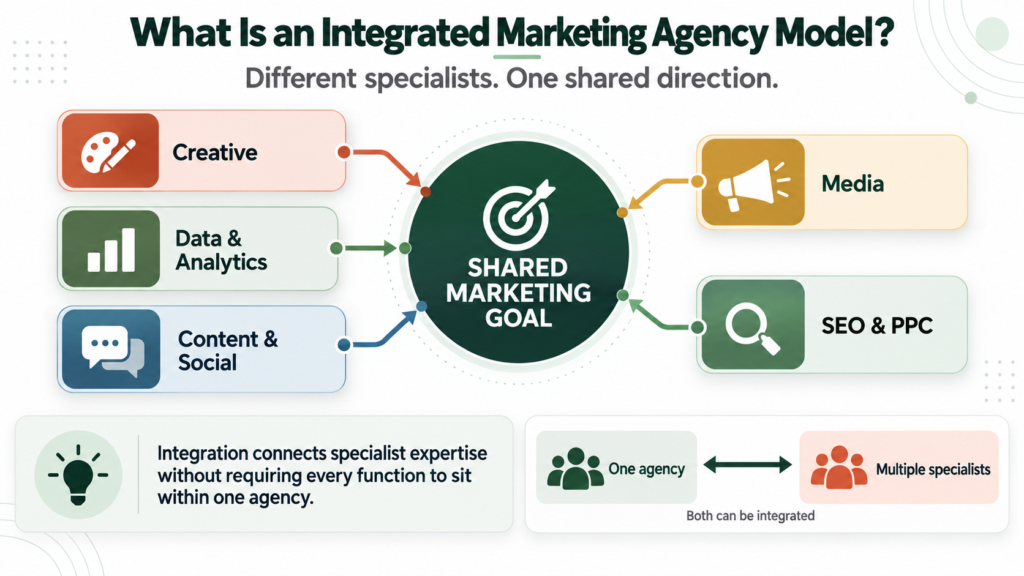
One Strategy, Multiple Specialists
An integrated marketing agency model links creative, media, SEO, PPC, social, content and data functions through a single strategic framework. Each specialist retains its own expertise, but the brief, the objectives and the performance measures are shared.
This is different from simply hiring several agencies and hoping they collaborate. Integration requires deliberate coordination, shared planning cycles, common KPIs and a clear picture of how each channel contributes to the overall outcome.
Integration Does Not Mean One Agency
A common misconception is that an integrated model means appointing one full-service agency to handle everything. That is one possible structure, but it is not the only one, and for many large advertisers, it is not the preferred one.
Integration is about how agencies work together, not how many agencies you employ. A business can run an integrated model with three specialist agencies and a lead partner, or with a single agency that houses multiple disciplines. The structure matters less than the coordination.
The Role of the Lead Agency
In practice, many integrated models rely on a lead agency to coordinate briefs, priorities and brand direction.
Sky, for instance, appointed Mother as its lead agency in 2018, tasked with developing a master brand campaign that other partner agencies would feed into. WCRS retained the broadband and mobile account, while Brothers & Sisters handled Sky VIP.
The lead agency does not necessarily do the most work. Its role is to hold the strategic thread, ensuring that creative development, media planning and specialist execution all serve the same idea.
Where In-House Teams Fit
Internal marketing teams often retain strategic control while agencies provide specialist execution. Sky Creative, the broadcaster’s in-house agency, has grown into one of Europe’s largest, handling everything from Christmas campaigns to product launches.
Simon Buglione, Managing Director of Sky Creative, describes it as “the hub of a network of external creative partnerships”, a structure that allows Sky to draw on specialist expertise both inside and outside the organisation.
In-house teams provide continuity, brand knowledge and speed. Agencies bring category expertise, fresh perspective and scalable resources.
How Do Top UK Advertisers Balance Specialist Agencies?
Keep Expertise Where It Matters
Large advertisers rarely force every marketing function into a single agency. They keep specialist partners because deep expertise in media buying, creative strategy or data analytics is difficult to replicate in-house, and because competition between specialists tends to raise standards.
Sky’s media planning and buying, for example, is handled by Publicis Media across the UK, Ireland, Germany, Austria and Switzerland, while WPP retained the Italian market. That is not a failure of integration. It is integration working as intended: specialist agencies operating within a coordinated framework.
Build Around Shared Objectives
Integration succeeds when separate agencies work towards common business goals rather than isolated channel targets. Shared campaign objectives, aligned performance measures and a single strategic brief create the connective tissue.
This sounds straightforward. In practice, it requires someone, a lead agency, an in-house team or a central marketing function, to own the coordination. Without that ownership, integration becomes an aspiration rather than an operating reality.
Connect Media With Creative
Creative development and media planning need to work together rather than operate as isolated functions. A brilliant creative idea that cannot be delivered effectively through the chosen media mix is a wasted investment.
Equally, a media plan optimised for reach but disconnected from the brand’s creative direction produces forgettable advertising. P&G’s modular agency model addresses this by keeping strategy, production and media placement as distinct but connected functions.
Marc Pritchard, P&G’s Chief Brand Officer, has described it as “a modular approach where we leverage each other’s superpowers” rather than expecting one agency to do everything.
Centralise What Needs Control
Brand guidelines, customer data, reporting frameworks and strategic direction benefit from central oversight. These are the elements that need consistency across every agency and every channel.
What does not need centralising is execution. A media agency should not be writing your brand guidelines. A creative agency should not be managing your customer data platform. The integrated model works best when central control focuses on the things that genuinely need it.
What Can Sky and P&G Teach Us About Agency Integration?
Sky's Multi-Channel Challenge
Sky operates across television, broadband, mobile, streaming and sports, each with its own audience, competitive dynamics and marketing requirements. Coordinating creative, media and digital activity across that portfolio is a substantial organisational challenge.
The broadcaster’s response has been to build a hybrid structure. Sky Creative, with around 400 full-time staff, handles the vast majority of Sky’s advertising output. External creative partners fill specialist gaps and bring outside perspective.
Media planning and buying sit with Publicis Media. The in-house team provides continuity and brand consistency; external agencies provide flexible specialist capacity.
That hybrid approach, in-house hub, external specialist network, is increasingly common among large advertisers.
P&G's Global Scale
Procter & Gamble’s adds more brands, more markets and more agencies to the same problem. Its finance chief once told investors the company intended to cut back the number of agency relationships sharply, arguing that the existing set-up had grown too complicated and costly.
It has also experimented with structure. One model, called Fixed and Flow, pays an agency of record a retainer for most creative work while other projects go to different agencies. Trade coverage of a Marc Pritchard talk also reported that nearly 30% of P&G’s media spending was being planned in-house at that point. Agency consolidation and in-housing, in other words, often happen together.
Different Structures, Same Need
It would be misleading to claim that Sky and P&G use identical agency structures. They do not. Sky’s model leans heavily on its in-house agency as the central creative hub. P&G’s model is more distributed, with a modular approach that separates strategic, production and media functions.
What they share is the recognition that integration is a coordination problem, not a procurement problem. You cannot buy your way to an integrated model by appointing one agency or consolidating your roster. You have to build the processes that make integration work.
Integration Behind the Campaign
The processes that make an integrated model function are rarely visible in the final campaign. They include shared objectives that every agency understands and accepts.
Regular communication between agency partners, not just between each agency and the client. Clear governance that defines who decides what. Consistent measurement that connects channel-level metrics to business outcomes.
These are unglamorous. They are also the difference between an integrated model that works and one that exists only on an org chart.
How Does an Integrated Agency Model Improve Marketing Performance?
Fewer Gaps Between Channels
When agencies work in isolation, campaigns develop gaps. The search campaign promotes a message the social campaign contradicts. The display ads drive traffic to a landing page that does not reflect the creative proposition. The email sequence references an offer that has already expired.
Closer coordination reduces these disconnects. It also reduces duplicated activity, two agencies briefing the same audience, or producing assets that serve the same purpose without either knowing about the other.
Faster Campaign Decisions
Shared information and clearer ownership reduce the delays that accumulate between strategy, creative, media and optimisation. When everyone is working from the same brief and the same performance data, decisions get made faster.
This matters more than it used to. Campaign cycles that once ran for months now run for weeks. The ability to adjust creatively, shift media weight or respond to competitive activity in real time depends on having the right people, internal and external, connected to the same information.
One View of Performance
Integrated reporting connects channel-level metrics with wider business objectives. Instead of a media agency reporting on impressions, a creative agency reporting on engagement and an SEO team reporting on rankings, the integrated model asks a more useful question: what did all of this activity achieve together?
That requires agreeing on shared KPIs before the campaign launches, not after. It also requires someone to own the reporting framework, typically the lead agency or the in-house team.
Consistent Customer Experience
Customers do not experience your marketing as separate channels. They see a brand across search, social, advertising, websites and email. An integrated model helps ensure that experience is connected.
A customer who sees a TV ad, searches for the brand, clicks a paid result and lands on a page that reinforces the same message is having a coherent experience. That coherence does not happen by accident. It happens when the agencies responsible for each touchpoint are working from the same plan.
What Should Businesses Consider Before Integrating Agencies?
Start With the Marketing Objective
The decision to integrate agencies should follow the marketing objective, not precede it. What are you trying to achieve? More leads? Higher conversion rates? Better brand awareness in a specific market? The answer determines whether integration is actually necessary.
A business with a single marketing channel and one specialist agency does not need an integrated model. A business running campaigns across five channels with three agencies almost certainly does.
Map Every Agency Role
Before restructuring anything, identify which agency owns creative, media, SEO, PPC, content, technology and data. Overlaps become visible quickly. So do gaps, capabilities that no one is currently handling.
This mapping exercise is also useful for identifying agencies that are duplicating work. If two agencies are both producing social content, for example, that is either a coordination failure or an unnecessary cost.
Define Ownership Clearly
Integration without clear ownership creates confusion rather than coordination. Every function needs an owner, and every owner needs to know what they are responsible for and what they are not.
The most common mistake we see is businesses assuming that “everyone will collaborate” without defining how that collaboration actually works. It does not happen automatically. Someone has to own the process.
Choose the Right Operating Model
There is no single correct structure. The right model depends on internal capabilities, marketing complexity and how much specialist expertise the business needs. A full-service partner suits some organisations.
A lead-agency model suits others. A network of specialists with a strong in-house team suits others still. The key is choosing deliberately rather than drifting into a structure by accident.
Integrated Marketing Agencies vs Specialist Agency Networks
One Partner, Broader Capability
An integrated marketing agency provides multiple services through a centralised relationship. Creative, media, digital and data sit under one roof, which reduces coordination overhead and simplifies reporting.
The trade-off is depth. A single agency may not have the same specialist expertise in every discipline as a dedicated specialist would. For businesses where breadth matters more than depth in any single channel, an integrated agency can work well.
Several Specialists, Greater Flexibility
A specialist agency network brings deep expertise in each discipline. The media agency knows the media. The creative agency knows how to be creative. The SEO team knows search.
The trade-off is coordination. Multiple agencies require stronger management, clearer briefs and more deliberate communication. Without that coordination, the network fragments into disconnected activity.
Where the Lead Agency Model Fits
The lead agency model sits between a fully integrated agency and a completely fragmented network. One agency holds the strategic thread, coordinating briefs, aligning priorities and ensuring consistency, while specialist partners deliver in their areas of expertise.
For larger organisations with several agency partners, this is often the most practical structure. It provides the coordination of an integrated model without sacrificing the specialist depth of a network.
Compare the Models Clearly
Model | Agency Structure | Main Strength | Main Challenge | Best Suited To |
Integrated agency | One connected agency team | Centralised delivery | May have fewer specialist options | Businesses wanting one coordinated partner |
Specialist network | Multiple specialist agencies | Deep expertise | Requires stronger coordination | Complex multi-channel marketing |
Lead agency model | Lead agency + specialist partners | Central strategy with specialist support | Requires clear ownership | Larger organisations with several partners |
In-house + agencies | Internal team + external specialists | Strong internal control | Greater management responsibility | Businesses with established marketing teams |
All-in-one marketing services make sense when coordination matters more than specialist depth. A specialist network suits businesses where each channel requires genuinely expert input, performance marketing, for example, or highly technical SEO.
The lead agency model works when you need both coordination and specialist capability. An in-house team supplemented by external agencies suits businesses that have the internal resources to manage multiple relationships effectively.
How Should a Business Build an Integrated Marketing Model?
Audit the Current Agency Mix
Start by identifying what you actually have. Which agencies are working on which channels? Where are the overlaps? Where are the communication gaps? Which capabilities are missing entirely?
This audit often reveals that the problem is not the number of agencies but the absence of coordination between them. Adding a lead agency to a fragmented network will not fix fragmentation. It will just add another layer.
Create One Shared Brief
A single strategic brief keeps different agencies aligned with the same business and customer objectives. It does not replace individual agency briefs. It sits above them, providing the context and constraints that every agency needs to understand.
The shared brief should cover the business objective, the target audience, the competitive context, the brand positioning and the measures of success. Every agency should be able to articulate how their work contributes to that brief.
Agree on Shared KPIs
Channel-level metrics have their place, but they should not be the only measures of success. Shared KPIs: leads, revenue, customer acquisition, return on investment; connect agency performance to business outcomes.
This changes agency behaviour in useful ways. A media agency optimising for impressions has different incentives from one optimising for qualified leads. Shared KPIs align those incentives.
Review and Optimise the Structure
Agency structures are not permanent. Business needs change, channels evolve, marketing priorities shift. The integrated model that worked two years ago may not be the right one today.
Review agency relationships regularly, at least annually, and ask whether the current structure still serves the business. The goal is not integration for its own sake. It is the structure that most effectively connects specialist expertise to business outcomes.
Conclusion
Top advertisers do not necessarily need every marketing function handled by one agency. Sky works with a network of external creative partners alongside its in-house team. P&G favours a modular approach that separates strategy, production and media rather than bundling everything into a single relationship.
What they have in common is a deliberate approach to coordination. Shared objectives, clear ownership, consistent measurement and a structure that connects specialists rather than isolating them.
Integration becomes more important as marketing operations grow more complex. A business running campaigns across three channels with one agency does not need an integrated model. A business running campaigns across eight channels with five agencies almost certainly does.
For businesses considering an integrated marketing agency model, the right model depends on internal capabilities, marketing complexity and the need for specialist expertise. There is no universal answer.
If you are weighing up how to bring different digital marketing activities together without unnecessary complexity, Midland Marketing can help you assess your current agency mix and build a structure that connects the right specialists around the right objectives.
Frequently Asked Questions
What is an Integrated Marketing Agency Model?
Marketing agency integration connects multiple marketing disciplines, creative, media, digital, social, content, data, around one shared strategy and set of objectives. It is not necessarily a single agency doing everything. It is a structure that coordinates specialists so they work towards the same outcome.
Why do large advertisers use integrated agency models?
Large advertisers use integrated models to maintain consistency across channels, coordinate multiple specialist agencies, centralise strategic direction and connect marketing activity to business performance. The complexity of running campaigns across many channels with several agency partners makes coordination essential.
Do integrated agency models mean using one agency?
No. Integration is about coordination, not consolidation. A business can run an integrated model with several specialist agencies connected through a lead agency or a central in-house team. The structure matters less than the processes that keep the agencies aligned.
What is the difference between an integrated agency and a specialist agency?
An integrated agency provides multiple services through one relationship, which simplifies coordination but may offer less depth in any single discipline. A specialist agency brings deeper expertise in a specific area but requires coordination with other agencies. Many businesses use both, with specialist agencies coordinated through a lead agency or in-house team.
How can a business create an integrated marketing strategy?
Start by defining the marketing objective. Then map every agency role to identify overlaps and gaps. Establish clear ownership for each function. Create one shared brief and agree on shared KPIs. Finally, review the structure regularly as business needs change.

Written by - Lauren Davison
Introducing Lauren – one of our content writers who has a flair for SEO and creative strategy!
With a Master’s Degree in Creative Writing, Lauren has niched down into SEO and content writing.
Outside of work, she loves watching the darts, reading and the pub on the weekend.
Want some more?
Latest Insights & News
UK Advertising Spend 2026: Where the £50.5 Billion Is Going
Introduction UK advertising spend is forecast to reach £50.5 billion in 2026, but growth is uneven across channels. Search remains the largest category, while social
Integrated Marketing Agency Model: How Top UK Advertisers Coordinate Specialists
Introduction An integrated marketing agency model connects specialist agencies, in-house teams and external partners around one shared strategy. Rather than placing every marketing function under
LinkedIn Thought Leadership for UK Tech Founders: How to Win Enterprise Deals
Introduction Buying software is no longer just about a sales call. Before they speak to a vendor, many UK business leaders look at the company,