


Introduction
The national search is crowded. loud and sure competitive. Yet some brands still break through. The difference usually comes down to one thing: insight. When you study rivals closely, patterns appear, missed terms, weak pages, gaps in intent coverage. That’s where competitor analysis strengthen your national keyword to become powerful.
It turns guesswork into direction. In the sections ahead, we will look at how competitor research shapes targeting decisions, reveals search intent shifts, and strengthens content positioning. This helps us to build authority that scales across the whole country.
Table of Contents
Why Competitor Analysis Matters In National SEO Strategy
National search is a different animal. Locally, you compete with a handful of businesses and a map pack. Nationally, you face brands with layered content, digital PR, and serious topical authority mapping. And these are already in place to move forward.
Visibility isn’t just about ranking anymore. It’s about AI visibility, featured placements, and trust signals that stretch across the UK.
The Difference Between Local And National Keyword Competition
Local terms are narrower, and the intent is clearer. National SEO keyword targeting, however, blends informational, commercial, and transactional queries at scale. Ranking difficulty rises fast because authority compounds.
Strong domains reinforce EEAT (Experience, Expertise, Authority, Trust). They do it through content depth, backlinks, and brand signals. You’re not just competing for clicks; you’re competing for credibility.
How Competitor Analysis Strengthen Your National Keyword
Here’s where things get interesting. When you run a detailed keyword analysis for your national SEO strategy. You often find blind spots in emerging queries, long-tail variations, and underserved informational topics. Many national players chase volume. Few refine intent. That gap is an opportunity, especially when backed by sharp UK search intent analysis.
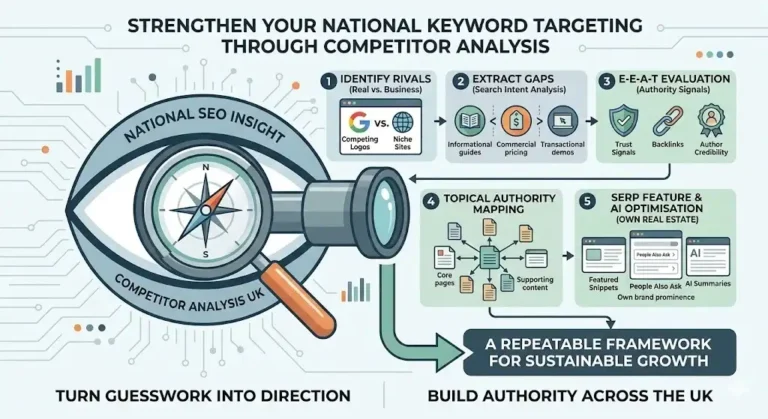
Understanding Market Saturation Through SERP Feature Optimisation
Search results now include featured snippets, AI summaries, People Also Ask boxes, and expanding SERP layouts. Proper SERP feature optimisation shows where visibility is truly crowded and where it isn’t. Saturation isn’t about how many ranks. It’s about who owns the real estate that users notice first.
Mapping Competitor Keyword Landscapes For National Targeting
Effective national SEO keyword targeting doesn’t start with brainstorming. It starts with evidence. Raw, sometimes messy, search data. When you map what competitors rank for, patterns surface. In addition to it, clusters, intent layers, and authority gaps.
This is where competitor analysis strengthen your national keyword from a report into a roadmap. Done right, it feeds topical authority mapping. Additionally, it strengthens AI visibility and stops you from chasing keywords. Because these paths were never realistic wins in the first place.
Identifying True Search Competitors Versus Business Competitors
Your real SEO rivals are not always your commercial rivals. A niche blog, a comparison site, or even a government page. It can outrank major brands. Search engines reward relevance and trust, not company size. Knowing who actually owns page one tells you whose strategy you must dissect.
Extracting Keyword Gaps Using UK Search Intent Analysis
Not all keywords want the same thing. Some demand guides to it. Others want pricing, demos, or quick answers. Strong UK search intent analysis separates informational curiosity from commercial research and transactional readiness. Miss that distinction and rankings stall, even with good content.
Spotting Authority Signals Through EEAT Evaluation
National rankings lean heavily on EEAT (Experience, Expertise, Authority, Trust). Backlinks, author credibility, brand mentions, and content depth all signal reliability. When competitors dominate, it’s rarely luck. Its authority compounded over time.
Turning Competitor Insights Into Strategic Keyword Targeting
Spreadsheets don’t rank. Decisions do. You can run the cleanest reports in the world. But unless those findings shape direction, they sit there tidy and useless. The real value of competitor insight shows up when it sharpens national SEO keyword targeting and forces hard choices. Not every keyword is worth chasing. Not every gap is profitable.
Prioritising Keywords Based On Ranking Feasibility
It’s tempting to grab the biggest numbers first. High volume feels exciting. But feasibility matters more. Look at domain strength, backlink depth, and how deeply competitors have embedded EEAT (Experience, Expertise, Authoritativeness, Trust) into their pages. Sometimes the smarter play is a mid-volume term with softer resistance and clearer intent. Momentum builds faster there.
Building Topic Clusters With Topical Authority Mapping
Single pages rarely move national rankings anymore. Clusters do. Thoughtful topical authority mapping connects core pages. It’s for supporting content through structured internal linking. That web of relevance signals depth. It also reinforces credibility in the eyes of search engines, which increasingly evaluate context, not just keywords.
Aligning Keywords With AI Visibility Trends
Search layouts are shifting. AI summaries, generative answers, and dynamic result blocks compress attention spans. Winning now requires awareness of AI visibility and careful SERP feature optimisation. Sometimes ranking first isn’t enough. You need to own the snippet. The expandable answer and the section users actually read.
Using Competitor Content Benchmarking To Outperform Rankings

Beating national rivals isn’t about copying what they publish. It’s about spotting where they stop short. Strong competitor content benchmarking shows you not just what exists. But what’s missing, and that difference, is where rankings shift.
The competitor analysis tends to strengthen your national keyword and used better. When used, the benchmarking becomes less of a checklist and more of a tactical advantage.
Analysing Content Depth, Structure, And Intent Match
Start with substance. Does the page actually answer the query? High-ranking content usually aligns tightly with intent. Demonstrates EEAT (Experience, Expertise, Authority, Trust), and uses a structure that search engines can interpret easily. Headers, schema, and clarity matter more than keyword repetition.
Finding Content Weakness Signals In Competitor Pages
Thin sections. outdated references and no structured data. These are quiet gaps, but powerful ones. Fixing them improves AI visibility and strengthens eligibility for enhanced listings through smarter SERP feature optimisation.
Designing Better Pages Instead Of More Pages
Volume doesn’t win national SEO. Precision does. One well-built page with clear depth and strong topical authority mapping often outperforms ten shallow ones.
Building A Repeatable National Keyword Strategy Framework
Quick wins feel good. Then they fade. Sustainable growth in national SEO keyword targeting comes from building something that keeps moving even when you are not watching it closely. Search shifts. Competitors adjust. Algorithms nudge things around. A solid strategy responds without panic.
Creating Monitoring Cycles For Competitor Movements
Rankings rarely crash in a single day. They slide. A competitor improves a guide. A new landing page appears. Google recalibrates signals. Gradual tracking helps spot those movements before they become real losses. It also reveals where stronger EEAT (Experience, Expertise, Authority, Trust) signals are. In addition to it, rising AI visibility is giving others an edge.
Updating Keyword Targets Based On Search Behaviour Trends
Language evolves. Seasonal change in demand. News cycles reshape queries. Even slang creeps into search boxes. Reviewing data at intervals keeps decisions realistic. Consistent topical authority mapping is useful for content. As they ensure new content strengthens existing themes rather than pulling focus away.
Scaling National SEO Keyword Targeting Without Cannibalisation
Growth can create confusion if the structure lacks discipline. Clear page hierarchy, defined intent separation, and purposeful internal linking. These reduce overlap and support cleaner SERP feature optimisation across the domain.
Conclusion
National campaigns become far more predictable when decisions come from evidence, not instinct. The real advantage is that doing competitor analysis strengthen your national keyword and SEO support. It replaces guesswork with direction. By studying what rivals rank for, where they are weak, and how they structure authority, businesses can target smarter, not harder.
Insights shape priorities, refine content focus, and sharpen positioning across the whole search landscape. Over time, that clarity compounds. Rankings improve, visibility stabilises, and growth stops feeling random. Because strategy, not chance, is driving it.
Frequently Asked Questions
1. What Is Competitor Keyword Analysis In National SEO?
It’s the process of studying what other sites rank for across the UK. So we can see where they’re strong, where they’re thin, and where realistic opportunities sit.
2. How Does It Improve Targeting Accuracy?
It shows us which terms actually drive visibility, not just traffic estimates, so I focus my effort where results are more likely.
3. Do I Need Expensive Tools To Do This Well?
Not always. We can start with basic data sources, then layer tools later once patterns start appearing.
4. How Often Should Competitor Keywords Be Reviewed?
We check regularly. Rankings shift quietly, and small changes early often signal bigger moves coming.
5. Can This Help Smaller Brands Compete Nationally?
Yes. Smart targeting and gap spotting often beat bigger budgets when strategy is sharper.