


Introduction
Have you ever noticed how Google doesn’t really guess anymore? It confirms.
A few years back, you could slap some basic schema on a page and call it a day. Not anymore. Today, search engines cross-check your structured data against real-world signals.
Here’s the problem: most websites have schema. But they use it wrong. They treat it like a checkbox, not a strategy.
This isn’t another “what is schema” post. It’s about applying schema markup in different ways. The approach depends on whether you’re an organisation, an author, or a brand.
If you want reliable signals, you need schema markup for best practices that reflect real identity. Organisations, authors, and brands all behave differently online. Treating them the same weakens everything.
Table of Contents
A Shift in How Search Understands Entities
Search used to be about pages. Then keywords. Now? Entities.
Google builds knowledge graphs. It wants to know: who created this, what they’re known for, and whether external sources agree.
Schema is no longer just an enhancement. It’s validation.
But here’s the kicker: if your structured data says one thing and your social profiles say another, you create confusion, not authority.
Think of it like a three-legged stool:
- Content
- Structured data
- External references (Wikipedia, LinkedIn, news mentions, etc.)
A mismatch? The stool wobbles.
Clarity? Trust grows.
Consistency? Your signals get louder.
Most people skip the consistency part. Don’t be like most people.
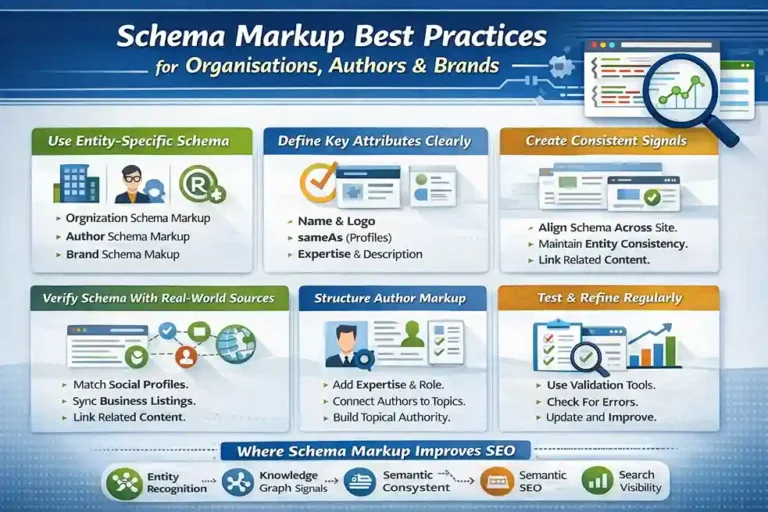
Before diving into implementation, here’s a quick visual overview of how schema markup supports entity clarity and strengthens SEO performance
Building Reliable Structured Data Across Entity Types
Start With Entity-Specific Schema, Not Generic Markup
You’d be surprised how many sites use the Organisation schema for everything. A blog run by one person? That’s not an organisation, that’s a Person or Brand.
A generic schema weakens your signal. It’s like wearing a Halloween mask to a job interview.
Instead, match the type to the actual role:
- Organisation schema markup for companies with legal structure
- Author schema markup for individual writers, researchers, or experts
- Brand schema markup for product lines, publications, or public figures
And please don’t mix entity types on a single page. Pick one. Stick with it.
Define Attributes That Actually Matter
Not all schema fields are created equal.
Some carry weight. Others? Google basically ignores them.
Focus on what search engines confirm, not what looks fancy:
- Name (exact match to your real-world name)
- Logo or image (consistent across platforms)
- SameAs (your verified social profiles, Wikipedia, Crunchbase)
- Description (accurate, not keyword-stuffed)
- Role/expertise (especially for authors — more on that later)
What gets ignored? Obscure fields like award (unless you’re an Oscar winner) or DUNS (unless you’re B2B).
What creates ambiguity? Using different names on your site versus your LinkedIn versus your byline. Pick a single identity. Stick to it like glue.
Build Internal Consistency Across Pages
Here’s where most people slip.
Your homepage might have a perfect organisation schema. But your blog posts? Different story. Suddenly, the author doesn’t link back. Or the logo changes.
That randomness kills trust.
Best practice: repeat the same entity structure across:
- Homepage
- About page
- Blog content
- Author archive pages
Link between them. Use the same @id reference. Maintain identical names, images, and URLs.
Search engines are dumb in a beautiful way: they believe in repetition. Don’t confuse them.
Connect Schema With Real-World Signals
The schema alone is not enough. I’ll say it louder for the people in the back:
“The schema alone is not enough”.
You need alignment with real-world presence. That means:
- Your social profiles say the same thing as your schema
- Your business listings (Google Business Profile, Yelp, Trustpilot) match
- External mentions (news, podcasts, directories) don’t contradict you
If your schema claims you’re a “leading cybersecurity firm” but your Twitter bio says “tech enthusiast”, you just broke the system. Be boringly consistent. That’s the secret.
Structure Author Entities With Context, Not Just Names
Author schema is criminally underused. Most people add a name and call it done. But Google wants to know: why should I trust this person?
Add:
- KnowsAbout (topics they actually write about, not everything under the sun)
- WorksFor (their organisation or publication)
- SameAs (LinkedIn, Google Scholar, GitHub, Medium)
- Description (their expertise, not their life story)
Then connect authors to topics across multiple posts. That builds topical authority over time.
One post with author schema? Fine. Fifty posts, all linking back to the same author profile? Now we’re talking.
Use Schema to Clarify Content Relationships
Schema isn’t just about entities. It’s about relationships. Who created this? What does it relate to? Why does it exist?
You can link:
- Article → author (obvious, but often broken)
- Brand → service (which services belong to which brand)
- Organisation → content (who’s responsible for this page)
Entity-based search rewards clarity. If your schema looks like a spiderweb of disconnected facts, you lose. Keep it clean. Three relationship types max per page.
Validate, Test, and Refine Regularly
Schema is not “set and forget.” I wish it were. It’s not. Every CMS update, every redesign, every plugin change, something breaks.
You need a rhythm:
- Implement (using Schema.org types, not guessing)
- Test (Rich Results Test, Schema Validator)
- Monitor (Google Search Console’s “enhancements” report)
- Refine (fix missing fields, incorrect types, broken @id references)
Do this monthly or quarterly at a minimum. I’ve seen sites lose rich results overnight because someone deleted an image without updating the schema. Don’t be that person.
Where Structured Data Impacts Performance
You won’t see a direct ranking boost from schema. Anyone promising that is selling something. But you will see:
- Better entity recognition (Google knows who you are)
- Stronger knowledge graph signals (you appear in panels, lists, and related entities)
- Enhanced semantic SEO (your content connects to relevant topics)
- Increased trust (when schema matches real-world data, clicks go up)
Long-term? That’s where schema markup for best practices pays off. Not in a spike. In a slow, compounding advantage.
Think of it like exercise. One workout does nothing. A year of consistent, smart work? Different body entirely.
Conclusion
Schema isn’t about complexity. It’s about clarity. Strong entity signals come from three things:
- Consistency (same name, same image, same links everywhere)
- Accuracy (truthful, verifiable, not aspirational)
- Alignment (schema + content + external references all saying the same thing)
Don’t bulk-add schema to every page. Think first and then implement. Because at the end of the day, search engines aren’t grading your effort. They’re checking your honesty.
And schema markup for best practices is just you, telling the truth in a language Google finally understands.
Get in touch to learn more about schema markup for seo.
Frequently Asked Questions
1. What is schema markup in SEO?
It’s a code (structured data) you put on your website to help search engines understand your content. Think of it as subtitles for search bots. It doesn’t guarantee rich results, but it removes ambiguity.
2. Why is schema important for entity SEO?
Because entity SEO relies on identity. Schema tells Google who you are, what you do, and how you’re connected to other things. Without it, you’re just another page.
3. Which schema types should organisations use?
Start with Organisation. Add LocalBusiness if you have a physical location. Then ContactPoint, OpeningHoursSpecification, and SameAs for social profiles. Avoid mixing with Person unless you’re a sole proprietor.
4. How can authors benefit from schema markup?
The author schema builds personal authority. Add knowsAbout, worksFor, and sameAs to your bylines. Over time, Google recognises you as an expert — not just a name on a page.
5. How often should schema markup be updated?
Check it every time you update your website’s design, content structure, or plugins. Run validation tools monthly. If your business name, logo, or social handles change — update schema immediately.