


Introduction
Search engine optimisation is frequently viewed as one discipline that is treated the same throughout the world. One single playbook, one single goal: higher rankings. That assumption causes more damage than bad keywords ever will.
A local electrician does not compete the same way a national software brand does. A service provider limited to the UK market does not experience the same search competition as a company that sells internationally. However, a lot of companies implement SEO strategies that don’t take into account the way customers actually find and choose them.
We’re not talking about the question of SEO effectiveness. SEO works. The question is which version of SEO fits your business reality.
Knowing the difference between Local SEO, National SEO, and Global SEO can save you from wasting your marketing budget. It also helps you avoid slow results and traffic that looks good in reports but never converts.
Table of Contents
Why SEO Scope Is a Business Decision, Not a Marketing One
Most SEO failures do not come from poor execution. They come from misalignment.
Search engines reward relevance. Relevance is shaped by intent, geography, and delivery capability. When those signals conflict, rankings become unstable, and trust erodes.
Choosing the wrong SEO scope affects:
- How competitive your search landscape becomes
- How long results realistically take
- How much authority must you prove
- How complex does your website structure need to be
SEO works best when it mirrors how your business operates day to day. When it doesn’t, performance feels unpredictable, even when “best practices” are followed.
Understanding the Three SEO Models
What Local SEO Is Really Designed to Do
Local SEO exists to solve immediate problems.
When someone searches locally, they are not browsing options. They are filtering. Search engines respond by prioritising proximity, trust, and real-world presence.
Local SEO focuses on showing businesses that can actually serve the searcher where they are, not theoretically, but practically.
It is most relevant for:
- Service businesses tied to physical locations
- Brick-and-mortar shops
- Multi-location brands competing city by city
Local visibility depends on signals that prove legitimacy. That means accurate listings, genuine reviews, and content grounded in real local knowledge.
When those signals align, local SEO can deliver results quickly. When they don’t, visibility collapses just as fast.
How National SEO Changes the Rules
National SEO removes geography from the equation.
Instead of competing for attention in one area, you are competing across an entire country. Search engines stop asking “Who is nearby?” and start asking “Who deserves to rank?”
That shift changes everything.
National SEO relies on:
- Demonstrated expertise
- Breadth and depth of content
- Authority built over time
- User engagement that signals trust
This is why national SEO suits businesses that sell digitally, operate nationwide, or support longer decision cycles. It rewards credibility more than convenience.
The upside is scale, though it comes at the cost of patience.
Why Global SEO Is Not Just “Bigger SEO”
Global SEO is often misunderstood. Many businesses assume it is national SEO multiplied by countries. It isn’t. Global SEO introduces complexity at every level, from language to culture to search behaviour. Trust also varies by region, shaping how users respond to content.
Search engines need clarity. They must understand which page serves which audience, and why. When that clarity breaks down, rankings suffer across all regions. Global SEO works best for businesses that already understand their international markets. Without that insight, expansion creates noise instead of growth.
Local SEO in Practice: When Location Drives Decisions
Local SEO performs well because it aligns with how people act.
When searches are time-sensitive or location-dependent, users want certainty. They want reassurance that a business is nearby, credible, and active.
How Local Search Optimisation Actually Works
Strong local SEO is built on consistency.
Search engines compare business details across platforms. They analyse review patterns. They assess whether content reflects real service areas or just keyword targeting.
Small gaps matter more than they seem. Incorrect hours, mismatched addresses, or thin location pages each chip away at trust.
When accuracy is high, visibility follows.
The Strengths of a Local SEO Strategy
Local SEO often delivers:
- Faster traction
- Clearer intent
- Shorter sales cycles
For many service businesses, it becomes one of the most reliable lead channels available.
Where Local SEO Reaches Its Limits
Local SEO cannot generate demand outside its geographic area.
Once coverage is strong in a defined area, growth slows unless new locations or broader strategies are introduced. This is where businesses often feel “stuck” without understanding why.
National SEO: Visibility Built on Authority
National SEO is slower by design. Search engines test credibility over time. They look for consistency. They measure how users interact with content. Authority is not assumed. It is earned.
What Drives National Search Visibility
Performance depends on:
- Topic coverage that answers real questions
- Content that goes beyond surface explanations
- Signals that users trust and return
This is not about publishing more pages. It is about publishing better ones.
Why Businesses Choose National SEO
National SEO supports long-term growth. It strengthens brand recognition. It builds defensible positions in competitive markets. The return is not immediate, but it compounds.
The Reality of Competing Nationally
Competition is intense, investment must be steady, and results take time. National SEO fails when it is treated like a quick acquisition channel instead of a strategic asset.
Global SEO: Growth Without Losing Control
Global SEO magnifies both strengths and weaknesses. Strong systems scale well. Weak processes break quickly.
What Makes Global SEO Difficult
Global strategies require:
- Clear technical structure
- Localised keyword research
- Understanding of regional expectations
Mistakes are costly. Duplicate content, misused language signals, and pages ranking in the wrong countries all take a toll. Global SEO succeeds only when supported by operational maturity.
Comparing Local SEO vs National SEO vs Global SEO
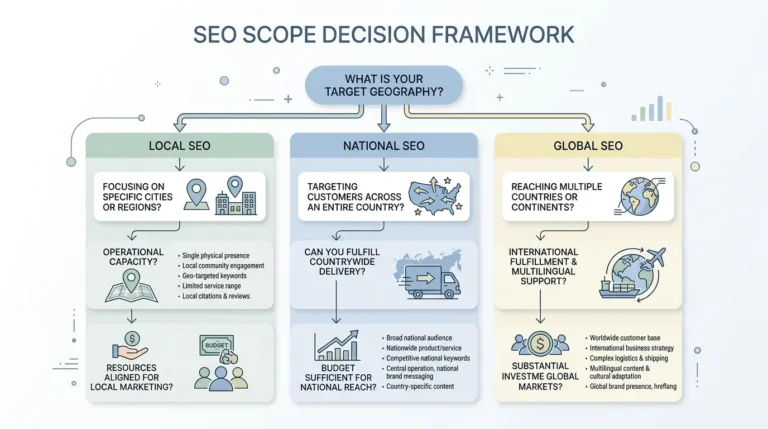
- Local SEO captures immediate intent.
- National SEO captures consideration and research.
- Global SEO spans multiple intents across regions.
- Local strategies cost less and move faster.
- National strategies demand consistency.
- Global strategies demand coordination.
Each model works, each model fails, and fit makes the difference.
How to Choose the Right SEO Strategy
The best SEO strategy starts with restraint. Ask:
- Where do customers realistically come from?
- How far can we actually deliver?
- What resources can we sustain long-term?
Over-scaling SEO before the business is ready rarely pays off.
Blended SEO Models Often Win
Many businesses combine approaches:
- Local SEO for branches with national authority content
- National SEO first, followed by selective international expansion
- Location pages within broader educational hubs
Growth does not require jumping straight to the widest scope.
When SEO Strategy Needs to Change
The best SEO strategy starts with restraint. Ask:
- Where do customers realistically come from?
- How far can we actually deliver?
- What resources can we sustain long-term?
Over-scaling SEO before the business is ready rarely pays off.
Conclusion: SEO Should Follow Reality, Not Hype
The decision between Local SEO vs National SEO vs Global SEO is not about scale for its own sake. It is about alignment.
When the search strategy reflects how a business serves customers, SEO becomes stable, measurable, and valuable. When it doesn’t, even good execution struggles.
Choose the scope that fits today. Build authority there. Expand only when the foundation can support it. That is how SEO turns from guesswork into growth.
At Midland Marketing, we align SEO strategy with how businesses actually work.
Reach out to us for further information.
Frequently Asked Questions
Is local SEO only suitable for small businesses?
No. Large brands use it extensively for regional visibility.
Can local and national SEO work together?
Yes. Many successful strategies combine both.
Is global SEO just translated content?
No. It requires technical and strategic localisation.
Which SEO strategy delivers results fastest?
Local SEO is when demand is location-driven.
When should a business move beyond local SEO?
When growth is limited by geography, not demand.