


Introduction
Your website gets fewer clicks than it did six months ago. Your Google rankings look much the same. So, what has changed?
For some UK businesses, Google’s new AI search features may be part of the answer. People can now get information from AI-generated results without opening a website.
But a drop in clicks does not tell you whether your business is losing customers.
A plumber may get fewer visits but the same number of calls. An online shop may lose traffic and sales at the same time. These are very different problems. First, check what the numbers say about your business.
Table of Contents
How Google AI Mode Can Affect Website Clicks
Google AI Mode lets people ask questions and explore topics through AI-generated answers. It can also show links to sites with more information.
Some users will click these links. Others may get what they need from the answer on the search page.
The effect will vary by business. Someone looking for a simple fact may not need to visit a website. Someone who needs a builder, accountant or solicitor may still want to compare firms before making a choice. This means a drop in clicks does not always tell the full story.
Google explains how these features work in its official guide to AI search features. It also says that the core rules of SEO still apply.
For your business, the first step is to check your own data. Do not assume that every fall in traffic comes from AI search.
1. Find Out Which Pages Have Lost Clicks
Open Google Search Console. Set the date range to the last three months and compare it with the same period last year.
Look at clicks, impressions and click-through rate (CTR).
- Clicks show how many people reached your site from Google.
- Impressions show how often your pages appeared in search results.
- CTR shows the share of impressions that led to clicks.
Now look at the pages with the biggest changes.
Say a Birmingham electrician’s page for emergency repairs used to get 200 clicks a month. It now gets 120. Has the page lost rankings? Are fewer people searching for emergency repairs? Or are more people finding answers on the search results page?
Each cause needs a different response. Do not assume AI search is the cause until you have checked the data.
2. Check Whether Fewer Clicks Mean Fewer Enquiries
A fall in visits can look worrying. But what happens after people reach your site matters just as much.
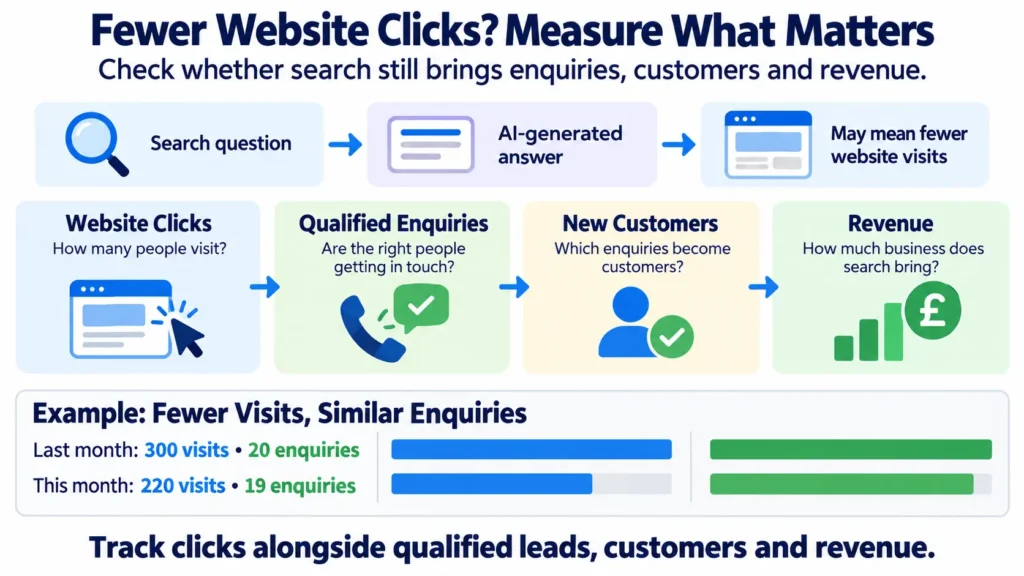
Take a small roofing firm. Last month, 300 people visited its website from Google. Twenty asked for a quote. This month, 220 people visited, but 19 asked for a quote.
Traffic has fallen. Enquiries have barely changed. The firm should still look into the traffic loss. Yet it should not judge its marketing by visits alone.
This is where the Google AI Mode impact on website traffic needs a closer look. Check whether fewer visits have led to fewer calls, quote requests or sales.
Google Analytics 4 (GA4) can track these actions if the right events are set up. A sales record or customer database can show which enquiries became paid jobs.
If you need help improving the pages that bring in customers, see Midland Marketing’s SEO services.
3. Look at Leads, Not Just Form Submissions
Not every enquiry is worth the same amount. A firm may receive 20 contact forms, but only five may come from people who need its services. Another month, it may receive 12 forms, eight of which are good leads.
The smaller number could bring in more work. For this reason, SEO performance measurement should include lead quality.
Ask your sales team to record which enquiries turn into real jobs. For a service business, track calls, quotes and bookings. For an online shop, track orders and sales value. Then compare search traffic with the results that matter.
Check your tracking, too. If a form stops sending data to GA4, your report may show fewer leads even when customers are still getting in touch.
4. Check Your Visibility in Google AI Search
You no longer need to rely only on third-party tools to measure visibility in Google’s AI search features.
Google’s Generative AI performance report in Search Console shows impressions from AI Mode and AI Overviews. It can also show which pages appear, along with data by country and device. The report may not be available for sites with too few impressions.
Check which pages appear in these results. Then compare their visibility with clicks and enquiries.
For example, a service page may gain AI search impressions while its website clicks fall. That is worth noting, but it does not prove that the page has generated more customers. An impression is not a sale. Use this report alongside your other data.
5. Find Out Whether Sales Have Changed
Website visits are easy to count. The value of those visits can be harder to measure.
Imagine two campaigns. The first brings in 20 enquiries and two sales. The second brings in 12 enquiries and six sales.
Which one helped the business more? It depends on each sale’s value and the cost of winning those customers.
This is why the Google AI Mode impact on website traffic should be judged against revenue, too.
Track the measures that fit your business:
- Sales from organic search.
- New customers.
- Qualified leads.
- The share of leads that become customers.
- Revenue from online orders.
For longer sales cycles, link your website data to your customer records. A person may find your business through Google, call a week later and buy a month after that. Without this link, the value of your search work can be easy to miss.
6. Choose the Right Measures for Your Business
The best measures depend on what you sell.
Business type | What to track |
Local trades | Calls, quote requests and booked jobs |
B2B firms | Good leads, sales pipeline and new customers |
Online shops | Orders, revenue and conversion rate |
Accountants and solicitors | Enquiries, meetings and new clients |
Blogs and publishers | Engaged readers and useful actions |
These are practical SEO metrics beyond clicks. They show whether search helps your business reach the right people. Start with a few measures. You do not need a dashboard full of numbers that no one uses.
7. Make a Monthly Check Part of Your Routine
Set aside time each month to review three things.
First, check Google Search Console: Which pages gained or lost clicks? Did impressions change as well?
Next, check GA4: Did people visit key service pages, send forms or make purchases?
Finally, check your sales records: Did the number of good leads or new customers change?
Write down anything that may explain the figures. You may have changed a page, launched an offer or fixed a website problem.
If your reports are hard to read, Midland Marketing’s Analytics & Reporting service may help you understand what the data means. The aim is to find the cause of a change before spending money on a fix.
Should You Stop Tracking Clicks?
No. Clicks still show how many people visit your site from Google.
The mistake is to treat them as the only sign of success. Good SEO performance measurement looks at clicks alongside leads, sales and revenue. If clicks fall, these other figures help you judge how much the change matters.
Do not change your whole SEO plan because of one bad month. Check the trend, find the pages affected and look at the results for your business.
Final Thoughts
A fall in clicks is a reason to investigate, not a reason to panic. Check which pages have changed. Find out whether enquiries and sales have changed too. Use Google’s AI search report as an extra source of data where it is available.
The most useful SEO metrics beyond clicks are the ones that help you decide what to do next. Your website does not need to win every click. It needs to help your business win the right customers.
Frequently Asked Questions
- Does Google AI Mode reduce website clicks?
It can lead to fewer visits for some searches because people may get an answer without opening a website. The effect varies by search and business, so check your own data.
- How can I track my website’s visibility in AI search results?
Use Google Search Console and look for the Generative AI performance report. It shows impressions from AI Mode and AI Overviews when enough data is available.
- What should a small UK business track?
Start with clicks and impressions. Then track calls, quote requests, good leads and sales. Choose the measures that match how your business earns money.
- Can website traffic fall while sales stay steady?
Yes. You may get fewer visits but still receive a similar number of good enquiries. Check sales and lead data before deciding whether the fall is a serious problem.
- Should I change my SEO strategy because of AI search?
Not without checking the cause. Look at your search data, website tracking and sales first. Then make changes based on what you find.

Written by - Lauren Davison
Introducing Lauren – one of our content writers who has a flair for SEO and creative strategy!
With a Master’s Degree in Creative Writing, Lauren has niched down into SEO and content writing.
Outside of work, she loves watching the darts, reading and the pub on the weekend.