


Introduction
You’ve spent years mastering Google’s ranking factors. Links, content quality, Core Web Vitals- you know the playbook. Then generative search arrived, and suddenly, the rules felt unfamiliar. You’re not alone in that.
Here’s the thing about AI search engines like ChatGPT, Gemini, or Perplexity: they don’t rank websites in the traditional sense. They select sources. It’s a subtle but massive shift. Instead of asking “how do I get to position one?” The smarter question is “what makes an AI choose my content as the foundation for its answer?”
That’s what this piece explores. The content selection signals in AI search that matter right now in 2026. Understanding how AI determines authoritative content is no longer optional – it’s the core of generative visibility.
We’ll cut through the speculation. Some signals will feel familiar, like authority still matters, maybe more than ever. Others might surprise you, such as Machine readability, source consensus, and whether other trusted sites mention your research, even without linking. The AI is essentially checking its own homework, and it prefers content that makes that verification easy. These are the trust signals in AI search results that separate cited sources from ignored ones.
This isn’t another “how to optimise for AI” tactical guide. Plenty of those exist. This is about understanding the AI answer source selection criteria first. Because once you know what the machine looks for, the tactics practically write themselves.
Stick around. This matters more than you think.
Table of Contents
Signal Category #1: Source Authority & Entity Recognition
Let’s start with something that might frustrate you. All that effort you put into backlinks? Still matters. But not quite how you think.
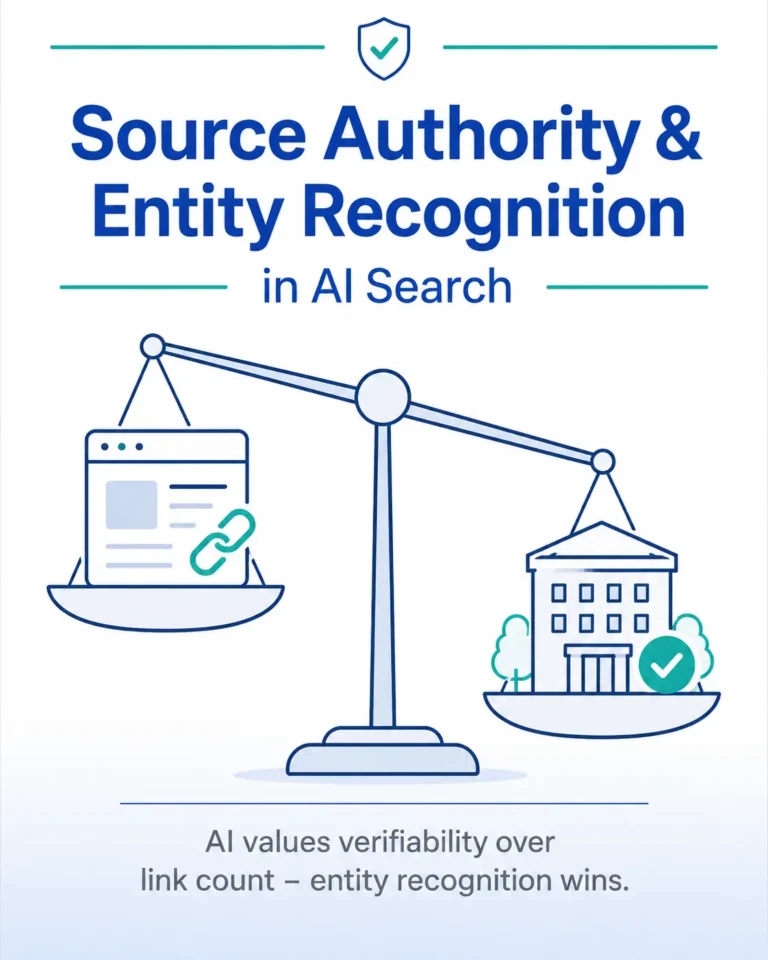
Generative engines approach authority differently. They’re not counting links as Google’s old PageRank algorithm did. Instead, they’re asking a more fundamental question: “Is this source who it claims to be?” This is one of the primary ranking signals in generative search engines: entity verification over raw link volume.
This is where entity recognition becomes critical.
Think of it this way. When ChatGPT or Gemini pulls content about UK employment law, it doesn’t just look for well-written articles. It looks for sources it can verify. Is the content from a recognised legal practice? A .gov.uk domain? A university with established research credentials? If the AI can’t confirm you’re a real, legitimate entity, your content becomes riskier to cite.
Why? Because generative models hate being wrong. Hallucinations damage user trust. So these systems prioritise sources with clear entity signals. These are the document authority signals for AI answers that go beyond traditional backlinks.
What does that look like practically? Your organisation needs to exist in the knowledge graph. Not just your website, your brand as an entity. Consistent NAP (name, address, phone) across the web helps. So does Wikipedia presence, even a modest one. Accredited industry bodies linking to you. Clear authorship on bylined articles.
Here’s the uncomfortable truth: a brilliant blog post from “admin” on a site with no clear ownership will lose every time to a slightly less brilliant post from a named barrister at a recognised chambers. The AI values verifiability over flair.
For UK readers specifically, there’s an advantage here. Domains like .gov.uk, .nhs.uk, and .ac.uk carry implicit authority. The AI knows what these mean. If you operate in regulated industries, such as finance, law, and healthcare, displaying your regulatory credentials prominently isn’t just good compliance. It’s a generative search evaluation factor that boosts your selection probability.
Signal Category #2: Information Freshness & Temporal Relevance
Here’s a question. When was the last time you actually updated that cornerstone blog post from 2022?
Be honest.
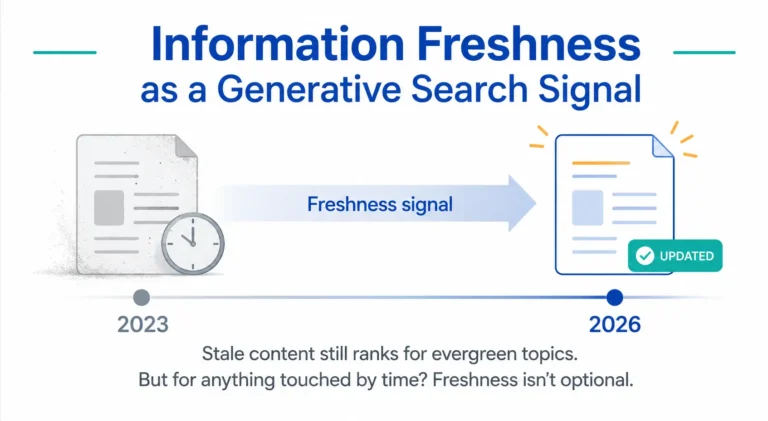
Generative engines notice. Not in a punitive way – there’s no “freshness penalty” like the old days. But for certain queries, recency becomes the dominant signal. The AI asks itself: “Does this answer expire?” This is another key generative search evaluation factor that determines whether your content gets pulled into real-time answers.
Think about searching for “UK interest rates 2025” or “current HMRC self-assessment deadlines.” If your content still mentions Rishi Sunak as Chancellor, the AI spots the disconnect. It moves on. Not because your writing is bad. Because it’s wrong now.
This is what we call temporal query handling. Some questions have a shelf life. News, finance, politics, and product releases demand current sources. Generative models trained on 2023 data can’t help with 2026 queries unless they retrieve fresh content in real time.
But here’s the nuance. Freshness isn’t just about publication dates. It’s about demonstrable upkeep. Clear “last updated” timestamps help. So does evidence of substantive revision not just rewording a paragraph, but also adding new statistics, addressing regulatory changes, and citing recent events. These are all document authority signals for AI answers that show the model your content is alive.
One more thing. Google’s Caffeine indexing system was built for speed. Modern generative retrieval takes that further. If your content regularly refreshes on predictable schedules- weekly roundups, monthly data updates, and annual guides- the AI learns to trust you for time-sensitive queries.
Stale content still ranks for evergreen topics. But for anything touched by time? Freshness isn’t optional.
Signal Category #3: Structural Clarity & Machine Readability
Ever tried explaining something important to someone who keeps interrupting?
That’s how AI engines feel when they encounter poorly structured content. Not angry, exactly. Just… efficient. They move on to something easier to parse.
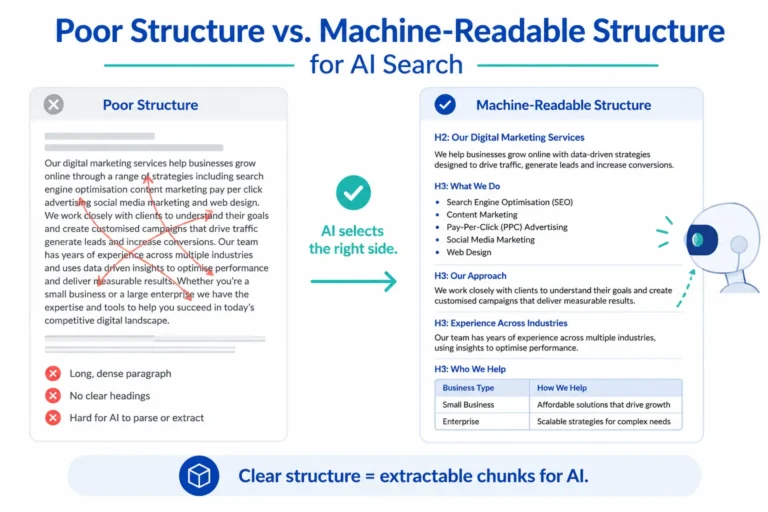
Here’s what I mean. Generative models don’t read like humans. They don’t savour a well-turned phrase or appreciate your clever metaphors. They scan for usable chunks. Information they can extract, attribute, and ground. If your content buries the lede beneath three paragraphs of preamble, the AI might never reach the good part.
This is machine readability. And it’s becoming a quiet differentiator. In fact, among all ranking signals in generative search engines, structural clarity is one of the easiest to fix and most rewarding.
Think about your own content. Do you put the answer first, then the explanation? Or do you build up slowly, saving the conclusion for the end? The old “mystery novel” approach to blog writing, teasing the reader forward, works against you here. Generative engines want the headline upfront.
Headings matter more than ever. Not for keywords but for navigation. Clear H2s and H3s act like signposts. They tell the AI what each chunk contains. When the AI needs a specific type of information, it knows exactly where to look. That’s how AI determines authoritative content at the micro level.
Lists help. Tables help. Short paragraphs with single ideas help. These aren’t just readability tactics for humans anymore. They are retrieval tactics for machines.
One caveat. This doesn’t mean writing robotic, stripped-back prose. Your human audience still needs to stay engaged. The trick is layering. Clear structure on the outside. Rich, valuable content underneath. The AI reads the structure. The human reads the depth. Both get what they need.
Signal Category #4: Citation Frequency & Source Consensus
Remember being a kid and telling your parents something you desperately wanted to be true? “But everyone at school says it!”
Their response probably included a raised eyebrow and the phrase “if everyone jumped off a cliff…”
Here’s the irony. Generative AI kind of falls for that line of reasoning. Not the cliff part. The consensus part.
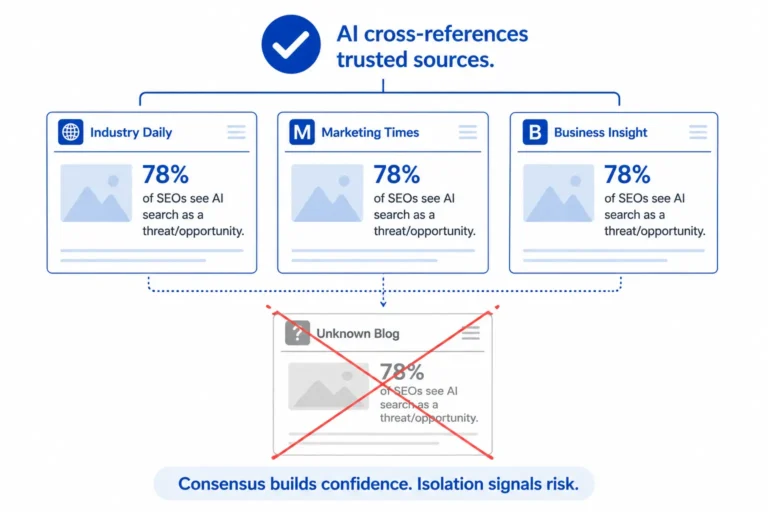
When multiple authoritative sources agree on a fact, the AI breathes easier. It’s found safety in numbers. This is multi-source validation in action. The machine effectively checks its own homework across dozens of trusted domains before committing to an answer. These trust signals in AI search results are built on agreement, not isolation.
Think about how you’d research something important. You don’t stop at one source. You look for patterns. If three respected publications report the same statistic, you trust it more than if one random blog mentions it. Generative engines work the same way.
This creates an interesting dynamic. Your content could be excellent. Flawless, even. But if you are the only one saying it, if your perspective sits outside the established consensus, the AI may treat you as risky. Not wrong. Just… uncorroborated.
What does this mean practically? It means citations matter beyond backlinks. When other trusted sites reference your research, your data, or your methodology, even without linking to them, it builds what we might call citation equity. The AI notices who gets mentioned. This is a core AI answer source selection criteria that many SEOs overlook.
The takeaway? Being right isn’t always enough. Being right alongside others that the AI already trusts? That’s the sweet spot.
Signal Category #5: Brand Salience & Real-World Presence
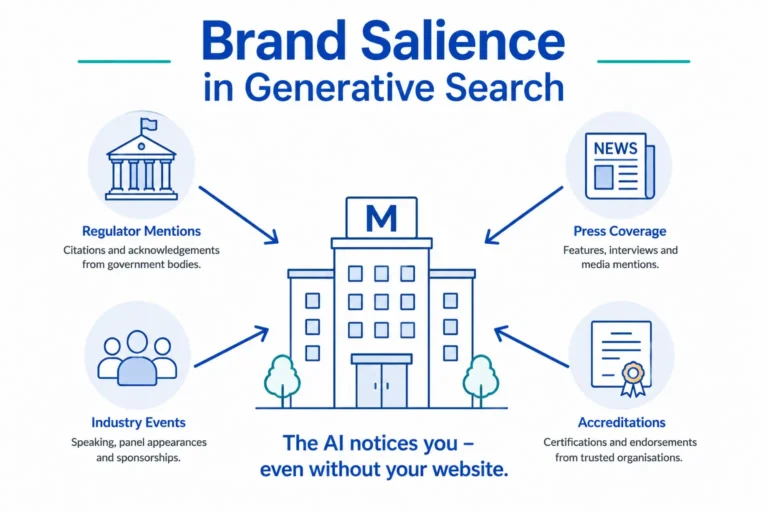
Have you noticed how some brands appear in AI answers even when their own content isn’t directly cited?
Here’s what’s happening. The AI knows about you from elsewhere, such as news coverage, industry reports, regulatory bodies, and professional directories. You exist in the world, and the machine has noticed.
This is brand salience. Not just being visible online, but being present in contexts the AI recognises as trustworthy. It’s one of the more subtle generative search evaluation factors, but it carries enormous weight.
Think about a UK-based financial advisory firm. If they are registered with the FCA, that’s a signal. If they are mentioned in FT articles, that’s another. If their directors speak at industry events covered by trade press, that’s more evidence. The AI doesn’t need to crawl their blog to know they’re legitimate. The provenance markers already exist.
This creates an interesting dynamic for generative search. Your website becomes almost secondary to your reputation. The AI asks: “Does this brand exist in ways I can verify beyond their own claims?” That’s how AI determines authoritative content when on-page signals are ambiguous.
For smaller businesses, this feels unfair. And honestly? It can be. But it also clarifies something important. Generative search rewards reality like real offices, real regulators, real press coverage, and real industry recognition. What makes you trustworthy to humans increasingly makes you selectable to AI.
Conclusion
So, where does this leave you? Hopefully, with a clearer sense of what the machine actually wants.
Five categories emerged through this piece. Source authority tells the AI who you are. Freshness tells you’re current. Structure makes you readable. Consensus validates your claims. Brand presence proves you’re real.
Notice something? None of these are purely technical. They are not hacks you can buy or automate overnight. They are built slowly, earned carefully, and maintained consistently.
That’s the frustration and the relief of generative search. The game hasn’t changed because the rules were rewritten. It’s changed because the rules now resemble what serious content creators have always done. Be authoritative, stay current, write clearly, get cited, and exist in the world.
The tactics will keep evolving. But these content selection signals in AI search? They are not going anywhere.
Frequently Asked Questions
1. Does my website need backlinks to be selected by generative AI?
Not directly. Backlinks help authority, but AI prioritises entity recognition and source trust over link counting.
2. How often should I update content for better AI selection?
For time‑sensitive topics, update at least quarterly. Evergreen content needs less frequent refreshes but clear “last updated” timestamps.
3. What’s the most overlooked signal for AI content selection?
Machine readability. Clear headings, short paragraphs, lists, and answer‑first structure help AI extract your content easily.
4. Can small brands with no Wikipedia page still get mentioned?
Yes, focus on consistent NAP data, industry accreditations, and mentions in trusted local or niche publications.
5. How does brand salience differ from traditional brand awareness?
Brand salience for AI means your name appears in verified contexts (regulators, news), not just audience recall.
6. Is the “source consensus” signal the same as duplicate content?
No, consensus means multiple trusted sources agree on a fact. Duplicate content offers no extra verification value.