


Introduction
Scaling SEO across the UK is not simple. What works in one city often fails nationwide. Many brands chase traffic and forget why people search. They publish guides but neglect sales pages. Or they push commercial terms too hard and lose early-stage users. This imbalance weakens growth.
Balance informational and commercial intent in national keyword strategy means aligning every keyword with the right stage of the journey. It sits at the core of a strong National SEO keyword strategy. The aim is steady traffic, stronger authority, and clear paths to conversion without overlap or wasted effort.
Table of Contents
Search Intent Matters in a National SEO Keyword Strategy
A national campaign reaches people at different stages. Some are learning. Some are comparing. Others are ready to buy. A strong National SEO keyword strategy must reflect that shift in intent. Without it, growth stalls.
Understanding Search Intent Optimisation at Scale
Informational keywords answer questions. Commercial keywords compare options or explore services. Transactional keywords show buying intent.
Intent moves with the customer journey. Early searches sit at the top of the funnel. This is TOFU vs BOFU content in action. A blog guide attracts early interest. A service page targets buyers.
Search intent optimisation means mapping keywords to search intent before creating pages. Each term must match the right format and goal.
The Risk of Ignoring Intent in National Campaigns
Traffic alone means little. Visitors may read and leave, which makes conversions drop. Landing pages can also misalign. An informational query sent to a sales page creates friction.
Worse, poor planning leads to overlap. Multiple pages target the same theme and rankings get to split. Strong keyword cannibalisation prevention avoids this waste and keeps authority focused.
How To Balance Informational And Commercial Intent In National Keyword Strategy
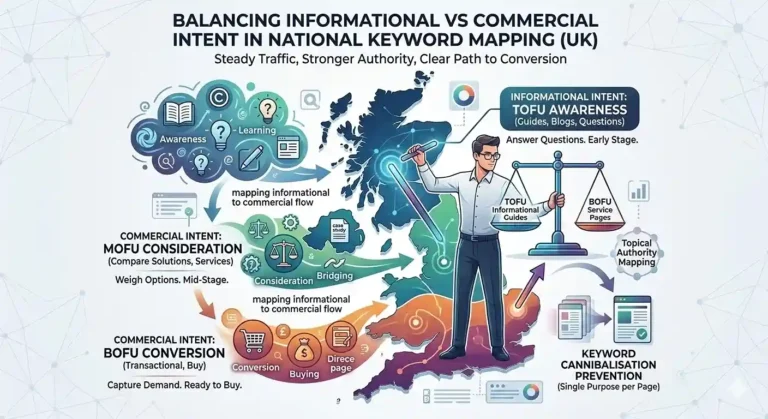
Balancing the informational and commercial intent in national keyword planning is important. What you need is make sure to have structure. A clear map stops guesswork. And it connects traffic with revenue.
Step 1: Mapping Keywords To Search Intent Across The Funnel
Start with the funnel. Some searches seek answers. Others compare options. A few show buying signals. Balancing content marketing funnel stages keeps effort aligned.
Customer journey SEO means matching each query to a stage. Early terms support awareness. Mid-stage pages build trust. Late-stage pages push action. TOFU vs BOFU content must stay distinct. When mapping keywords to search intent, assign one clear purpose per page.
Step 2: Keyword Clustering For Commercial Intent
Keyword clustering for commercial intent groups relates buying terms to one strong page. This avoids thin content. It builds depth.
At the same time, informational support articles link back. This is topical authority mapping. Clusters create strength without overlap.
Step 3: Structuring National Landing Pages Without Cannibalisation
Clear structure prevents confusion as each intent needs its own space. An intent-based URL hierarchy keeps themes separate. Strong keyword cannibalisation prevention protects rankings and keeps signals focused.
Also Read : What Are the Key Components of an Effective National SEO Keyword Strategy?
National SEO Keyword Strategy UK: Funnel-Based Content Distribution
A strong National SEO keyword strategy spreads content across the full funnel. Not every page should sell. Not every page should teach. Growth comes from balancing content marketing funnel stages with care.
TOFU Content For National Visibility
Top-of-funnel content builds reach. Blog posts answer broad questions, and guides go deeper. Industry explainers simplify complex topics.
This stage relies on search intent optimisation for awareness terms. The aim is trust, not pressure. Traffic grows here, and authority forms over time.
MOFU Content That Bridges Informational And Commercial Intent
Mid-funnel content narrows focus. Comparison pages weigh options. Industry solution pages show how services solve real problems. Case studies add proof.
This layer connects research with action. It supports users who are close, but not ready yet. Intent shifts and content must shift, too.
BOFU Content Focused On Conversion
Bottom-of-funnel pages drive results. Service pages target strong buying terms. Location landing pages capture regional demand.
Here, strong commercial keyword clustering matters. Pages must stay clear and direct. When each funnel stage has its role, performance improves across the campaign.
Topical Authority Mapping And Customer Journey SEO
National growth depends on depth. One page cannot carry a full topic. Search engines reward clear coverage as users expect clarity. This is where structure matters.
Building Topical Authority Without Overlapping Intent
Topical authority mapping means planning content around themes, not random keywords. Each theme has a core page. Supporting pages expand on related angles.
Intent-based siloing keeps focus sharp. Informational articles sit in one cluster. Commercial pages sit in another. They connect, but they do not compete.
Structured internal linking ties the cluster together. Guides link to solution pages. Solution pages link back to deeper resources. The flow feels natural. Rankings stay stable because intent stays clear.
Aligning Content With The Real Customer Journey
Customer journey SEO in national campaigns requires empathy. People move from curiosity to action in steps. Content must reflect that path.
Mapping informational to commercial flow helps users progress. A blog builds trust with its content. A comparison page reduces doubt for users, and a service page closes the gap.
Strong conversion paths guide visitors without force. Each stage supports the next. This alignment turns visibility into measurable growth.
Common Mistakes When Trying To Balance Intent In National Keyword Planning
Many brands chase big traffic numbers. It looks good in reports. Yet visits without action bring no return. Over-prioritising traffic often weakens results.
Some teams avoid strong sales pages. They fear being too direct. Under-investing in BOFU content leaves ready buyers with nowhere to go.
Duplicate commercial pages cause another issue. Several URLs target the same intent. Ignoring keyword clustering for commercial intent also hurts structure. Instead of building one strong page, teams create many weak ones. Depth disappears.
Poor keyword cannibalisation prevention makes it worse. Pages compete against each other. Signals blur. Search engines struggle to decide which page matters. Small gaps grow over time. Clear planning prevents them.
A Practical Framework To Balance Intent In National Keyword Campaigns
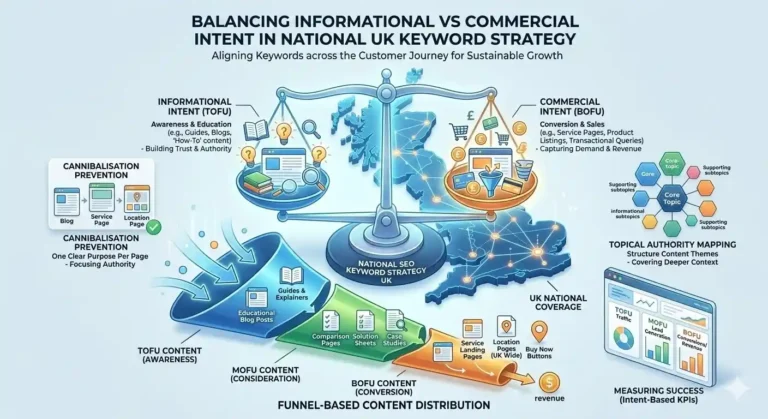
To balance informational and commercial intent in national keyword campaigns, you need a simple system. Clear steps reduce waste and sharpen focus.
- First, conduct intent-based keyword research. Look beyond volume. Study what users expect to see when they search.
- Second, segment terms by TOFU vs BOFU content. Awareness queries need education. Buyer terms need direct answers.
- Third, build keyword clustering for commercial intent. Group related buying phrases into strong, detailed pages. So make sure to avoid thin content.
- Fourth, apply topical authority mapping. Create support content around core themes. Link pages with purpose.
- Finally, monitor conversion-led KPIs. Track leads, sales, and assisted conversions. Traffic alone is not enough.
When these steps work together, balance becomes measurable. Growth follows structure, not chance.
Measuring Success In Search Intent Optimisation
Results must link to revenue. Start with the conversion rate by intent type. Informational pages may assist, and commercial pages should close.
Track assisted conversions, as many users return later. Early content often plays a quiet role in the final sale. Watch funnel progression. See how visitors move from guides to solution pages. Small shifts matter.
Measure organic revenue by keyword cluster. Strong clusters should drive steady income, not just clicks. This data shows whether you are truly balancing the content marketing funnel stages. When intent aligns with outcome, performance becomes predictable and scalable.
Conclusion
National visibility is not built on traffic alone. It comes from structure and clarity. When you balance informational and commercial intent in national keyword planning, results stabilise. Each page serves a purpose. Each search has a path.
A strong National SEO keyword strategy connects learning with buying. It builds trust first, then captures demand. Over time, this creates durable authority.
Conversions improve because users feel understood. Rankings hold because themes stay organised. Sustainable growth follows when intent, content, and revenue work together without friction.
Frequently Asked Questions
What Does It Mean To Balance Informational And Commercial Intent In National Keyword Strategy?
We match each keyword to the right stage of the journey. Some pages educate. Others convert. The goal is steady traffic and steady sales.
How Do I Avoid Keyword Cannibalisation When Mapping Keywords To Search Intent?
We assign one clear intent per page. We group related terms together and avoid creating multiple pages for the same purpose.
What Is The Difference Between TOFU and BOFU Content In National SEO?
TOFU content builds awareness. BOFU content targets ready buyers. We use both, but for different goals.
How Does Keyword Clustering For Commercial Intent Improve Conversions?
We combine similar buying terms into strong pages. This builds depth and trust, which lifts conversion rates.
How Long Does It Take To See Results From A National SEO Keyword Strategy UK?
We usually see movement in three to six months. Strong authority takes longer, but results compound over time.