


Introduction
Search is changing. People can now ask ChatGPT, Gemini or another AI tool a full question and get a direct answer. They may not open several websites first.
AI search for businesses raises a new question: will your business still be found when people search in a new way?
The change is already clear in the UK. The UK Business Data Survey 2026 found that 28% of businesses using AI use it to research information, including as an alternative to search engines such as Google.
This blog looks at what that means for your business. It covers AEO, GEO and SEO, how AI tools find and use business information, why clear answers and strong proof matter, and what you can do to improve your visibility.
You will also learn how to make your website easier for AI tools to understand, how to answer your customers’ questions, and how to build trust through useful content and real evidence. The aim is simple: help your business stay visible as search changes.
Table of Contents
Why AI Search Is Changing The Way Businesses Get Found
From Search Results To Direct Answers
Old search was easy to picture. A person typed a query, scanned results and opened a few sites.
Now, a buyer can ask an AI tool to compare suppliers, explain a service or suggest what to check before buying. The answer may name firms and point to sources.
Your website still matters. It may be seen later in the journey. For AI search for businesses, that change in timing is important.
Customers May Discover A Brand Before Visiting The Website
A person may see your company in an AI answer, then search your name later. They may read reviews, check your site and view case studies before they call.
That is why AI search visibility is not just a traffic issue. It is about being present while a buyer builds a shortlist. Strong visibility gives a brand more chances to enter that shortlist.
Why Growing Businesses Face A Bigger Risk
Large brands often have years of reviews, links and public mentions. A smaller firm can offer better work but have less proof online.
Make the basics easy to find. Say what you do, who you help and where you work. Back up strong claims with real evidence.
What UK Businesses Need To Know About The AI Search Shift
AI Adoption Is Rising Across UK Businesses
The Office for National Statistics reported in July 2026 that AI use among UK businesses with 10 or more employees rose from about 12% in late 2023 to about 35% in June 2026.
It was also found that use was 58% in information and communication, compared with 13% in construction. The latest ONS figures show that adoption is growing, even though the pace differs by sector.

Businesses Are Already Using AI For Research
The 2026 UK Business Data Survey found that researching information was the most common reason businesses gave for using AI, at 28%. For large firms, it was 56%.
This does not mean every customer has left Google. It shows that AI tools are now part of the research mix. That matters when someone is comparing a supplier or service.
Google Is Building More AI Into Search
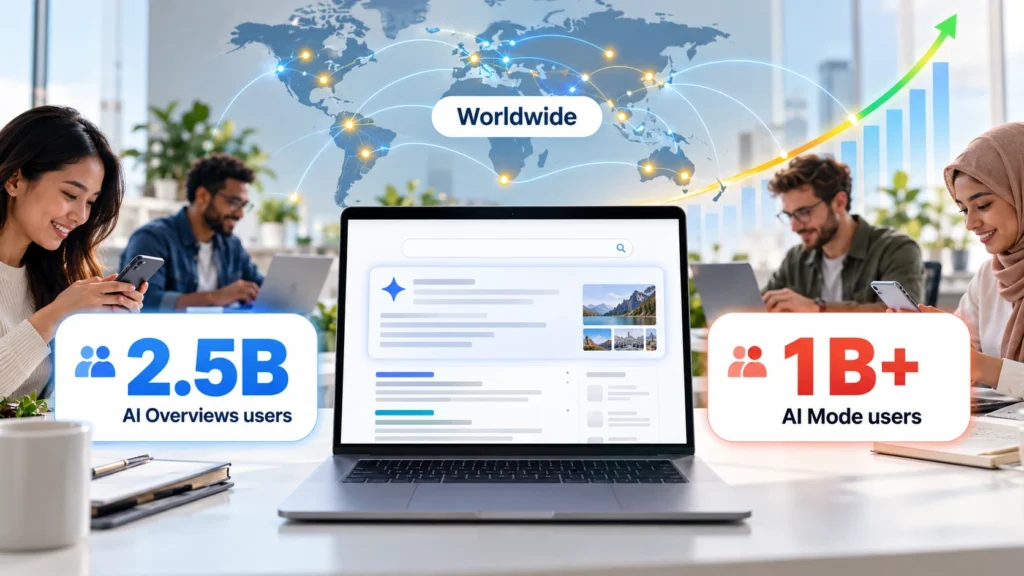
Google said in June 2026 that AI Overviews had more than 2.5 billion monthly active users and AI Mode had passed one billion monthly users worldwide. Google’s Search update reports those figures as part of its wider move into AI-led Search.
Those are global figures, not UK figures. Still, they show how large this change has become.
The Real Risk Is Losing Visibility, Not Losing SEO
A Lower Click Count Does Not Always Mean Lower Influence
A buyer may see your company in an AI answer and search for your name later.
That visit may appear as a branded search. The first AI touch may not show in a normal traffic report.
Watch branded searches, direct visits, leads, sales, and clicks.
The Danger Of Being Missing From The Shortlist
Picture a buyer asking for three trusted suppliers. Two names appear. Your firm does not. Your rankings could still look healthy. But the buyer has already formed a view.
Good AI search visibility means checking the questions that matter to sales and seeing who appears.
Why Established SEO Still Matters
Technical SEO, useful content, clear site structure, trusted links, and search intent still matter. Google says its AI search features use core Search systems and web content.
AI SEO for businesses should build on those basics rather than sit apart from them.
AI SEO for Businesses: What Needs To Change?
Build Clear Topical Authority
One page cannot answer every useful question. Build a group of pages around customer needs.
Cover the main service, common problems, costs, risks, buying questions and related topics. The aim is to better cover the questions buyers ask.
Make Your Brand Easy To Understand
Your site should answer five things fast:
- Who are you?
- What do you offer?
- Who do you help?
- Where do you work?
- What proves your claims?
Keep these facts consistent across your site and trusted profiles.
Create Content That Answers Real Questions
Start with questions your sales team hears every week. Answer each one early. Then add the facts needed to make a choice.
A strong page can explain who needs a service, what the process looks like, what to check and what a good provider should offer.
Strengthen Third-Party Proof
Your website is only one source of trust. Genuine reviews, case studies, trade coverage, partner mentions and awards can add weight when they are relevant.
Match proof to the claim. If you say you cut costs, show the result. If you claim specialist skills, show the work or qualification. That makes AI SEO for businesses more evidence-led.
Generative Engine Optimisation Is Part Of The New Search Mix
Generative engine optimisation helps make a brand easier for AI systems to understand and use as a source.
For AI search for businesses, this can mean clearer topic coverage, sound page structure, strong entity signals, useful answers, structured data and trust signals.
What GEO Actually Means
Think of it as making your online information easier to understand.
State what you do. Explain who you help. Make locations clear. Link related ideas. Support important claims with evidence.
There is no fixed trick that makes ChatGPT, Gemini or another tool mention a company for every query.
The work is about clearer information, not a magic formula.
GEO Works Alongside SEO
SEO helps search engines discover, crawl, index and rank pages. Generative engine optimisation looks at how useful information can also be understood and surfaced in AI-led answers.
Both can use the same base: sound technical health, useful content, clear entities and trusted sources.
AI Search Optimisation: 7 Things Your Business Should Fix Now
1. Check Whether Your Brand Appears In AI Answers
Use AI search optimisation to test real customer questions.
Ask which firms offer your service. Ask what buyers should check. Ask which providers serve your town or sector.
Record the names, sources and facts used in the answer. Repeat the checks later. One test is only a snapshot.
2. Find Gaps In Your Existing Content
Read your key pages as a new buyer would. Can they find the process, price range, risks, time frame and next step?
List the gaps. Turn the useful ones into new sections or pages.
3. Strengthen Entity Signals
Keep your company name, services, locations and key facts consistent.
Check your website, profiles and trusted listings. Fix old addresses, mixed service names and outdated details. Make it easy to link your brand with the work you actually do.
4. Improve Internal Links
Good internal links help people move from one page to another without getting lost.
Link a main service page to a useful guide. From that guide, link to a related case study or a page that helps the reader take the next step.
Keep the links clear and relevant. Do not add links just to fill space.
A simple link path also helps search engines understand how your pages fit together. It can show which topics are closely linked and which pages cover the main subject.
The goal is simple: help readers find the right information with fewer clicks.
5. Add Evidence And First-Hand Expertise
Show what your team has learned from real work.
Use client results, original data, project examples, author details and relevant qualifications. Keep claims tied to facts.
AI search optimisation is not about writing for a machine. It is about making useful information clear and strong enough to trust.
6. Review Structured Data And Technical SEO
Check that key pages can be crawled, indexed and reached. Look at broken links, mobile use, page speed, schema and site structure.
Structured data can help search engines understand page details, but it is not a shortcut to an AI mention.
Keep the technical base clean. Reviewing these points is a practical part of AI search optimisation.
7. Track Visibility Beyond Rankings
Keep rankings, impressions, clicks, leads and sales in your reports. Then add AI checks. Record brand mentions, cited sources, competitor names and errors in your business details. Google now provides reporting for AI Overviews and AI Mode in Search Console.
AI Search and SEO: What Should Your Business Measure?
Do Not Abandon Traditional SEO Metrics
Keep rankings, impressions, clicks, leads and sales. Do not replace them with one AI score. AI search and SEO should be viewed together because they show different parts of the search journey. A useful AI search and SEO plan keeps both in view.
Add AI Visibility Metrics
Pick questions that matter to your sales team. Test them across the AI tools your market may use. Note whether your brand appears, how it is described, which sources are cited and which rivals are named. Save the results and repeat the test after major changes.
Measure Business Outcomes, Not Vanity Metrics
An AI mention sounds good, but it is not a sale. Look at branded searches, direct traffic, qualified leads, conversion rate and revenue. A small number of mentions can still be useful if they bring the right people.
How To Prepare Your Business For The Next 90 Days
Days 1–30: Find Your Visibility Gaps
List ten questions your best prospects ask before they buy. Test them in AI tools. Record who appears and which sources are used.
Review your own pages for weak answers, poor proof, broken links and unclear business facts. Pick the gaps tied closest to sales. This gives you a starting point for AI search visibility.
Days 31–60: Build Stronger Signals
Improve the pages that matter most. Add clear answers, real proof, useful internal links and stronger topic coverage. Fix technical issues that stop pages from being found or used. Keep the work tied to your normal marketing plan.
Days 61–90: Measure And Refine
Run the same questions again. Compare the results with your first test. Check rankings, clicks, branded searches, leads and AI mentions.
Keep changes that help. Rewrite weak pages. Add new content when customer questions or data show a real need.
What Growing UK Businesses Should Do Next
If Your SEO Is Weak
Start with the basics. Fix technical issues. Improve key pages. Make the site easy to use. Answer the questions buyers ask most. Do not spend heavily on new AI tactics while the main site still has clear gaps.
If Your SEO Is Already Strong
Test how your brand appears in AI search. Look at questions where competitors appear. Study the pages and sources that support their mentions.
Then improve gaps in your own content and proof. AI SEO for businesses can extend work that already produces results.
If Competitors Already Appear In AI Answers
Do not copy their wording. Check why their information may be useful. Look at topic coverage, evidence, reviews and public business facts. Then build a stronger answer in your own voice.
If You Are Unsure Where You Stand
Start with a simple review. Check your rankings, content, technical health, brand details and AI mentions.
Then look at how ChatGPT and Perplexity handle questions linked to your industry. Check which businesses they mention, what sources they use and whether the information about your business is correct.
This gives you a clear view of where you stand and what needs work.
Conclusion
AI search for businesses is not a reason to throw away SEO. Some people will keep using Google. Others will ask an AI tool first. Many will use both. The safer plan is to make your website useful in both settings.
Write for real questions. Show what your team knows. Support claims with proof. Keep business facts clear. Check where your brand appears.
You do not need to predict every change in search. For businesses AI search, the goal is simple: build a website that keeps up with your customers.
Frequently Asked Questions
- Is AI search replacing traditional SEO?
No. Google still uses core Search systems while adding AI features. Good SEO helps pages get found, understood and ranked.
- How can a business appear in AI search results?
There is no guaranteed shortcut. Publish useful content, keep business facts clear, show real expertise and maintain strong technical SEO.
- Does GEO replace SEO?
No. GEO works alongside SEO. Both benefit from clear pages, useful information, strong site structure and trusted sources.
- How do I improve my business’s AI visibility?
Test real customer questions. Check which firms appear, which sources are used and whether your company is described correctly. Improve gaps in content, proof and site structure.
- Is AI search important for small and growing UK businesses?
It is worth watching. ONS data shows AI use among UK businesses with 10 or more employees rose from about 12% in late 2023 to about 35% in June 2026.