


Introduction
If you run a small business in the UK and need more qualified leads, you’ve probably had the emails:
“We’ll get you 50 leads a month, guaranteed.”
Some of the agencies sending them are good. Some are selling the same enquiry to four of your competitors. This guide explains how to tell the difference, what a fair price looks like, and the questions that will sort a good agency from a bad one on the first call.
We’ve written it as an agency, so we have an interest. We’ll be open about where that matters. Everything below applies whether or not you ever speak to us.
Table of Contents
1. Decide what kind of help you actually need
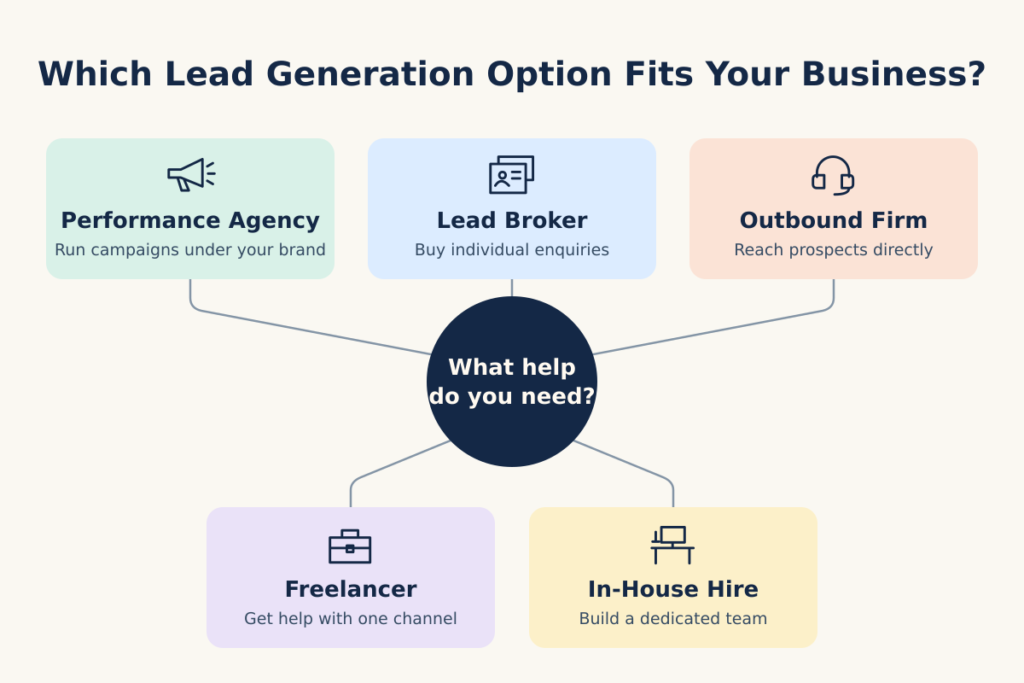
“Lead generation” covers very different businesses. Before comparing agencies, be clear which of these you’re looking for.
Option | What you get | Who owns the leads | Best for | Watch out for |
Performance marketing agency | Campaigns run under your brand: Google Ads, Meta ads, SEO, landing pages | You, exclusively | Most small service businesses | Agencies that report clicks instead of enquiries |
Lead seller / broker | Contact details sold per lead, often from comparison or quote sites | Often shared with competitors | Very high-volume, price-led sectors | Cold, shared or recycled leads |
Outbound / telemarketing firm | Calls, emails and LinkedIn outreach to prospects, booked meetings | You | B2B firms with a clear target list | Compliance with UK marketing rules (section 6) |
Freelancer | One specialist, usually one channel | You | Tight budgets, a single channel | No cover for holidays or illness; gaps between channels |
In-house hire | A full-time marketer | You | Businesses with steady, large budgets | A salary of £30k+ before any ad spend |
For most small businesses that sell a service locally or nationally, the first option is the right one. You get leads that come to you alone, under your own name, and you build up something (ad accounts, reviews, search rankings) that you keep.
2. Work out what a qualified lead is worth to you
Most agencies will quote you a cost per lead. That number on its own tells you very little, because a cheap lead that never buys is expensive. What matters is the cost per qualified lead, and to judge that you need to know what one is worth.
Here’s a quick way to work it out, using a kitchen fitter as an example:
Average job: £6,000
Gross margin: 35%, so £2,100 gross profit per job
Amount you’re happy to spend winning a job: 20% of that, so £420
Out of every 4 genuine enquiries, you win 1 job
So the most you can pay per qualified lead is £420 ÷ 4 = £105
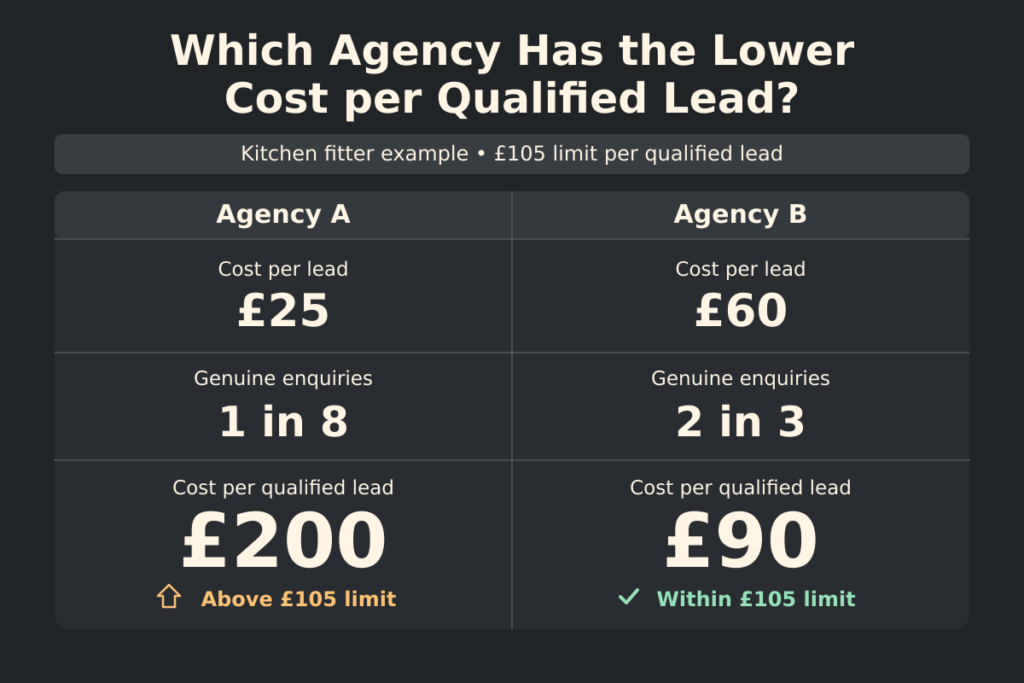
Now compare two agencies spending the same budget:
Agency A | Agency B | |
Cost per lead | £25 | £60 |
Share of leads that are genuine | 1 in 8 | 2 in 3 |
Cost per qualified lead | £200 | £90 |
Within your £105 limit? | No | Yes |
Agency A looks cheaper on its proposal. Agency B makes you money. Any agency worth hiring will help you do this sum before quoting.
3. Agree what "qualified" means, in writing
Ask the agency to write down, before launch, what counts as a qualified lead for you. A typical definition is someone in your service area, asking about something you sell, with a realistic budget or timescale, who gives details you can reach.
Without a written definition, every form fill can be reported as a success, including spam and people looking for jobs.
4. Match the channel to how your customers buy
Google Ads suits services people search for when they need them: plumbers, solicitors, clinics, accountants. Enquiries can start within days.
Facebook and Instagram ads suit services people don’t search for until they see them: event hire, fitness, home improvement. They usually need a few weeks of testing.
SEO is slower (months, not weeks) but keeps working after the ads stop, and it now affects whether AI tools like ChatGPT and Google’s AI Overviews mention you.
A good agency will recommend the channel that fits your customers, not the one it happens to sell.
5. Check they can connect leads to customers
Ask how they’ll show you which leads turned into paying work. At minimum, every call and form should be tracked to the campaign that produced it.
Better still, the agency should connect your CRM, or even a simple spreadsheet, so they can see which enquiries closed and adjust campaigns towards those.
An agency that can only show you clicks and impressions can’t tell whether it’s helping.
6. Know the UK rules you share responsibility for
If an agency contacts people on your behalf, the legal risk is partly yours.
Under the Privacy and Electronic Communications Regulations (PECR), marketing emails and texts to individuals generally need their consent. Marketing calls must be screened against the Telephone Preference Service (TPS) and the Corporate TPS, and you must be able to show where contact data came from.
The Data (Use and Access) Act 2025 raised the maximum PECR fines to UK GDPR levels.
Inbound campaigns (ads and SEO) carry far less of this risk, because the customer comes to you. If you hire an outbound firm, ask to see how they source and screen their data.
The ICO publishes clear guidance for businesses.
7. What a fair price and contract look like
Small-business lead generation in the UK is usually priced as a monthly management fee plus ad spend paid directly to Google or Meta.
Fees vary a lot. Some agencies publish entry packages around £100–£300 a month for one channel, while full-service retainers run into thousands.
Ours start at £99 a month per channel, plus ad spend. Midland Marketing’s lead generation packages have a six-month contract period with a 30-day notice period.
A low fee isn’t a red flag by itself. A low fee with no tracking and no account access is.
Whatever you pay, insist on:
- owning your ad accounts, tracking and landing pages from day one
- ad spend paid by you, directly to the platform
- a clearly stated contract term and notice period before you sign
- monthly reporting on qualified leads and cost per qualified lead
8. Questions to ask on the first call
- How will you define a qualified lead for my business, and will you put that in writing?
- Can you show me results for businesses similar to mine, in leads rather than traffic?
- Are the leads exclusive to me?
- Who owns the ad accounts, tracking and website if we stop working together?
- How will you track which leads become paying customers?
- What would you do in the first 90 days, and what should I expect by the end of it?
- How much should I budget for ad spend versus your fee?
- What happens if leads come in but don’t convert?
9. Red flags
- Guaranteed lead numbers before they’ve looked at your market
- Refusing account access or running ads from their own account
- Vague answers about where leads come from
- Reports full of impressions and clicks but no enquiries or sales
- Long lock-in contracts before you’ve seen a plan
- No case studies in leads, only “traffic up 300%”
10. What good looks like after 90 days
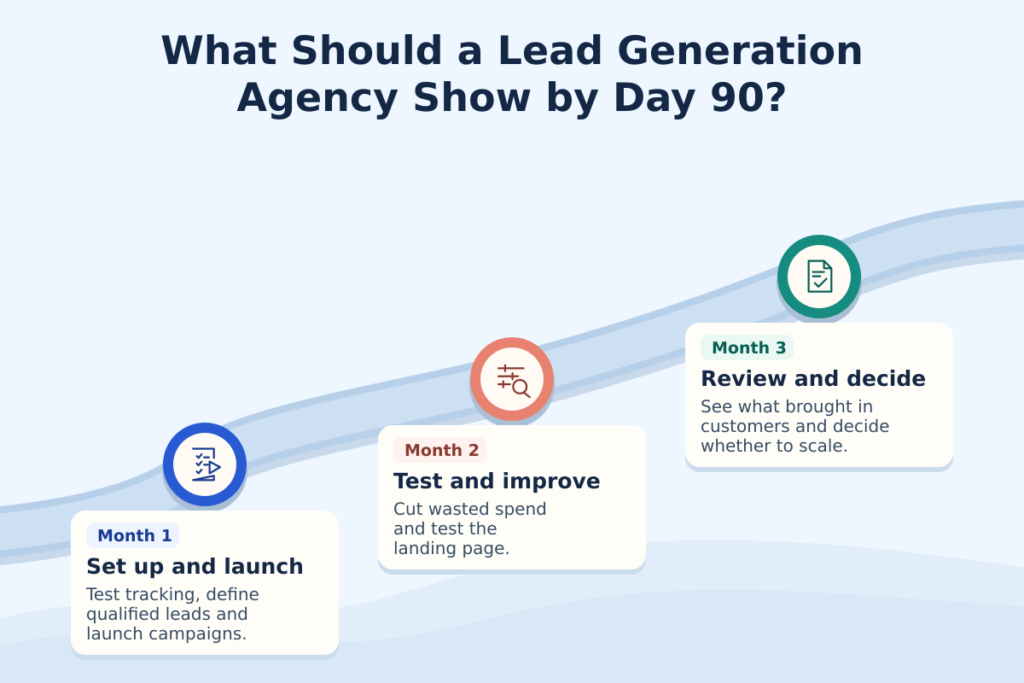
Month 1: tracking set up and tested, qualified-lead definition agreed, campaigns live, first enquiries in.
Month 2: wasted spend cut, landing page tested, cost per qualified lead starting to fall.
Month 3: a clear view of which campaigns produce customers, a stable cost per qualified lead you can compare with your limit, and a plan for whether to scale, add a channel or start SEO.
“A lead is only useful if it has a realistic chance of becoming a customer. We focus on qualified leads – people in the right area, looking for the right service, with genuine intent to buy – because that’s what actually matters to a small business.”
— Kurt Whitlock, Digital Marketing Manager, Midland Marketing
Frequently asked questions
How much should a UK small business spend on lead generation?
Start from what a customer is worth. Work out your maximum cost per qualified lead (section 2), then set an ad budget large enough to test properly, often a few hundred pounds a month for a local service business, plus the agency fee.
Is it better to buy leads or run my own campaigns?
For most small businesses, running your own campaigns through an agency is better. The leads are exclusive, under your brand, and you keep the accounts and data. Bought leads are often shared and harder to convert.
How quickly should a lead generation agency get results?
Google Ads can bring enquiries within days. Meta ads usually take two to four weeks to settle. SEO takes three to six months or more. Judge an agency at 90 days on cost per qualified lead, not on week-one volume.
What’s a good cost per lead in the UK?
It depends on your sector and job value. A plumber and a solicitor will see very different figures.
Compare cost per qualified lead with what a customer is worth to you, not with industry averages.
Should I choose a local agency?
Being local helps if you value meeting in person, but an agency’s grasp of your market and its willingness to prove results matter more than its postcode.