


Introduction
A rebrand is more than a new logo or fresh colours. It starts with a clear plan. A business must know what to keep, what to change and how it wants customers to see its brand.
Specsavers offers a good example. Its The Misheard Version campaign used misheard song lyrics to raise awareness of hearing loss. Singer Rick Astley recorded a version of Never Gonna Give You Up using well-known misheard lyrics. Specsavers shared the song without an early explanation, which sparked interest before revealing the link to hearing care.
WARC reports that the campaign gained 8 million social media views, 400 pieces of media coverage and a 66% rise in hearing-test appointments.
The key lesson is simple: a brand can try something new without losing what people know and trust. A clear rebranding strategy helps a business keep what works and change what no longer fits.
Table of Contents
What Can Specsavers Teach Businesses About Rebranding?
The most useful part of the Specsavers example is the relationship between familiarity and change. People already understand the concept of mishearing lyrics. It is something that happens naturally in everyday life, which meant the campaign did not have to spend its entire creative effort explaining an unfamiliar idea.
Instead, it used that existing familiarity to open a conversation about hearing health.
This is a valuable lesson for businesses because every established brand has its own collection of familiar associations. Customers may remember a particular colour, phrase, product, service, personality or advertising style. They may have developed an expectation about what the company represents without the business ever formally defining it.
Those associations are part of the brand’s equity.
A rebrand should therefore begin by understanding them rather than immediately replacing them. Some will still support the company’s future direction and should be protected. Others may have become outdated or irrelevant and need to change. The strategic challenge is knowing the difference.
This is why rebranding should not be approached as a blank sheet of paper. The business already has a history, customers already have opinions and competitors already occupy positions within the market. The new identity needs to respond to those realities.
Why Recognition Matters During a Rebrand
Brand recognition takes time to build. Customers encounter the same visual and verbal cues repeatedly until those details become connected with a particular business. Over time, that familiarity makes it easier for people to recognise the company and understand what it represents.
Removing those cues without understanding their value can create unnecessary friction.
That does not mean businesses should avoid significant change. If the current identity is holding the business back, keeping everything familiar simply because it is familiar can be equally damaging. The point is to make informed decisions about what deserves to remain.
A useful question is not, “How can we make the brand completely different?” It is, “How can we make the brand more relevant while protecting the recognition that already has value?”
That shift in thinking can completely change the direction of a rebrand.
Why a Rebrand Is About More Than a New Logo
A logo is one of the most visible parts of a brand, but it is only one part. Customers experience a business through its website, advertising, sales conversations, social media, customer service, packaging, products and every other interaction they have with the organisation.
Those experiences shape perception.
A company can have an attractive new logo and still struggle to explain what makes it different. Equally, a business can have an outdated visual identity while maintaining strong positioning, excellent customer relationships and a clear reason for customers to choose it.
The solution in each case will be different.
That is why the process needs to consider the wider commercial picture. Positioning, messaging, tone of voice, visual identity and customer experience need to work together rather than being treated as separate projects.
Midland Marketing’s approach to brand strategy and positioning follows this principle, focusing on defining what a business stands for, who it is trying to reach and where it can compete effectively before the creative work takes over.
The design should make the strategy visible. It should not be expected to create the strategy on its own.
What Should a Business Keep, Change and Remove During a Rebrand?
One of the hardest decisions in rebranding is deciding what happens to the existing identity. Businesses can become so focused on creating something new that they assume everything connected to the old brand needs to disappear.
That is rarely the most strategic approach.
A business may already have valuable recognition in its name, colour palette, tone of voice, customer promise or reputation. If customers associate those elements with quality or trust, removing them without consideration could weaken the brand rather than strengthen it.
The answer is to separate useful brand equity from elements that no longer serve the business.
Some assets should be protected because they still have meaning. Others may need refinement because they are recognisable but outdated. Some elements may need refinement because they are recognisable but outdated.
The objective is not to preserve the past. It is to understand the past well enough to make better decisions about the future.
What Should a Rebrand Keep?
Businesses should consider protecting anything that contributes positively to recognition and customer understanding. That could include a strong reputation, an established name, a distinctive visual element, a successful proposition or a particular aspect of the customer experience.
The age of an asset should not determine whether it survives. Its value should.
For example, an established business may have used the same colour for years. If customers immediately associate that colour with the company, removing it may provide very little strategic benefit. A controlled evolution could be more effective than a complete visual break.
What Should a Rebrand Change?
Other elements may no longer reflect the business accurately. Messaging can become outdated when services expand. Positioning can become unclear as new competitors enter the market. A website may continue presenting the company as it was several years ago even though the business has moved into a different stage of growth.
These are signs that change may be necessary.
The strongest rebrands make those changes for a reason. Every major decision should connect back to the business objective rather than simply being justified because the new version looks more modern.
What Should a Rebrand Remove?
Some parts of a brand can actively create confusion. Unnecessary messaging, outdated claims, inconsistent terminology or visual elements with no clear purpose can make the customer experience harder to understand.
Removing those elements can create space for a clearer proposition.
The goal is therefore not to make a brand look newer. It is to make the business easier to understand, easier to recognise and more relevant to the people it wants to reach.
When Does a Business Actually Need to Rebrand?
Not every business needs a complete rebrand. In some cases, the existing identity remains effective and only needs minor refinement. A more substantial process becomes appropriate when the current brand no longer reflects where the business is going.
Business growth is one common trigger. A company may begin with a small range of services and later expand into new markets or customer groups. If its identity still communicates the old version of the business, customers may struggle to understand the wider offer.
Changes in the target audience can create a similar problem. Messaging designed for one group may not resonate with another. A rebrand can help the business communicate its value more clearly without necessarily abandoning the trust built with existing customers.
Competition can also expose weaknesses in positioning. When several businesses begin making similar claims and using similar language, a company needs a clearer reason for customers to choose it. Rebranding can provide an opportunity to revisit that position and establish a more distinctive place in the market.
Another important trigger is a gap between customer perception and business ambition. If a company wants to be known for expertise, innovation or quality but customers continue to associate it with something else, the problem is not necessarily the logo. It is the position the brand occupies in people’s minds.
An outdated identity can also justify change, but visual age should not be considered in isolation. A design may be old yet highly recognisable and effective. Conversely, a modern-looking identity can still communicate an unclear or unconvincing proposition.
The question should always be whether the brand continues to support the business.
How to Build a Rebrand That Works
A successful rebranding strategy should move logically from understanding the current position to defining the future one.
Midland Marketing’s current rebranding process similarly places clarity and strategic direction before identity development and rollout.
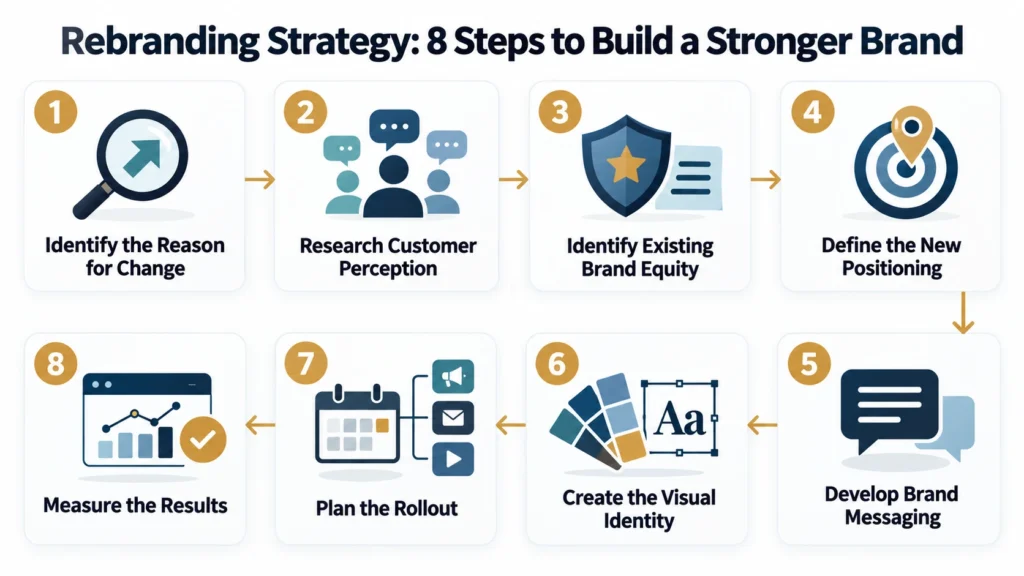
1. Establish Why the Business Needs to Change
Start with the commercial problem rather than the design brief.
Has the business expanded? Has its audience changed? Has the market become more competitive? Is the current proposition unclear? Does the existing identity fail to represent the quality or scope of the business?
The answer needs to be specific. “We want a modern logo” is not a strong strategic reason for a rebrand. “We have expanded into a new market, and our current positioning no longer explains our offer” provides a much stronger foundation.
2. Research Existing Brand Perception
The internal view of a business is not necessarily the same as the customer’s view.
Customer reviews, feedback, sales conversations, website behaviour and market research can reveal what people actually associate with the brand. Competitor analysis can then help establish how those associations compare with the wider market.
This research can uncover useful strengths as well as problems. It may show that customers already value something the business was planning to remove, or that a supposedly strong proposition is not actually understood.
3. Identify Existing Brand Equity
Once customer perception is understood, identify the elements that have genuine value.
These could include the brand name, reputation, messaging, colours, personality, service associations or customer experience. The purpose is not to preserve everything. It is to make deliberate decisions about what deserves to survive.
This is where a rebrand starts becoming strategic rather than cosmetic.
4. Define the New Positioning
The next step is deciding what the business should be known for.
A useful positioning exercise should establish who the brand is for, what problem it solves, why customers should choose it and what differentiates it from alternatives.
Positioning gives the rest of the rebrand direction. Without it, messaging can become inconsistent and visual decisions can become disconnected from the commercial objective.
5. Develop the Brand Messaging
Once the position is clear, turn it into language that customers and internal teams can understand.
The messaging should communicate the value of the business without relying on unnecessary jargon. It should also be consistent enough to work across different channels while remaining flexible enough to suit different audiences and formats.
6. Develop the Visual Identity
Only after the strategy and messaging are established should the visual identity become the main focus.
Logo design, typography, colour, photography and graphic systems should all reinforce the position the business has chosen.
This is where design earns its role. It should help customers recognise the business and understand something about what it stands for.
7. Plan the Rollout
A rebrand needs more than a launch announcement.
Businesses should identify every customer touchpoint that needs to change and plan the transition carefully. Websites, social media profiles, sales presentations, email templates, signage, packaging and printed materials should all move towards the same identity.
A controlled rollout prevents customers from encountering several different versions of the same brand.
8. Measure the Results
The final stage is understanding whether the change has achieved its purpose.
Depending on the business, useful measures might include brand awareness, search visibility, customer enquiries, engagement, conversion rates, retention and sales performance.
The purpose of measurement is not simply to prove that the new identity looks better. It is to establish whether the rebrand has improved the relationship between the business and its audience.
Common Rebranding Strategy Mistakes That Can Weaken a Brand
A rebrand can help a business grow, but poor choices can confuse customers. Avoid these common mistakes:
- Changing everything: Keep the parts of your brand that customers know and trust.
- Starting with design: Set clear goals before changing your logo, colours or style.
- Targeting everyone: Know who your customers are and what they need.
- Copying other brands: Find what makes your business different.
- Ignoring current customers: Think about how changes may affect the people who already trust your brand.
- Forgetting other channels: Update your website, social media, emails, ads and sales materials.
A rebrand needs a clear plan. Keep your message and look consistent so people can spot and trust your brand.
Final Thoughts
A good rebranding strategy needs a clear plan. Businesses need to know what works, what needs to change and what customers value.
Specsavers shows how a familiar idea can help people connect with a brand. Businesses can use the same lesson to share their message in a fresh way.
Midland Marketing can help you plan your next steps. Explore our Rebranding Services to build a brand that fits your business.
You can also explore our Brand Strategy & Positioning service to help define what your brand stands for.
Frequently Asked Questions
- Why is a rebrand important?
A rebrand helps a business show what it stands for. It can help the brand keep up with new goals and meet customer needs.
- What can businesses learn from Specsavers?
Specsavers used misheard song lyrics to talk about hearing health. WARC reports 8 million social views, 400 media stories and a 66% rise in hearing-test appointments.
- Is rebranding the same as changing a logo?
No. A rebrand can change the logo, colours, message, website and the way a business speaks to customers.
- When should a business rebrand?
A business may need a rebrand when its services, goals or customers change. It may also need one if its brand no longer shows what the business offers.
- Can a rebrand harm brand recognition?
Yes. Changing well-known colours, logos, or other features can make a brand harder to spot. Find out what customers know before making big changes.

Written by - Lauren Davison
Introducing Lauren – one of our content writers who has a flair for SEO and creative strategy!
With a Master’s Degree in Creative Writing, Lauren has niched down into SEO and content writing.
Outside of work, she loves watching the darts, reading and the pub on the weekend.