


Introduction
You ask ChatGPT about your business. It gives the wrong address, the wrong services, or a rival’s name. It is a nasty surprise, and it is more common than most owners think.
So why does AI give wrong information about my company? Usually, it is not random. AI builds a picture of your brand from many sources, and when those sources disagree, it guesses. This guide looks at what the UK evidence shows and how to fix it.
Table of Contents
Why Does AI Give Wrong Information About My Company?
If you keep asking “why does AI give wrong information about my company”, the short answer is this: it has to decide who you are before it can say anything about you. If your website, directories and profiles tell different stories, the system fills the gaps itself. That is where wrong details come from.
Think of it as entity resolution. A name is only a label. Before an AI tool can attach a service or a location to it, it must work out which organisation the label points to.
The scale of the problem is large. Rank4AI audited more than 1,400 UK business websites. It found 77% send conflicting signals to AI platforms. Some 62% describe the business differently across the title, H1 and meta description. And 44% have no machine-readable way to identify who they are, such as Organisation schema.
One caveat. Rank4AI is an agency, and this is its own audit, not peer-reviewed research. Even so, the pattern matches what other studies show.
Why Does ChatGPT Give Wrong Information About My Business?
Sometimes the fault is yours. Sometimes it is the model’s. ChatGPT blends what it learned in training with live web results, and either can be out of date or simply wrong.
PAN Communications checked more than 11,000 links that ChatGPT produced for business-executive questions. Only 69% were real and correctly attributed. Another 19% pointed to the wrong source. And 12% were invented. These were B2B prompts, so treat the figures as a guide rather than a UK average.
Answers also drift. In PAN’s later study of 31,500 responses across four AI tools, answers to the same questions changed substantially 50% to 60% of the time over four weeks.
So you cannot fix everything. You can remove the contradictions that give the model a reason to guess. Clear, repeated facts across trusted sites are harder to get wrong.
Why Does AI Confuse My Brand with Another Company?
Names are shared. If another organisation uses a similar name, and its signals are stronger, AI can attach its details to yours.
The best-documented case is TALA, a UK activewear brand. Researchers writing in Search Engine Land ran 14,140 API runs across 12 brands and five AI platforms, using UK geography. The language models placed TALA correctly in athleisure. But Google’s Knowledge Graph described it as a financial services company. TALA appeared in none of the athleisure recommendations tested.
The authors are careful here. Their data shows these things happened together. It does not prove the Knowledge Graph error caused the missing recommendations. Still, the case shows how one wrong, strong signal can sit beside correct ones.
If your name is common, add clear context everywhere. Use the same full trading name, your location and a one-line description. Then link your profiles together so AI can see they belong to one business. Also search your name on Google. If a knowledge panel appears, check that the description matches your real business.
Why Does AI Know My Brand but Not Recommend It?
Knowing a brand and recommending it are separate tests. The TALA study splits them into recognition, categorisation and recommendation. A brand can pass the first two and still fail the third.
Recommendation seems to depend on corroboration. AI tools lean on sources they already rely on. PAN found that 42% of sources cited in week one were still cited by week four. But established names held on far better. The NIH kept 76% of its positions and Deloitte 68%. Reddit kept 21%.
The lesson is not to chase volume. A brand mentioned consistently by a few credible sources is easier to recommend than one that appears everywhere with different descriptions.
Be specific about your category, too. A page that claims you do everything gives AI nothing firm to repeat. Name your main service and the area you cover.
Ask yourself a simple question. If a stranger read your website, your Google Business Profile and your LinkedIn page, would they describe you the same way each time? If not, AI faces the same doubt.
Does Inconsistent NAP Data Affect AI Search Visibility?
Probably, but the evidence is indirect. NAP means name, address and phone number. No controlled study we found isolates NAP as a cause of AI errors. What exists is audit data and long-standing local search practice.
The audit data is consistent with the risk. Rank4AI’s finding on mismatched descriptions shows how common small differences are. And people notice them too. A Storyblok survey of 200 consumers in the US and Europe found 80% said inconsistency reduces trust or raises doubts. Some 73% were less likely to buy. It is a vendor survey with a small sample, so read it as a signal, not proof.
Our view is practical. Fixing NAP costs little and helps customers, Google Business Profile and AI alike. You lose nothing by doing it.
Jason Barnard, who runs the consultancy Kalicube, offers a useful framing in a March 2026 working paper. He argues that AI “trust” is really how cheaply a system can process a brand. Contradictions make that harder. It is not peer-reviewed, but it explains why consistency matters.
How Do I Audit My Brand Information for AI Search?
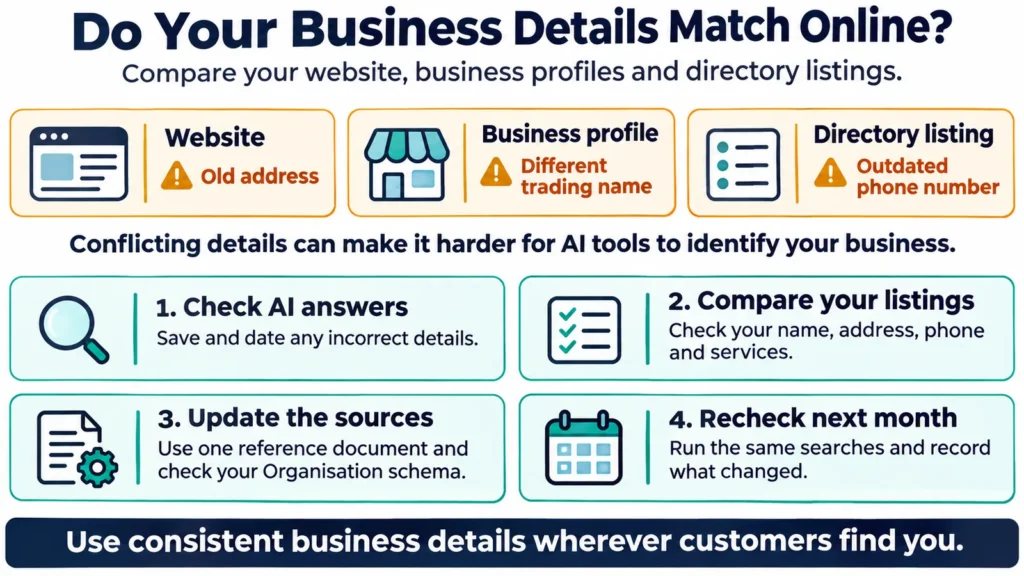
Start with what AI says, then trace each error back to its source. This takes an afternoon and needs no special tools.
- Ask the tools. Search your brand name in ChatGPT, Gemini and Google. Save each answer with the date. Answers change, so you need a record to compare. Note anything wrong or missing.
- Match your name. Compare Companies House, your website footer, Google Business Profile, LinkedIn and directories. Pick one trading name.
- Compare descriptions. Your title tag, H1, meta description and social bios should say the same thing about what you do.
- Check NAP character by character. “Road” and “Rd” are different strings. So are two phone number formats.
- Review your schema. Does Organisation markup show your current name, logo, address and profiles? Is it present at all?
- List old pages. Look for closed offices, old services and outdated team pages. Each is a contradiction.
Keep the results in one spreadsheet. You will need it for the next step.
How to Fix Conflicting Business Information Online for AI
Treat it as governance, not new content. Fix the sources first, then let the signals settle.
- Write one source of truth. A single document with your name, description, category, address, phone number and profiles. Every update starts there.
- Add Organisation schema. Include sameAs links to your official profiles. It is the clearest machine-readable way to say these accounts are one business. Our technical SEO work often starts here.
- Correct third-party listings. Update or remove old directory entries. Ask sites that mention you to fix errors.
- Make your homepage specific. Say what you do, who for, and where, in one clear sentence.
- Re-check each month. Rerun your audit prompts. AI answers move, so one check is not enough.
Go slowly and avoid constant rewrites. Rank4AI notes that frequent, conflicting changes can lower model confidence rather than raise it. For wider tactics, see our guide on how to get cited by AI search.
Conclusion
AI rarely gets your company wrong for no reason. It gets it wrong when your signals disagree, when another brand shadows yours, or when it has too little to go on. You cannot control the model. You can control the clarity of what it reads. Small, boring fixes, such as one trading name and one description, often matter more than any new page.
Start with the audit above, fix the biggest contradictions, and check again next month.
This guide is a free resource from Midland Marketing, a Wolverhampton-based digital marketing agency. If you want help checking how AI describes your business, you can explore our AI search visibility audit.
Frequently Asked Questions
Can I ask ChatGPT to correct what it says about me?
Not directly. You can report errors in the tool, but the lasting fix is to correct the sources it draws on.
How long until AI shows the right information?
No one can promise a date. Models update at different speeds, and answers vary week to week. Keep recording what each tool says.
Do I need schema markup?
It helps AI identify your business, but it does not guarantee a correct answer. It works best alongside consistent copy and listings.
Is this only a problem for small businesses?
No. The Rank4AI audit looked at SMEs, but any brand with mixed signals or a shared name can be misread.
Should I rewrite my whole website?
Rarely. Start with names, descriptions and contact details. Those are quick to change and carry most of the risk.

Written by - Lauren Davison
Introducing Lauren – one of our content writers who has a flair for SEO and creative strategy!
With a Master’s Degree in Creative Writing, Lauren has niched down into SEO and content writing.
Outside of work, she loves watching the darts, reading and the pub on the weekend.