


Introduction
Local service pages need clear service information, genuine local relevance, credible evidence and accessible content. Those elements give search systems the best chance of finding and understanding a page.
Nothing can guarantee selection, though. As of October 2026, Google’s guidance points to foundational SEO and useful content, not special AI-only tricks.
Customers research local services in two ways. Some type a short query into a search engine. Others ask an AI tool a full question and read the summary.
Many service pages fail both readers. They name a service, swap in a town and say little else. This guide shows how to improve content, trust signals and technical access. That is the practical side of local SEO for AI search.
Table of Contents
How Local SEO for AI Search Helps Service Pages Get Discovered
Clear pages help search systems see what you offer, where you work and which questions you can answer. Google’s guide to succeeding in AI search says the basics still apply. Useful content and good technical access come first.
Match local search intent
Think about what the searcher wants. Someone typing “emergency plumber in Dudley” wants to know if you cover their street and how quickly you respond. Repeating “Dudley” ten times answers neither question.
Give every page a clear purpose
Define the service, the audience, the coverage area and the main customer need before you write. Then sum up the page in one sentence. If you can’t, it isn’t ready.
Answer the main question early
Say what you offer, whom you serve and where, near the top of the page. Nobody should have to hunt for it.
Connect the service to a real need
Cover practical concerns such as response times, access requirements and project scope. That makes a page far more useful than a promotional copy.
Key takeaway: Build each page around a real search need and a clear service offering, not around keyword insertion.
How to Improve AI Search Visibility with Clear Answers
Easy-to-read content helps people first. It also helps systems interpret your page. No formatting trick guarantees an AI mention, so write for the reader and keep the page honest.
Lead with a direct answer
Open each section with the answer, then add detail. If a heading asks “Do you cover Walsall?”, the first line should say yes or no.
Turn common questions into headings
Use real customer questions to organise the page. Ask whoever answers your phones what people ask most. Those questions usually beat anything a keyword tool suggests.
Keep essential details easy to scan
Use short paragraphs and descriptive headings. Explain services, coverage, limitations and next steps in a few plain lines each.
Replace vague claims with specifics
“Excellent local service” tells the reader nothing. “We cover Wolverhampton and Walsall, and you can book online or by phone” tells them plenty. Specifics build confidence.
Key takeaway: Direct answers and useful detail help readers, and they help search systems interpret the page’s purpose.
Local Service Page Optimisation: What Every Page Needs
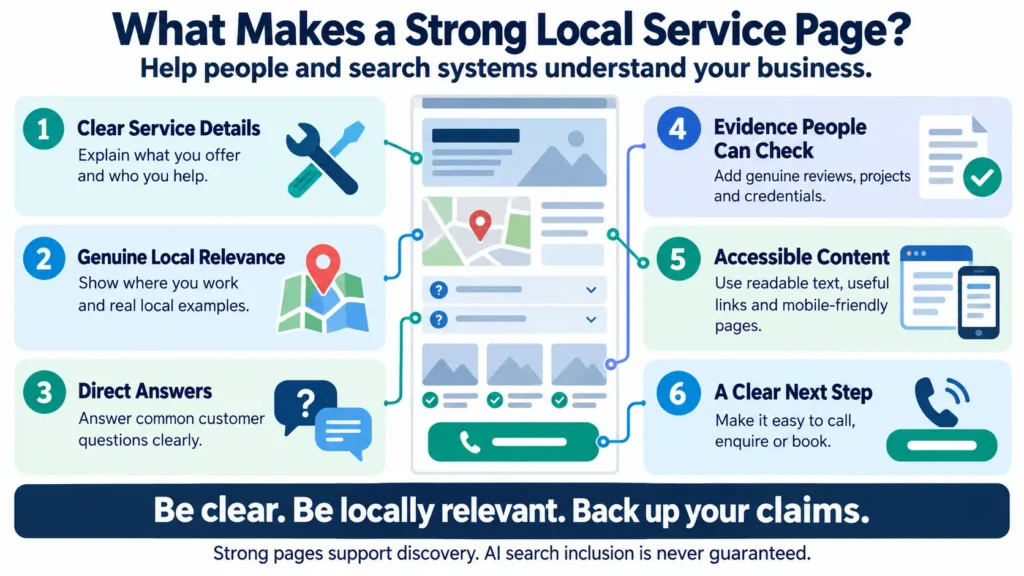
Strong pages share a few core elements. Local service page optimisation is mostly about being specific. Google’s local ranking guidance says results depend on relevance, distance and prominence. Your page should make relevance obvious.
Define the service and coverage area
State the services you offer, the locations you cover and any eligibility rules or boundaries. Mention important limitations. If you don’t offer weekend call-outs, say so.
Build distinct service area pages
Separate pages make sense when each serves a distinct local need. Copying a template and swapping place names does not count. Good location page SEO starts with having something useful to say about that place.
Add meaningful local context
Where you can, include verified project examples, genuine service-area details or practical notes about working in that location. Use only what is true.
Use a quick page-quality check
Compare your pages against this table.
Page element | Weak approach | Stronger approach |
Service description | Broad promotional claims | Clear scope, benefits and limitations |
Local relevance | Town name inserted repeatedly | Verified local context and coverage details |
Customer questions | Questions left unanswered | Direct answers to relevant concerns |
Evidence | Unsupported claims | Genuine examples, reviews or credentials |
Next step | Vague contact prompt | Clear, relevant call to action |
Key takeaway: Each location page should justify its existence. It should answer a specific local need and help the reader decide.
Build Trust with Evidence, Not Promises
A credible page backs up its claims. Anyone can write “trusted experts”. Far fewer businesses can show proof. Good local business SEO treats evidence as part of the content, not an afterthought.
Show verifiable business trust signals
Include relevant qualifications, accreditations, insurance details and genuine customer reviews, where applicable. Keep them accurate and easy to check. A badge with no link to the accrediting body proves very little.
Demonstrate experience through real examples
Use genuine project summaries, case studies or before-and-after evidence. First-hand observations work too. Describe what the job involved and what changed.
Keep business information consistent
Your website should agree with your other authoritative profiles. That covers services, contact details and coverage claims. Google says complete, accurate Google Business Profile information helps it understand a local business. Old phone numbers are the usual culprit.
Explain how the service works
Describe your process, set clear expectations and admit limits. Readers get more from an honest outline than from exaggerated claims.
Key takeaway: Support trust with evidence, consistent details and clear explanations. Never invent testimonials, credentials, local projects or statistics.
Make Every Page Easy to Crawl and Understand
Search engines must access a page before they can interpret it. The Bing Webmaster Guidelines cover crawlability, indexing and content clarity. None of this is a shortcut to AI visibility. It is simply good housekeeping.
Keep important content accessible
Put essential service details in readable page text. Don’t hide them inside images, since that makes them harder to access.
Strengthen internal links and URL structure
Link each location page to the relevant core service page, and back again. Use a logical site structure and readable URLs. Both users and crawlers can then follow related content.
Use structured data where it fits
LocalBusiness structured data can describe your business, but only when it is accurate. The markup must match visible content. It does not guarantee visibility.
Check indexing and mobile usability
Confirm that key pages can be indexed and crawled. Check canonical URLs, mobile usability and navigation. Use Google Search Console to inspect your important URLs.
Key takeaway: Content must be accessible and technically sound. No AI-specific file or schema type is mandatory for AI search.
Measure Results and Improve Pages Over Time
Good measurement focuses on meaningful results. Rankings and AI citations are not promises anyone can make. Bing’s guidelines also stress clear, well-maintained content.
Track visits and qualified enquiries
Use analytics to review organic traffic, contact form submissions and calls. Look at enquiries from the right area, not just visit totals.
Check technical performance regularly
Review indexing, crawl issues, broken links and page changes. Search reporting can flag pages that need a closer look.
Monitor AI search appearances carefully
Record any mentions or citations you can see. Note the date, query and platform. Visibility varies by query and platform, and not every appearance has a straightforward reporting method. Treat your notes as a rough guide.
Refresh pages when facts change
Update coverage areas, published prices, credentials, examples, FAQs and contact details once they go out of date.
Key takeaway: Let data and real customer needs guide updates. Don’t rewrite pages just to chase a perceived AI ranking trick.
Build Local Service Pages That Deserve to Be Found
Strong local service pages combine clear answers, genuine local relevance, verifiable evidence and accessible technical foundations. That is the heart of local SEO for AI search.
Start by making your service and coverage area obvious. Then prove local relevance with useful content and real evidence. Finally, review technical accessibility and performance on a regular schedule.
If you are reviewing your local SEO strategy, Midland Marketing can help. Audit your existing pages. Look for gaps in clarity, local relevance and trust. Then get in touch with our team to talk through the fixes.
Frequently Asked Questions
Do AI search engines use local service pages?
They can. A page may be discovered or referenced when it is relevant, accessible and useful. Inclusion is never guaranteed, and it varies by query and platform.
What should a local service page include?
Include a clear service description, your coverage area and the benefits to customers. Add relevant proof, useful answers to common questions and a clear next step.
Does structured data guarantee AI search visibility?
No. Structured data can help describe a page or business. Eligibility and visibility still depend on broader search systems and many other factors.
Should every town have its own service page?
Only when a separate page serves a distinct local need and offers useful information. Avoid near-identical pages created purely to target place names.
How can I measure AI search visibility?
Monitor search reporting, website traffic, qualified enquiries and any AI citations you observe. Measurement differs across platforms, so expect an incomplete picture.

Written by - Lauren Davison
Introducing Lauren – one of our content writers who has a flair for SEO and creative strategy!
With a Master’s Degree in Creative Writing, Lauren has niched down into SEO and content writing.
Outside of work, she loves watching the darts, reading and the pub on the weekend.