


Introduction
UK retail giants keep display spend under control by being selective about who sees an advert, where it appears and how often it is served. That is the practical role of display advertising UK when campaigns are built around audience relevance rather than volume alone.
A broad audience can create plenty of impressions without creating enough interest. Retailers therefore look at signals that give them more context, such as previous website activity, product interest, browsing behaviour and engagement.
The aim is not to reach everyone. It is to reduce irrelevant impressions and put more of the available budget behind people who have a reasonable connection with the product or category.
That approach brings several campaign decisions together. Audience groups need to be defined properly. Ad creative needs to fit those groups. Exposure needs to be controlled, and campaign data needs to influence where the budget goes next.
Table of Contents
How Display Advertising UK Campaigns Control Wasted Spend
Display advertising UK campaigns control wasted spend by narrowing audience selection, checking placement quality and directing budget towards activity that shows useful results.
Audience Segmentation
Audience segmentation gives retailers a way to separate people according to behaviour or level of interest. A visitor who has viewed several products has provided different information from someone who has never interacted with the website.
Existing customers are another distinct group, with their own purchasing history and potential value. Separating these audiences makes it possible to adjust the advert and budget accordingly.
It also makes campaign data easier to interpret because results are not being blended across very different groups.
Contextual Targeting
Contextual targeting places an advert according to the content or environment in which it appears.
For example, a retailer selling sports equipment may find relevant opportunities around content covering running, fitness or training. The surrounding subject gives the advert a clear connection with what the user is already viewing.
This can make prospecting more relevant without depending entirely on previous interactions with the retailer.
Intent Signals
Intent signals provide clues about how closely a user may be connected to a purchase decision.
A product view, category visit or previous interaction can carry more useful information than a broad demographic characteristic. Search and browsing behaviour can also help advertisers identify stronger signals of interest.
None of these actions guarantees a purchase. They simply provide more context for deciding where advertising spend may be useful.
Budget Allocation
Budget should not remain fixed across every audience and placement when campaign data shows clear differences in performance.
Areas producing useful results can receive more attention. Placements or audiences that repeatedly consume spend without contributing meaningful outcomes can be reviewed.
This makes budget allocation part of ongoing campaign management rather than a one-off decision made before the campaign starts.
How Hyper-Targeted Display Advertising Improves Audience Relevance
Hyper-targeted display advertising makes campaigns more relevant by using specific audience signals instead of treating every potential customer as one broad group.
Retargeting
Retargeting focuses on people who have already interacted with a website, product or category.
That previous interaction gives the advertiser useful context. Someone who viewed a product has already shown a level of interest that a completely new visitor has not.
The follow-up advert can therefore be more closely related to what the person previously considered, rather than introducing an unrelated product or generic brand message.
First-Party Signals
First-party signals come from a brand’s own customer and website interactions.
For retailers, this can include information about products viewed, previous engagement and existing customer activity. These signals can help create audience groups with a clearer connection to the brand.
The benefit is greater context when deciding who should receive particular advertising messages.
Lookalike Audiences
Lookalike audience modelling can help retailers reach new people who share characteristics or behaviours with an existing audience.
This extends targeting beyond people the retailer already knows. It can be useful when a campaign needs to find new prospects while retaining some connection to an established audience.
The resulting audience still needs to be measured. Similar characteristics do not automatically translate into similar buying behaviour.
Creative Relevance
A carefully selected audience can still receive a poor advert if the creative does not reflect its interests.
A previous product interaction, for instance, gives the advertiser a reason to show something more specific than a general brand message. Different audiences may also need different offers, product references or calls to action.
Targeting and creative therefore need to work together. One cannot compensate fully for the other.
What a Retail Display Advertising Strategy Looks Like in Practice
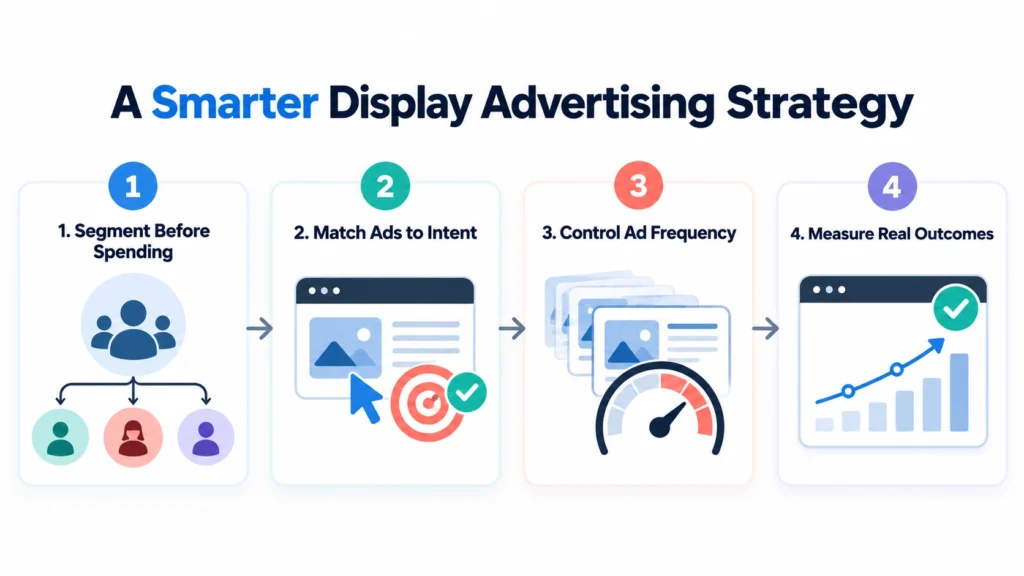
A display advertising strategy should connect audience selection with creative, campaign objectives and measurement. It should also leave room for changes once real performance data starts coming in.
Segment Before Spending
Audience groups should have a clear reason for existing before substantial budget is allocated to them.
If a retailer separates new prospects, returning visitors and existing customers, each group can be assessed on its own terms. That is more useful than combining everyone into one audience and trying to explain the results afterwards.
The segmentation does not need to be complicated. It needs to make a meaningful difference to how the campaign is managed.
Match Ads to Intent
The advert should make sense for the user’s position in the buying journey. A person seeing a brand for the first time may need a different message from someone who has already viewed a product. The landing page should follow the same logic.
When the advert and landing page reflect the user’s likely intent, there is less of a gap between the promise made in the advert and what happens after the click.
Control Ad Frequency
Frequency capping limits how often a user is exposed to the same campaign. Without a sensible limit, an advert can continue appearing to someone who has already seen it several times.
Those additional impressions may have diminishing value. Frequency should therefore be monitored alongside campaign performance. The right level will depend on the audience, campaign objective and buying cycle.
Measure Real Outcomes
Impressions tell a retailer how often an advert was served. They do not, on their own, show whether the campaign generated commercial value.
Conversions, revenue, cost per acquisition and return on ad spend provide a clearer picture where sales are the objective. Engagement can add useful context, but it should not replace outcome-based measurement.
Which Targeting Tactics Help Retailers Spend Smarter?
There is no single targeting method that suits every retail campaign. The right combination depends on the audience, objective and stage of the buying journey.
Targeting tactic | How it works | Budget benefit | Best use |
Audience segmentation | Groups users by defined characteristics or behaviours | Reduces irrelevant reach | Different customer groups |
Contextual targeting | Matches adverts with relevant content | Improves contextual relevance | Prospecting |
Retargeting | Re-engages previous website or product visitors | Focuses spend on warmer audiences | Consideration and conversion |
Frequency capping | Limits how often users see adverts | Reduces repetitive impressions | Always-on campaigns |
First-party audience targeting | Uses a brand’s own customer or engagement data | Improves audience precision | Existing customers and high-value segments |
High-Intent Audiences
High-intent audiences have shown behaviour that gives advertisers a stronger reason to reach them.
A person repeatedly viewing a product or returning to a particular category has provided more useful information than someone with no recorded interaction.
That does not mean every high-intent user will convert. It means the audience can be treated differently when deciding where advertising budget should go.
Product-Level Targeting
Product-level targeting connects the advert with a specific product or category that has already attracted interest.
For a retailer with a large catalogue, this distinction matters. Showing someone a relevant product is more precise than repeatedly serving a generic advert for the entire brand.
Product interest can also inform the creative itself, giving the advert a clearer reason to appear.
Placement Quality
Audience targeting is only one part of the decision. Retailers also need to examine the quality of the placements receiving their budget.
A placement can reach the intended audience and still fail to produce useful results. Reviewing performance at placement level can reveal where spend is generating little return.
Removing weak placements can therefore be just as important as finding new audiences.
Frequency Capping
Frequency capping prevents a campaign from repeatedly serving adverts to the same users beyond a useful level.
This matters particularly for campaigns that remain active for extended periods. A user who has already seen the same advert several times may be less valuable than another relevant user who has not yet been reached.
The purpose is not simply to reduce impressions. It is to avoid spending repeatedly where additional exposure has limited value.
How Targeted Display Advertising Connects Data, Creative and Timing
Targeted display advertising becomes more useful when audience data, creative decisions and campaign timing point in the same direction.
Behavioural Signals
Behavioural signals show how people interact with a website or campaign. Browsing activity, product views and previous engagement can help identify relevant audience groups.
They can also provide clues about which products or messages may be appropriate. These signals should inform campaign decisions rather than being collected without a clear purpose.
Dynamic Creative
Dynamic creative allows elements of an advert to vary according to the audience or product information available.
For retail campaigns, that could mean showing different products or messages to different groups. Someone who has interacted with one category does not necessarily need to see an advert for another.
The variation should have a clear purpose. Adding multiple versions without measuring their effect simply makes the campaign harder to assess.
Buying-Stage Signals
People at different stages of the buying journey have different needs. A new prospect may need an introduction to the brand or product. Someone who has already considered a product may respond better to more specific information.
Recognising that difference allows the message to change with the audience rather than repeating the same advert throughout the journey.
Timing Matters
Timing can affect how relevant an advert feels. Seasonal demand, promotional activity, product launches and changes in customer behaviour can all influence when a particular message makes sense.
A well-targeted audience is not enough if the advert arrives at an unsuitable point. Campaign timing needs to sit alongside audience and creative decisions.
How Display Advertising Campaigns Can Be Optimised Without Increasing Spend
Display advertising campaigns can often be improved by reallocating existing budget rather than simply adding more money.
Cut Weak Placements
Weak placements should be identified through campaign performance and reviewed before more budget is committed to them.
If a placement consistently consumes spend without producing meaningful results, reducing or excluding it can prevent the same problem from continuing.
This is a straightforward optimisation decision: find where the money is going and check whether the result justifies it.
Refine Audience Pools
Audience groups should be reviewed as more campaign data becomes available. Some groups may prove more valuable than expected. Others may be too broad or may fail to generate useful actions.
Refining those groups helps keep the campaign aligned with what the data is actually showing rather than relying on assumptions made at launch.
Test Creative Variations
Testing can show whether a different message, format or call to action produces a better response.
Each test should have a clear purpose. Changing everything at once makes the result difficult to interpret because there is no clear indication of what caused the difference.
Small, focused changes make the findings more useful for the next round of creative.
Shift Budget Gradually
Budget changes should follow evidence rather than happen simply because one result looks promising.
Moving spend gradually towards stronger-performing areas gives advertisers more time to check whether the improvement holds. It also makes it easier to spot when performance changes after an adjustment.
The aim is to improve allocation without creating a new source of wasted spend.
What UK Retailers Can Learn From Hyper-Targeted Display
UK retail giants can control display advertising waste by tightening audience selection, using relevant behavioural signals, matching creative to intent and limiting unnecessary exposure.
Retargeting gives retailers a way to reconnect with people who have already shown interest. Contextual targeting provides another route to relevance by considering the content surrounding an advert. Frequency controls help prevent repeated impressions from consuming budget without enough additional value.
The broader lesson is straightforward: effective display advertising UK campaigns are not built around reach alone. Audience relevance, placement quality, creative and timing all affect whether an impression is worth paying for.
For businesses reviewing their own campaigns, the useful starting point is to look at where budget is going, which audiences are taking meaningful actions and which placements are producing little in return.
Midland Marketing can help businesses review those areas and build a more focused approach to audience targeting, creative testing and campaign optimisation.
Frequently Asked Questions
What is display advertising UK?
Display advertising is online visual advertising aimed at audiences in the UK across websites, apps and digital platforms. Campaigns can use audience, behavioural and contextual signals to decide where adverts are shown.
How does hyper-targeted display advertising reduce wasted budget?
It reduces waste by focusing spend on more relevant audiences and limiting unnecessary exposure. Audience segmentation, behavioural signals, contextual targeting, retargeting and frequency controls can all help narrow where budget is used.
What targeting methods do large retailers use in display advertising?
Large retailers can use audience segmentation, retargeting, contextual targeting, first-party data and audience modelling. These methods help separate audiences according to their previous interactions and likely relevance.
How can businesses improve their display advertising strategy?
Businesses should start by defining useful audience groups and matching creative to user intent. They can then review placements, control frequency, test different creative and adjust budget according to measurable performance.
What should businesses measure in display advertising campaigns?
Businesses should measure outcomes that match the campaign objective. Useful measures can include conversions, revenue, cost per acquisition, return on ad spend and engagement. Impressions show reach, but they do not show commercial performance by themselves.