


Introduction
The biggest financial and insurance advertisers do not win Google Ads simply by spending more. They focus on valuable searches, control acquisition costs and measure what happens after the click.
Google Ads for financial services can be expensive because advertisers compete for searches linked to products with significant commercial value. A single customer or policy can be worth considerably more to a business than the cost of acquiring them.
That makes campaign efficiency critical. A large budget does not fix poor targeting. If irrelevant searches, weak landing pages or low-quality leads consume the budget, increasing spend can simply increase waste.
Large advertisers can justify higher budgets when their campaigns generate enough valuable customers to support the acquisition cost. The important question is therefore not how much a brand spends, but what that spend produces.
For financial businesses, that means looking closely at search intent, bidding, audience signals, conversion tracking and lead quality.
Table of Contents
How Do Google Ads for Financial Services Compete in High-Cost Search Markets?
Financial services PPC campaigns compete by controlling where their budget goes. High CPCs make broad targeting particularly risky, so advertisers need to distinguish valuable searches from clicks that are unlikely to produce a commercial outcome.
High CPCs Change the Economics
A high cost per click leaves less room for error. If an advertiser pays more for each visit, irrelevant traffic becomes expensive very quickly.
This is why financial advertisers need to monitor which searches trigger their ads and whether those visits lead to meaningful actions. Keyword selection, negative keywords and campaign structure all help reduce wasted spend.
The aim is not necessarily to find the cheapest clicks. It is to find clicks that have a reasonable chance of becoming valuable customers.
Intent Matters More Than Traffic
Search intent tells advertisers what a person is trying to achieve. Someone searching for general information about a financial product may not be ready to enquire.
A person searching for a specific product or quote may be much closer to taking action. Campaigns can separate these different types of searches and allocate budget accordingly.
This helps prevent high-value campaigns from being judged simply by traffic volume. More clicks are not automatically better. A smaller number of relevant visits can be more useful if those visitors are more likely to convert.
Segmenting Valuable Audiences
Financial products attract different audiences with different needs. A campaign for a business insurance product, for example, should not be treated in exactly the same way as one targeting consumers researching personal finance.
The keywords, messaging and landing-page experience need to reflect the product being considered. Audience segmentation can add another layer of context.
Advertisers can use relevant audience data to understand how different groups respond and where additional budget may be justified.
Winning Without Chasing Every Click
The goal is not to appear for every possible financial search. Strong campaigns concentrate spending where the commercial opportunity is clearer.
Search terms, conversion data and lead quality can then inform decisions about where to increase or reduce investment.
That approach matters when budgets are large, but it is just as relevant to a smaller advertiser. Spending less does not remove the need for discipline.
What Google Ads Strategies Do the UK’s Top Financial Brands Use?
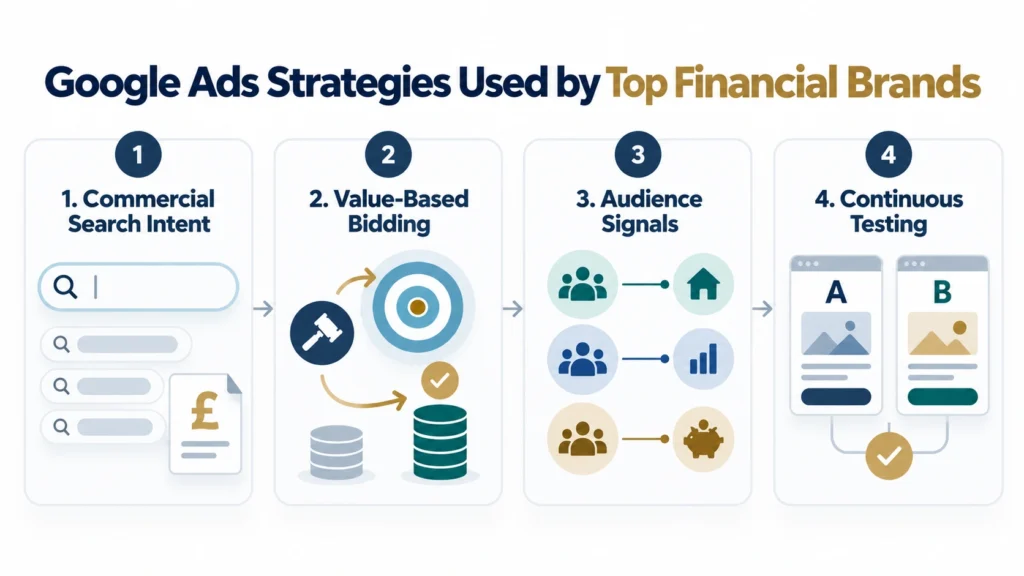
The core strategies behind Google Ads for financial services are built around commercial intent, value-based bidding, audience information and continual testing.
Search Terms With Commercial Intent
Commercially relevant search terms are usually closer to a business outcome than broad informational searches.
Advertisers can examine search terms that generate clicks and conversions, then assess which ones attract the right type of prospect. Product-specific searches often provide clearer intent than broad category terms.
This does not mean every high-intent keyword will perform well. Competition, landing-page relevance and the offer still affect the result. The useful distinction is between buying traffic and buying relevant opportunities.
Bidding Around Business Value
Bidding decisions need to reflect what a conversion is worth to the business. A click is only the start of the customer journey.
If one type of conversion tends to produce more valuable customers than another, that difference should be considered when assessing campaign performance.
Acquisition targets also matter. A campaign can generate plenty of conversions while becoming less commercially attractive if acquisition costs rise too far.
The better question is simple: does the cost of acquiring the customer make sense for the business?
Audience Signals That Add Context
Audience data can help advertisers understand who is responding to their campaigns and how different groups behave.
Remarketing can also bring previous visitors back into the buying journey, where appropriate. Someone who has already visited a relevant product page may need different messaging from someone encountering the brand for the first time.
Audience information should support search and conversion data rather than replace it. A campaign still needs to prove its value through actual results.
Testing That Drives Better Performance
Testing should focus on changes that could affect commercial performance. Advertisers can test different ad messages, calls to action and landing-page experiences.
The purpose is not to make constant changes. It is to identify which version produces a more useful response.
For example, if one landing page generates more enquiries but those enquiries are consistently lower quality, increasing conversion volume alone would give a misleading picture. Good testing therefore looks beyond the first conversion.
How Do Google Ads for Insurance Companies Turn Clicks Into Customers?
Google Ads for insurance companies work best when the search, advert and quote journey all match the customer’s specific need. Insurance is not one single search category.
Someone looking for business insurance has a different reason for searching from someone looking for car, home or specialist cover. Campaign structure needs to reflect those differences.
Matching Ads to Insurance Needs
The advert should make clear why it is relevant to the search. A person searching for a specific type of insurance should not have to work out whether the landing page covers their requirement.
The message should carry through from the keyword to the advert and then to the page. This improves relevance and gives the visitor a clearer next step.
Making Quote Searches Count
Quote-related searches can indicate a stronger intention to take action. That makes the journey after the click particularly important. If someone is ready to request a quote, unnecessary steps can create friction and reduce the chance of completion.
The quote process should make the required action clear. Forms should ask for information that is genuinely needed, rather than creating avoidable barriers.
Lead Quality Over Lead Volume
A cheap lead is not necessarily a valuable lead. An insurance campaign might produce a high number of enquiries while generating relatively few prospects that fit the insurer’s target market.
Looking only at the cost per lead would hide that problem. Lead quality should therefore feed back into campaign decisions. If sales data shows that certain searches produce better prospects, that information can help shape future budget allocation.
Building Trust Before the Click
Financial and insurance searches often involve products that require a degree of trust. Clear advertising helps set expectations before someone visits the website.
The landing page then needs to provide relevant information without making the visitor search for basic details. Clarity matters here. A polished advert cannot compensate for a confusing page or an unclear next step.
Which Finance PPC Strategies Protect Profitability at Scale?
The most important finance PPC strategies protect profitability by measuring the full customer journey rather than treating clicks or leads as the final result.
Track the Cost of Acquisition
Cost per acquisition shows how much advertising spend is required to generate a conversion.
This becomes particularly important when clicks are expensive. A campaign may have a healthy conversion rate but still produce an acquisition cost that does not work commercially.
CPA should therefore be considered alongside the value of the resulting customer. A lower CPA is useful only when the conversions being acquired are genuinely valuable.
Measure What Happens After the Lead
A lead is not necessarily the end of the advertising journey. Financial businesses should, where their systems allow, connect advertising activity with what happens after an enquiry. This can show whether leads become qualified opportunities, applications or customers.
Without that information, an account may appear successful because it generates conversions while the sales team sees little value from them. That gap is easy to miss when PPC reporting stops at the initial form submission.
Optimise for Lead Quality
Lead quality gives advertisers a more useful view of campaign performance. If one keyword generates ten enquiries but another generates five enquiries that are much more commercially relevant, the second keyword may deserve greater attention.
Conversion tracking should capture meaningful actions where possible. Sales information can then help distinguish between a conversion that looks good in an advertising dashboard and one that contributes to business revenue.
Scale What Actually Works
Campaigns should scale when performance data supports additional investment.
Metric | What it shows | Why it matters |
CPC | Cost of each click | Reveals search-market competitiveness |
Conversion rate | Percentage of clicks that convert | Shows landing-page and traffic efficiency |
CPA | Cost to acquire a conversion | Helps control acquisition costs |
Lead quality | Value of generated enquiries | Shows whether conversions have commercial value |
ROAS | Revenue generated against ad spend | Helps assess campaign profitability |
No single metric should determine a budget decision. A low CPC can look attractive while producing poor leads. A high conversion rate can also be misleading if those conversions rarely become customers.
Looking at the metrics together gives a more useful picture. For larger advertisers, this becomes increasingly important because small inefficiencies can become expensive when multiplied across a substantial budget.
How Do Landing Pages Support High-Value Financial Advertising?
Landing pages support high-value financial advertising by continuing the same message and intent that brought the visitor to the site. A strong advert can attract the right person, but the landing page still has to make the next action clear.
Continue the Search Journey
The landing page should match the search and advert that led the visitor there. If someone searches for a specific financial product and clicks an advert about that product, sending them to a generic homepage creates unnecessary work.
Relevant page content helps visitors understand that they have reached the right place. It also gives advertisers a clearer way to measure the performance of individual campaigns.
Remove Unnecessary Friction
Financial forms do not need to be complicated simply because the product is complex. The page should make the next action obvious.
Forms should avoid unnecessary questions, while important information should remain accessible to visitors who need more detail before enquiring.
Small points can make a difference here. If the visitor cannot quickly work out what happens after submitting a form, the page has created uncertainty at the point where clarity matters most.
Give Visitors Reasons to Trust You
Trust needs to be supported by clear information. Financial customers may want to understand the product, the service and what happens next before they submit their details.
Important information should therefore be easy to find rather than buried beneath sales-focused copy. The landing page should answer the questions that are most likely to prevent someone from taking the next step.
Connect Landing Pages to Conversion Data
Landing-page performance should be assessed alongside campaign performance. If traffic increases but conversions fall, the problem may not be the advertising itself. The page, offer or conversion journey could be creating the issue.
Conversion tracking helps identify where performance changes. Advertisers can then test the relevant part of the journey instead of changing the entire campaign without knowing what went wrong.
What Can Smaller Financial Brands Learn From Multi-Million Pound Campaigns?
Smaller financial brands do not need million-pound budgets to apply the principles used by large advertisers. The key is to be selective about where the available budget goes.
Bigger Budgets Are Not the Whole Strategy
Large advertisers have more room to test and scale campaigns, but money alone does not create efficiency.
A smaller business can still focus tightly on its most valuable products and searches. In some cases, that narrower focus makes it easier to see which parts of the account are producing useful results. Efficiency should come before expansion.
Start With Your Most Valuable Searches
Limited budgets should not be spread across every possible keyword. Start with searches that closely match the products or services the business wants to sell.
Review the search terms regularly and remove traffic that does not fit the target customer. This keeps the budget focused on relevant opportunities rather than simply increasing the number of clicks.
Build Around Measurable Outcomes
Choose conversions that reflect genuine business value. Depending on the business, that could include an enquiry, application, phone call or another meaningful action. The important point is to avoid treating every interaction as equally valuable.
Where possible, connect PPC data with sales outcomes. That gives the business a clearer view of whether advertising is contributing to revenue.
Scale Only When the Numbers Support It
More traffic is not enough reason to increase spending. Budget increases should follow evidence that the campaign is producing acceptable results and that additional demand can be handled profitably.
A campaign that produces more conversions at a much higher acquisition cost may need further optimisation before receiving a larger budget.
Conclusion
The biggest lesson from large financial advertising campaigns is that budget size is only one part of PPC performance. Google Ads for financial services works best when spending is guided by search intent, lead quality and measurable commercial outcomes.
Successful financial advertisers connect search intent with relevant targeting, sensible bidding and a clear landing-page journey. They also measure what happens after the click, because lead volume alone does not show whether a campaign is commercially successful.
For smaller financial and insurance businesses, the same principle applies. Focus on valuable searches first, monitor lead quality and scale only when the numbers support it.
Midland Marketing can help businesses build PPC campaigns around measurable commercial outcomes, with clear reporting and a focus on what the advertising is actually delivering.
Frequently Asked Questions
Why are Google Ads for financial services so expensive?
Google Ads can cost more in financial services because many businesses compete for the same searches. The cost of each click can also change based on the product, keyword and level of competition. There is no fixed CPC for the whole sector.
How much do financial services companies spend on Google Ads?
There is no set Google Ads budget for financial services companies. The right budget depends on the product, target market, competition and business size. It should also reflect what the business can afford to spend to win a new customer.
What makes Google Ads effective for insurance companies?
Good insurance campaigns focus on searches that show a clear need. The advert should match the search and lead to a relevant page. A simple quote process can also help turn more visits into enquiries. Conversion tracking shows which searches bring useful leads.
How can financial companies reduce Google Ads costs?
Start by cutting wasted clicks. Review search terms, remove keywords that bring poor traffic and use negative keywords where needed. Landing pages should also match the advert and make the next step clear. The aim is not just to spend less, but to get more value from the budget.
What should financial businesses measure in Google Ads?
Financial businesses should track more than clicks. Key measures include CPC, conversion rate, CPA and lead quality. Where the data is available, revenue and customer value should also be tracked. This gives a clearer view of whether the campaign is bringing useful business.
Can smaller financial businesses compete with large advertisers?
Yes, smaller businesses can still use paid search without matching the budgets of large brands. The key is to focus spend on searches that closely match their services. Tracking lead quality can then show which searches are worth more of the budget.