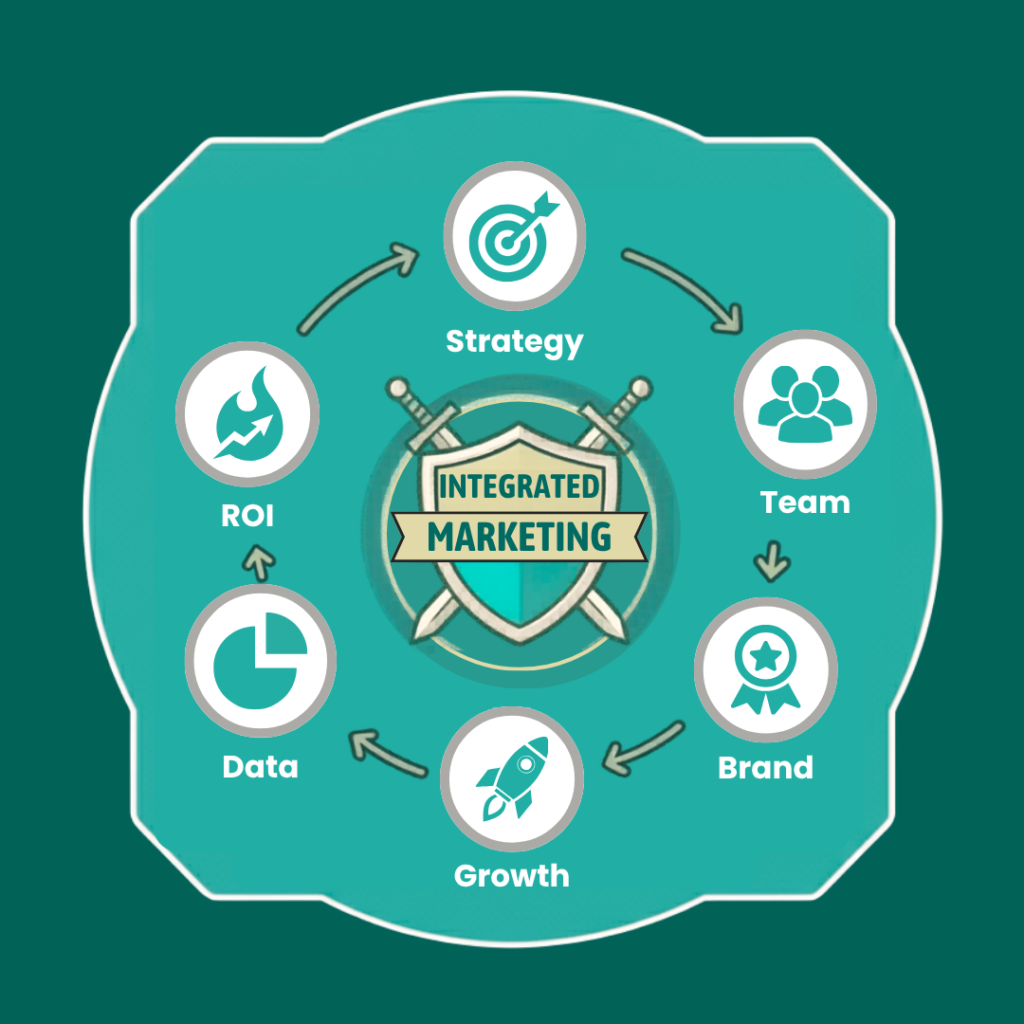


Introduction
Does your Monday morning start with three agency update calls before you’ve even opened your actual to-do list? For a lot of UK small and medium-sized business owners, that scenario stopped being a joke somewhere around 2024.
By 2026, patience with fragmented marketing has worn thin. The shift towards single all-in-one marketing solutions is not a trend. It’s a quiet rebellion against wasted time, muddled messaging, and budgets that bleed from a dozen different retainers.
What started as a convenience is now being treated as a genuine business growth strategy, and the numbers back it up.
This piece walks through why holding together a patchwork of separate agencies no longer makes sense, what genuinely integrated marketing services look like in practice, and how a consolidated approach can protect the brand you’ve worked so hard to build.
Table of Contents
Why fragmented marketing no longer works for growing businesses
Too Many Meetings, Too Little Progress
It starts innocently. A PPC agency here, a social media specialist there, an SEO consultant you found through a recommendation. Before long, the calendar fills with status calls that all begin the same way: ‘Just to recap where we left off last week…’
That weekly sync with three different teams eats into the time you should be spending on operations, product development, or actually speaking to customers.
And honestly, who’s got the patience for that? (You know the sort — the meeting that could have been an email, then becomes a thread of seventeen emails anyway.) The admin burden alone can quietly throttle a growing business.
Campaigns get delayed because one agency’s deliverable depends on another’s data, and nobody seems to own the timeline. When deadlines slip, momentum does too.
Mixed Messages Hurt Your Brand
Different agencies work from different playbooks. One team pushes a quirky, informal tone on Instagram while another runs LinkedIn ads that sound like a corporate annual report.
Neither side is necessarily wrong — they simply operate inside their own bubble. The result? Brand consistency erodes. Customers notice, even if they can’t articulate it.
They experience a business that feels slightly different depending on where they land, and that flicker of inconsistency chips away at trust. A unified voice doesn’t happen by accident. When multiple suppliers chase separate KPIs, the customer journey fractures.
One agency might be optimising for clicks whilst another prioritises engagement, and neither is looking at the full picture. Broadly speaking, the brand suffers most in the spaces between those handoffs.
Costs Add Up Faster Than Expected
Retainers are easy to count. The hidden costs are not. There’s the time senior managers spend coordinating activity across suppliers, the duplicated reporting tools nobody thought to consolidate, and the occasions when two agencies accidentally bid against each other on the same keyword.
None of that shows up on a single invoice, but it all lands on the P&L eventually. Then there’s the awkward reality: when you pay three separate retainers, you’re often paying for three sets of account management overhead.
An all-in-one marketing solution rolls that into one relationship, which tends to leave more budget for actual campaign delivery. It’s one of those things that feels counterintuitive until you see the numbers side by side.
How integrated marketing services simplify business growth
One Strategy, Every Channel
Imagine every channel briefed from the same plan. SEO, PPC, social, content, and web design all pulling towards the same commercial goal, not competing for credit. That’s the core difference integrated marketing services bring.
Instead of patching together five separate strategies and hoping they align, a single team builds one roadmap and adjusts it in real time. Business objectives stay central because nobody is siloed.
The social media manager knows what the paid search team is testing, and the content writer understands which landing pages need support. That alignment is hard to replicate across multiple agencies — at least in most cases, because each one naturally prioritises its own scope of work.
Better Decisions Through Shared Data
When reporting lives in different dashboards, insight gets trapped. You might see that organic traffic rose last month, but you won’t necessarily know that paid social engagement dropped over the same period unless someone manually pieces it together.
Most SMBs don’t have a dedicated data analyst sitting idle. So the connection simply gets missed. Unified reporting changes that. A single view of performance across every channel makes it easier to spot what’s actually driving marketing ROI and what’s just making noise.
Budget shifts happen faster, testing cycles shorten, and the whole operation becomes more responsive. There’s genuine commercial power in knowing, on a Thursday afternoon, that reallocating spend from one channel to another will likely lift conversions by the weekend.
More Time to Focus on Your Business
This is the benefit owners feel most immediately. Less diary Tetris. Fewer emails chasing updates from three different account managers. Instead of playing intermediary between agencies that never speak to each other, leadership teams get back to running the company.
The operational difference is tangible. When marketing becomes a single relationship rather than a coordination exercise, the mental load drops. Founders and directors rediscover headspace for product, service delivery, and customer experience — areas where their attention genuinely moves the needle.
What to expect from a full-service marketing agency
Every Specialist Working Together
The term full-service marketing agency sometimes gets thrown around loosely, but the real thing has a distinct feel. Designers, SEO specialists, PPC experts, developers, and content writers sit on the same team. They brief together, troubleshoot together, and share wins together. That proximity changes the work.
A developer flags a page speed issue that the SEO lead was about to raise anyway. A content writer picks up a customer objection from the PPC team’s ad copy tests and works it into a blog post before the week is out.
It’s not about having every skill under one roof just for the sake of it. It’s about the speed and quality of collaboration that comes from people who are genuinely aligned. When specialists trust each other’s judgement, campaigns move from idea to execution with far less friction.
Accountability Becomes Clear
Perhaps the biggest shift when you consolidate agencies is that responsibility has nowhere to hide. Performance dips. Who do you call? There’s one partner, one conversation, one action plan.
That might sound simple, but for businesses used to navigating the polite finger-pointing that happens between separate suppliers, it’s a revelation. A single point of contact — backed by an entire integrated team — means problems surface faster and get resolved without the usual diplomacy.
Clear accountability also changes the tone of the relationship. It becomes less about managing suppliers and more about building a partnership where honest conversations about what’s working (and what isn’t) can happen without contractual awkwardness.
Easier Scaling Without Starting Again
Growth creates complexity. You add a new product line, expand into a different region of the UK, or decide to test a channel you’ve never used before. With a fragmented setup, each move often means scoping, onboarding, and aligning yet another agency.
An integrated team simply pulls the new requirement into the existing plan. The learning curve doesn’t reset. That scalability matters enormously for ambitious SMBs.
Having an outsourced marketing team that already understands the brand’s history, audience, and commercial goals makes expansion feel less like a gamble and more like a natural next step.
Signs your outsourced marketing team is holding you back
Campaigns Feel Disconnected
You might not spot it immediately. But over time, a pattern emerges. The email campaign promotes an offer the social team hasn’t mentioned. The landing page the PPC ads point to uses messaging the brand team moved away from six months ago.
Nothing is technically broken, yet nothing quite hangs together. That disconnected feeling is often the first signal that an outsourced marketing team — spread across multiple agencies — lacks the connective tissue of a unified strategy.
When campaigns feel like separate islands, customers notice the inconsistency. They might not complain. They simply click away. And each micro-friction point becomes a conversion that never happened.
Nobody Owns the Results
Performance reviews become exercises in attribution gymnastics. The SEO agency points to ranking improvements. The paid media agency highlights click-through rates. The content team talks about engagement metrics.
Yet the lead volume stayed flat. Nobody steps forward and says, ‘That’s on us — here’s what we’re changing.’ That absence of ownership is corrosive. It erodes trust and wastes months chasing explanations rather than improvements.
Businesses often tolerate this dynamic because they assume it’s just how agency relationships work. It isn’t. A healthy partnership has clear, shared accountability written into its daily rhythm, not buried in a quarterly review deck.
Growth Has Started to Plateau
This is the quietest warning sign, and arguably the most dangerous. Marketing activity increases. Budgets grow. The output looks busy. But the pipeline doesn’t expand. Enquiries stay flat.
When that plateau arrives, many business owners double down on the same fragmented structure, hoping more spend will break the ceiling. In reality, the ceiling is often created by the structure itself — duplicated effort, delayed optimisation, and a fundamental lack of joined-up thinking.
Why more UK SMBs are choosing one marketing partner in 2026
Better Marketing ROI With One Strategy
Scattered budgets produce scattered returns. A single strategy, executed by one team, eliminates the duplicated work that quietly inflates costs. There’s no overlap in audience targeting, no competing keyword bidding, no redundant reporting tools.
The efficiency gain is immediate, but the real impact shows up over time. Marketing ROI compounds when every channel feeds into a shared learning loop — insights from paid social inform organic content, which shapes email sequences, which influence retargeting audiences.
Business owners who’ve made the switch often talk about the relief of seeing a complete picture. Not five separate reports each telling a slightly different story. One view, one truth, one set of decisions.
Comparison Table — Fragmented Agencies vs All-in-One Marketing
Area | Fragmented Agencies | All-in-One Marketing Solutions |
Contact points | Multiple contacts, each with different priorities | Single point of contact who coordinates the full team |
Strategy | Separate strategies built in isolation | Unified strategy across every channel |
Reporting | Individual, disconnected reports | Combined, cross-channel reporting |
Communication speed | Slower, reliant on inter-agency handoffs | Faster collaboration within one team |
Management time | High — requires constant coordination | Simplified — one relationship to manage |
Brand identity | Inconsistent branding, mixed messages | Consistent brand identity across all touchpoints |
Budgeting | Separate budgets, difficult to track holistically | Centralised budgeting with full visibility |
Accountability | Difficult to pinpoint responsibility for results | One accountable partner, clear ownership |
Future-Proofing Your Marketing Strategy
The move towards integrated marketing isn’t a fad that will reverse. As customer expectations rise and attention spans fragment further, the brands that thrive will be the ones whose messaging feels coherent wherever it’s encountered.
Marketing solutions for small businesses have had to mature quickly in response. Cookie-cutter packages no longer cut it; what’s needed is a considered, joined-up approach that evolves alongside the business.
Building a resilient marketing function means choosing structures that can adapt without collapsing into chaos. Consolidation offers that. It removes the fragility that comes from relying on multiple independent suppliers who may or may not stay aligned as priorities shift. In a landscape where agility counts, simplicity is an asset.
Conclusion – Build Smarter Growth With Midland Marketing
UK small and medium-sized businesses are making a clear call in 2026. The experiment with juggling three, four, or five separate agencies has run its course. Too much time lost. Too many messages diluted.
Too many budgets leaking through the cracks. The all-in-one marketing solutions model is not just a convenience — it’s quickly becoming the smarter commercial choice for organisations that want marketing to feel like an investment, not an overhead.
At Midland Marketing, that’s exactly how the team operates. Every specialist — from SEO and paid media to content, design, and development — works under one roof, with one shared understanding of what your business needs to achieve.
If you’ve been managing marketing solutions for small businesses as a collection of separate contracts, now is the moment to review whether that structure is still serving you or quietly slowing you down.
A conversation about your goals costs nothing. What you learn might reshape the entire trajectory of your growth. Get in touch and let’s talk.
Frequently Asked Questions
What are all-in-one marketing solutions?
It’s a service model where a single agency provides every marketing discipline a business needs — strategy, SEO, PPC, social media, content, web design, and reporting — delivered by one coordinated team. The goal is to replace multiple separate supplier relationships with one unified partnership.
Why are UK SMBs moving away from multiple marketing agencies?
Time, cost, and brand consistency are the three biggest drivers. Coordinating several agencies consumes management hours, inflates total marketing spend through duplicated overheads, and often leads to inconsistent messaging. UK businesses increasingly value the efficiency and clarity of working with one accountable partner.
Is a full-service marketing agency more cost-effective?
In many cases, yes — though the value goes deeper than a simple price comparison. Consolidating services eliminates duplicated account management fees, reduces wasted ad spend from competing campaigns, and frees up internal time. The overall marketing ROI tends to improve because budgets work harder across a unified strategy.
What services are usually included in an all-in-one marketing solution?
Typically, the core disciplines include marketing strategy, search engine optimisation (SEO), pay-per-click advertising (PPC), social media management, content writing, email marketing, and website design or development. Some providers also offer branding, video production, and CRM integration, depending on the business’s needs.
How do I know if my business needs an integrated marketing strategy?
If you recognise any of the signs covered earlier — disconnected campaigns, unclear accountability, plateauing growth despite increased activity — it’s worth investigating. A discovery conversation with a provider offering integrated marketing services can quickly reveal whether your current fragmented setup is costing more than you realise.

Written by - Lauren Davison
Introducing Lauren – one of our content writers who has a flair for SEO and creative strategy!
With a Master’s Degree in Creative Writing, Lauren has niched down into SEO and content writing.
Outside of work, she loves watching the darts, reading and the pub on the weekend.
Want some more?
Latest Insights & News
Why UK SMBs Are Ditching Fragmented Agencies For All-In-One Marketing Solutions In 2026
Introduction Does your Monday morning start with three agency update calls before you’ve even opened your actual to-do list? For a lot of UK small
How AI-Powered Search and Generative Results Are Changing Local SEO
Introduction You searched for a local plumber. Google answered before you even clicked a result. No list of websites. Just an instant reply, with a
Everything You Need to Know About Google Business Profile Keyword Stuffing
Introduction Some business owners still think more keywords means more visibility. So they pack their Google Business Profile with city names, services, and repeat phrases.