


Introduction
National SEO rarely moves fast. It spreads wide, not just deep. You are not chasing one keyword. You are building presence across hundreds, sometimes thousands. That takes time as some pages climb early, while others sit still for months. Then they move all at once. It feels uneven because it is.
This is where most expectations break. Effort alone does not decide results; authority does. Search needs proof before it gives reach. That proof builds slowly.
So when we talk about Benchmarks for National SEO Campaigns, we are not chasing quick wins. We are tracking signals that show real authority forming over time.
Table of Contents
Why National SEO Growth Feels Slower Than Expected
Growth is not broken. Expectations often are. What works in local or niche SEO does not scale the same way at a national level. The field is wider. The signals take longer to settle. Early results can feel quiet, even when the work is right.
Larger Keyword Pools Slow Down Early Wins
You are not chasing ten or twenty terms. It can be hundreds, sometimes thousands. Each one behaves differently. Some move fast. Most do not.
Indexing takes time as trust builds slowly. Search engines test pages before pushing them higher. In the early stage, gains are scattered. One page may jump. Another stays buried. It rarely moves as a group.
Authority Gaps Take Time to Close
You are not competing with small sites anymore. Many already have years of content, links, and brand signals behind them. That gap does not close overnight.
Backlinks help, but speed matters more than raw count. A steady flow beats sudden spikes. At the same time, topical authority saturation plays a role. Until a topic is covered well from all angles, visibility stays limited.
Search Is Changing Faster Than Before
Search is not just ten blue links now. Layouts shift. Features take space. Search Generative Experience (SGE) impact is real. It can answer queries before users click.
AI Overview citation frequency also shapes who gets seen. Even when your page ranks, traffic may not follow. Organic visibility no longer guarantees visits. That gap is wider than before.
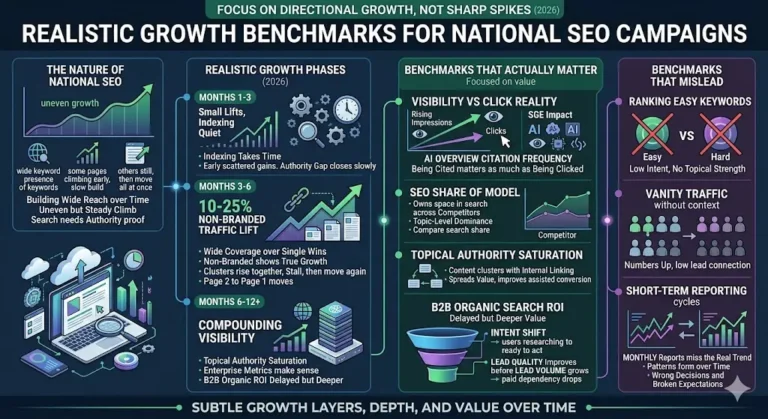
Realistic SEO Growth Targets in 2026
Forget vanity metrics and focus on directional growth. Realistic SEO growth targets for 2026 are not sharp spikes. They build in layers.
Traffic Growth Benchmarks by Phase
Months 1–3 stay quiet. Pages get indexed. Signals form. You may see small lifts, but nothing stable. Months 3–6 show change. A 10–25% non-branded traffic lift is a fair range. It comes from wider coverage, not single wins. Months 6–12 bring compounding visibility. Content starts to support itself. This is where Enterprise SEO performance metrics begin to make sense.
Keyword Position Benchmarks at Scale
Most gains come from Page 2 moving to Page 1. Not from new rankings. Clusters rise together, then stall, then move again. That pattern is normal.
Non-Branded Traffic as a True Signal
Brand traffic can hide weak reach. Non-branded traffic lift shows real growth. It links to topical authority saturation and supports long-term B2B organic search ROI.
Benchmarks for National SEO Campaigns That Actually Matter
Not all metrics deserve attention. Some look strong but add no value. Enterprise SEO performance metrics should show real progress, not surface noise.
Visibility vs Click Reality
Impressions often rise first. That is normal. Pages start to appear more, but clicks may lag. CTR can drop as the Search Generative Experience (SGE) impact grows. Answers show before users visit sites. This shifts behaviour. AI Overview citation frequency now plays a bigger role. Being cited can matter as much as being clicked.
SEO Share of Model Benchmarks Explained Simply
SEO Share of Model benchmarks look at your share of search, not just positions. It compares your reach against competitors across a topic. This shows topic-level dominance. It is not about a one-page ranking. It is about how much space you own in search.
Measuring Topical Authority Instead of Page Rankings
Single pages do not tell the full story. Content clusters give better signals. When clusters rank together, it shows depth. Topical authority saturation is a strong sign of maturity. Internal linking helps this flow. It connects pages, spreads value, and improves SEO assisted conversion value over time.
B2B Organic Search ROI Takes Longer
ROI is delayed, but deeper. Early stages can feel slow, but the value builds in layers and stays longer.
Assisted Conversions Matter More Than Direct Leads
Assisted conversions matter more than direct leads. In B2B, journeys stretch across weeks or months. This is where SEO assisted conversion value becomes clear. According to 2026 industry benchmarks, organic search now delivers a 748% ROI for B2B companies, even as AI-driven ‘zero-click’ searches change how users interact with the SERPs.
Lead Quality Improves Before Lead Volume
At first, traffic often comes from users in research mode. They read, explore, then leave. Over time, intent shifts. More visitors arrive ready to act. Lead quality improves before volume grows. This aligns with realistic SEO growth targets for 2026, where early gains are not always visible in raw numbers.
Authority Reduces Paid Dependency
As authority builds, reliance on paid ads drops. You spend less to acquire the same user. Cost per acquisition goes down over time. Organic traffic starts to replace paid channels in parts. This shift is gradual, but steady. It reflects a stronger presence, better coverage, and long-term compounding returns.
Benchmarks That Mislead National SEO Campaigns
Some metrics look good but mean little. They create noise, not clarity. Many teams track them, but they rarely reflect real progress.
Ranking for Easy Keywords
It feels good to rank fast. But easy keywords bring little value. They drive low-intent traffic and do not build strength. They do not improve Enterprise SEO performance metrics in any meaningful way. Nor do they help with topical authority saturation. Growth here looks quick, but it fades just as fast.
Traffic Without Conversion Context
Traffic alone can mislead. Numbers go up, but outcomes stay flat. This is vanity growth. Without linking visits to SEO assisted conversion value, the picture stays incomplete. Non-branded traffic matters more, but only when it connects to action. Otherwise, it adds little to B2B organic search ROI.
Short-Term Reporting Cycles
SEO does not fit into short windows. Monthly reports often miss the real trend. Small dips and spikes distract from long-term movement. Realistic SEO growth targets for 2026 require wider tracking. Patterns form over time, not in weeks. Looking too often can lead to wrong decisions and broken expectations.
What Good National SEO Progress Actually Looks Like
Real growth is subtle at first. It does not arrive as a spike. It builds in layers and becomes clearer over time.
Gradual Expansion of Ranking Clusters
You start seeing more keywords attached to the same page. Not just one term, but groups. This is how topic strength forms. Cluster growth signals progress better than single rankings. It aligns with Enterprise SEO performance metrics and supports realistic SEO growth targets for 2026.
Increasing Mentions Across Search Features
Visibility spreads beyond standard results. Pages begin to appear in featured snippets and other formats. AI Overview citation frequency also rises. This matters more now, as Search Generative Experience (SGE) impacts how users interact with search.
Stronger Internal Ecosystem
Content begins to support other content. Pages link with purpose. Authority flows across sections, not in isolation. This improves topical authority saturation and helps build steady B2B organic search ROI over time.
Conclusion
National SEO is not fast. It moves in stages, often quiet at first. Then things begin to connect. Benchmarks for National SEO Campaigns help set direction, but they are not fixed rules. They shift with authority, coverage, and time.
Real progress comes from building depth. One page supports another as a signal stack. Visibility grows across topics, not just single terms. That is where change happens.
Sudden spikes can mislead. They rarely last as steady growth holds. It builds trust, reach, and value over time. In national SEO, patience is not optional; it is part of the process.
Frequently Asked Questions
1. How long does it take to see results in national SEO?
We notice small changes after about three months. Real traction tends to build closer to six months, sometimes longer, depending on the space.
2. What is a realistic traffic growth target for national SEO?
We expect a slow start. Then it picks up. A 10–25% lift in non-branded traffic within six months feels reasonable in most cases.
3. Which metric should I trust the most?
We pay more attention to non-branded traffic and topic visibility. Rankings can look good, but they do not always reflect real reach.
4. Why does traffic grow but conversions stay low at first?
We often see early visitors still researching. They are not ready yet. Conversions improve as trust and authority grow.
5. How do I know if my SEO campaign is on track?
We look for steady gains in keyword clusters, wider visibility, and assisted conversions over time. Sudden jumps do not matter much.