


Introduction
National SEO rarely moves in a straight line. The effect of algorithm updates on National SEO is not just about ranking drops or gains. It changes how long things take. Some shifts happen fast, and others drag on. A page may fall in a day, but climbing back often takes months. That gap confuses many teams.
At scale, small changes ripple across hundreds of pages. Signals don’t reset at once. They settle in layers. This is why timelines stretch or shrink without warning.
This piece focuses on timing and adjustment. Not quick fixes and panic moves. Just what actually changes and how to respond without making things worse.
Table of Contents
Why National SEO Reacts Differently To Algorithm Updates
Local changes are quick, as national shifts take time. Scale alters how signals move and settle.
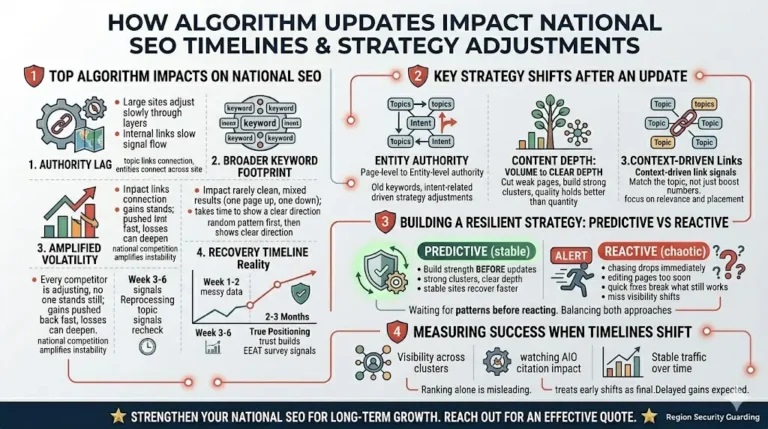
Authority Lag Across Large Site Structures
Large sites don’t adjust in one go. Signals travel through layers. Deep internal links slow that flow. A change on one page may take weeks to affect others. This is where entity-based ranking recalibration comes in. Google rechecks how topics connect across the site. That process is not instant. It builds, then settles.
Broader Keyword Footprint Means Mixed Impact
A national site targets many terms. So the impact is rarely clean. One section drops. Another climbs. It feels uneven. This is common after updates tied to SERP volatility and SEO timelines. The pattern looks random at first. It isn’t. It just takes time to show a clear direction.
National Competition Amplifies Volatility
At this level, every competitor is adjusting too. No one stands still. Small gains get pushed back fast. Losses can deepen before they recover. This is why National SEO strategy adjustments must stay measured. Rushed changes often extend the instability rather than fix it.
The Timeline Reality After A Core Update
Most teams expect quick wins in it, but that rarely plays out. Recovery moves in stages, not in bursts.
Immediate Phase (Week 1–2): Noise Over Clarity
The first shift feels sharp. Pages jump or drop without warning. Much of it links to SERP volatility and SEO timelines. At the same time, AI Overview (AIO) citation impact can change who gets seen. Some sites lose clicks even if their ranks look steady. The data here is messy. I don’t act yet.
Adjustment Phase (Week 3–6): Signal Reprocessing
Things begin to settle, slowly. Google reviews topical integrity signals across clusters. Strong sections hold. Weak ones fade. This is where the early March 2026 Google Core Update recovery patterns appear. I look for consistency, not spikes.
Stabilisation Phase (2–3 Months): True Positioning
Now the real picture shows. Rankings form a new base. E-E-A-T survey signals start to shape trust across pages. At the same time, destination source visibility becomes clearer. Gains here tend to last longer, even if they arrive late.
Algorithm Updates On National SEO And Strategy Shift
Updates don’t just move rankings. They reshape how a site must grow. Plans that worked before may stall without warning.
From Page-Level Optimisation To Entity-Level Authority
Old methods focus on single pages. That is fading. Now, topics matter more than isolated keywords. With entity-based ranking recalibration, Google checks how ideas connect across the site. I link related content with intent, not just structure. This shift drives real National SEO strategy adjustments, especially on large sites.
Content Depth Replaces Content Volume
Publishing more pages is no longer enough. Thin scaling fails over time. I cut weak pages and build stronger clusters instead. Clear depth improves topical integrity signals. It also supports a steady March 2026 Google Core Update recovery, where quality holds better than quantity.
Link Signals Become Context-Driven
Backlinks still matter, but context matters more. A link must match the topic, not just boost numbers. I focus on relevance and placement. This supports better destination source visibility and aligns with how Google now reads authority. At the national scale, links need layers, not random reach.
Strategy Adjustments After The March 2026 Google Core Update Recovery
Recovery is not about quick edits. It’s about fixing how the whole site works. Small patches won’t hold at scale.
Rebuilding Trust Signals Across The Site
We start with trust. Strong E-E-A-T survey signals help Google read the site with more confidence. That means clearer authors, real expertise, and steady brand proof. These changes shape long-term National SEO strategy adjustments, not short wins.
Restructuring Content Around Search Intent Clusters
Next, we clean the structure and merge pages that overlap. Then we group content by intent, not just keywords. This improves topical integrity signals and helps each section own a clear space in search.
Improving Internal Signal Flow
Finally, we fix how pages connect. Better links guide both users and search engines. It speeds up entity-based ranking recalibration and improves destination source visibility across the site.
Predictive SEO Vs Reactive SEO In A Volatile Landscape
Waiting for updates is reactive, as planning ahead changes how you absorb impact.
What Reactive SEO Gets Wrong
We see this often. Teams chase drops the moment they appear. They edit pages too soon. But early shifts are tied to SERP volatility and SEO timelines, not real loss. Quick fixes can break what still works. Many also miss how the AI Overview (AIO) citation impact shifts visibility without ranking changes. It leads to wrong conclusions.
How Predictive SEO Reduces Risk
We focus on building strength before updates land. Strong clusters support entity-based ranking recalibration. Clear depth improves topical integrity signals. This approach helps during the March 2026 Google Core Update recovery, where stable sites recover faster. It’s not about guessing updates. It’s about being ready for them.
Balancing Both Approaches
We still track changes closely, but it doesn’t react to every move. We have to wait for patterns. Then adjust with care. This keeps the National SEO strategy adjustments steady. It also supports lasting destination source visibility, even when results shift.
Measuring Success When Timelines Keep Shifting
Old KPIs fail when timelines change. What looks like a drop may just be movement.
Why Ranking Alone Is Misleading
Rankings move a lot during updates. This is normal with SERP volatility and SEO timelines. A page may fall, then return later. I don’t treat early shifts as final. They don’t show real growth.
Better Metrics To Track
We focus on wider signals. Visibility across clusters matters more than one keyword. We also watch the AI Overview (AIO) citation impact to see where content gets picked. Stable traffic over time gives a clearer view than short spikes. These patterns guide smarter National SEO strategy adjustments.
Understanding Delayed Gains
Some gains arrive late. That’s expected. Entity-based ranking recalibration takes time. As trust builds, E-E-A-T survey signals strengthen. This improves destination source visibility and holds rankings longer, even after updates settle.
Conclusion
Algorithm updates don’t break strong systems. They expose the weak ones. In algorithm updates on National SEO, the real issue is rarely a single page. It’s how the whole site is built. At the national scale, quick fixes don’t hold. You may see short gains, but they fade. What lasts is structure. Clear topics. Strong links between pages. Consistent signals over time.
I focus on building depth, not chasing movement. That reduces the shock when updates land. It also keeps recovery steady, not rushed. In the end, rankings follow patterns, not reactions. Stay consistent. Let authority grow. That’s what holds when everything else shifts.
Frequently Asked Questions
1. How long does it take to recover from a Google core update?
We often see small signs in a few weeks. Full recovery takes longer. In some cases, it runs for months. It depends on how wide the issue is and how deep it sits.
2. Should I change my strategy after every update?
We don’t rush changes. We watch the pattern first. Early moves can break stable parts of the site. Waiting helps us act with more control.
3. Why do some pages drop while others improve?
We see mixed shifts when signals are uneven. Some pages have stronger topic links. Others lag. Google tests and resets them at different speeds.
4. What is the biggest mistake after an update?
Trying to fix everything at once. We avoid that and start with structure, then move step by step.
5. Is predictive SEO better than reactive SEO?
We lean toward predictive SEO. It keeps the site steady. Reactive steps still matter, but only after clear trends appear.