


Introduction
Did you know that over 70% of ecommerce websites fail basic technical SEO standards? Most people don’t expect that. Yet it happens all the time.
You can run ads, publish content, and stay active every day. Still, growth feels slow. Rankings don’t climb. Something feels off. The problem is often hidden.
Search engines rely on clean structure, fast pages, and clear signals. When those break, performance drops. These are the kinds of technical SEO mistakes ecommerce sites make without noticing.
They don’t look serious at first. But they add up. This guide walks you through what’s going wrong. More importantly, it shows how to fix it so your store can rank, load faster, and grow the way it should.
Table of Contents
10 Common Technical SEO Mistakes That Hurt Ecommerce Rankings
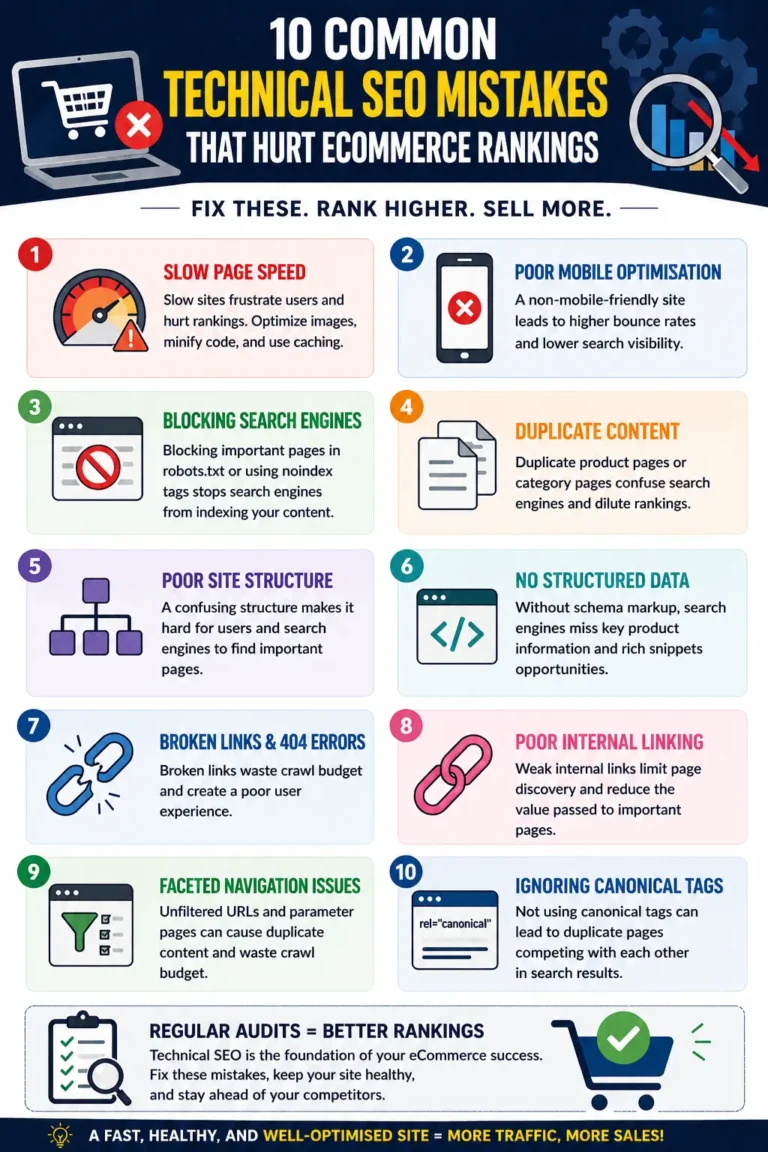
1. Slow Page Speed & Poor Core Web Vitals
Speed matters more than most expect. A slow store drives people away before they even browse.
Core Web Vitals measure how your site feels to users:
- LCP (Largest Contentful Paint): how fast the main content loads
- CLS (Cumulative Layout Shift): how stable the page layout is
- FID (First Input Delay): how quickly the page responds
If these fail, rankings slip, and users leave fast. Many ecommerce website optimisation errors stem from heavy images, poor hosting, or too many scripts. Even small delays can hurt trust.
2. Broken Links Across Product Pages
Broken links feel careless. They frustrate users and waste crawl budget. In fact, 62.4% of ecommerce sites have broken links. That’s a big number.
These issues often come from:
- Deleted products
- Changed URLs
- Outdated internal links
Search engines hit dead ends. Pages lose value. Users lose trust. Fixing this is basic, yet often ignored.
3. Missing or Incorrect Canonical Tags
Duplicate content is common in ecommerce. Filters, categories, and product variants create multiple URLs for the same page.
Without proper canonical tags, search engines get confused.
- Which page should rank?
- Which one is original?
Around 53% of ecommerce sites lack a proper canonical setup. This leads to major ecommerce technical SEO issues. The result? Diluted rankings and lost visibility.
4. Poor Mobile Optimisation
Most shoppers now browse on phones. Google knows this. That’s why it uses mobile-first indexing. If your mobile site feels slow or messy, rankings drop.
Common issues include:
- Buttons too small
- Text is hard to read
- Layout breaking on smaller screens
Users won’t wait; they leave. That sends a bad signal to search engines.
5. Weak Site Architecture & URL Structure
Structure shapes everything. If your pages sit too deep, search engines may not find them. Users won’t either. Bad structure often looks like:
- Long, messy URLs
- Too many clicks to reach products
- No clear category flow
A clean setup helps both bots and people move with ease. Without it, visibility suffers.
6. Poor Internal Linking Strategy
Internal links guide both users and crawlers. Yet 86% of ecommerce sites lack proper internal linking.
This leads to:
- Orphan pages
- Weak page authority
- Missed ranking chances
It’s one of the most ignored SEO errors hurting ecommerce rankings today. Smart linking builds paths. It spreads value across pages.
7. Thin or Duplicate Product Content
Many stores copy product descriptions from suppliers. It saves time. But it creates problems. Search engines see the same content everywhere. Nothing stands out.
Thin content also hurts:
- Low word count
- No unique details
- No real value
Pages like this rarely rank well. They often get ignored.
8. Improper Indexing (Noindex / Robots.txt Errors)
Sometimes, important pages get blocked by mistake.
This happens through:
- Wrong noindex tags
- Misconfigured robots.txt
Search engines can not access key pages. They disappear from the results. On the other side, index bloat can occur. Too many low-value pages get indexed. Both cases hurt performance.
9. Missing Structured Data (Schema Markup)
Structured data helps search engines better understand your pages. It also improves how your listings appear:
- Star ratings
- Prices
- Stock status
Without it, your listing looks plain. Others stand out more. That means fewer clicks and less traffic.
10. Ignoring Technical SEO Audits
Many store owners fix things once and move on. That’s a mistake. Websites change often. New issues appear over time. Without regular checks, problems grow unnoticed.
A proper technical SEO checklist should include:
- Crawl error checks
- Speed analysis
- Index coverage review
- Link audits
Skipping audits leads to long-term damage. Each of these issues may seem small on its own. Together, they can block growth completely. Fixing them is not optional; it’s essential.
Signs Your Ecommerce Site Has Technical SEO Issues
Not all problems are loud. Some stay hidden. You only notice them when growth slows down.
Watch for these signs:
- Sudden drop in rankings: Your pages were doing well. Then they fall without a clear reason. This often points to a deeper issue. Something is stopping search engines from trusting your site.
- Pages not indexed: You publish a page. It does not show up on Google. That’s a sign your pages are not being picked up.
- High bounce rate: People visit, then leave quickly. No clicks. No scroll. This shows they did not find what they expected, or the page felt hard to use.
- Low organic traffic: Traffic drops slowly or sometimes all at once. You did not change much, yet the results fall. This is a common signal of ecommerce site SEO problems.
- Wrong page ranking: A page ranks, but not the right one. For example, a category shows instead of a product. This means search engines are confused.
- Traffic without results: Visitors come in. Sales don’t follow. This gap shows something is off in the experience.
- Ranking jumps often: One day, you rank well. The next day, you don’t. This kind of movement shows instability.
- Pages get ignored: Some pages never gain traffic. They sit there with no visibility, almost like they don’t exist.
These signs may seem small at first. But they build up. Spot them early, and you stay in control.
Conclusion
Technical SEO often gets pushed aside. It does not look urgent. But it matters more than most expect.
Small issues do not stay small; they grow. Over time, they affect how your site performs. Rankings slip. Traffic slows down. Fixing things early keeps this from happening.
This is not a one-time job. Your site changes often. New pages go live. Old ones get updated. That’s why regular checks are needed.
The good news is simple. Even small fixes can help. A faster page, a cleaner path for users, and better signals for search engines. These changes build strong results over time.
If you’re dealing with the technical SEO mistakes ecommerce sites often face, don’t wait too long to act. And if you want clear direction, Midland Marketing can help you find the gaps, fix them, and keep your store moving forward.
Frequently Asked Questions
1. What are the most common technical SEO mistakes in ecommerce?
Many sites struggle with slow load time, broken links, and repeated content. Some also miss a clear structure, which makes pages hard to find.
2. How does technical SEO affect ecommerce rankings?
It helps search engines access and sort your pages. When gaps exist, your site loses position. Fewer people find it.
3. How often should I perform a technical SEO audit?
A review every few months is enough for most sites. If you update your store often, check it more often.
4. What tools help fix ecommerce SEO mistakes?
Google Search Console shows errors. Screaming Frog scans pages. Ahrefs tracks performance. Each tool helps in a different way.
5. Why is my ecommerce site not ranking on Google?
Your pages may not be visible to search engines, or there may be hidden ecommerce technical SEO issues affecting how your site performs.