


Introduction
Your ecommerce store may offer great products. That alone is not enough. If pages take too long to load, or the layout feels confusing, people leave. Search engines react the same way. They skip what they can not read or reach.
Even small delays matter. A single second can cut conversions by around 7%. Most users won’t wait to see what comes next.
This is where technical SEO for ecommerce comes into play. It deals with how your site runs behind the scenes. It is not about design or content. It is about the structure, the speed, and how search engines move through your pages.
When these parts work well, everything else improves. Pages load faster. Products show up in search. Visitors stay longer. Small fixes here often lead to steady growth over time.
Table of Contents
What is Technical SEO?
Technical SEO examines how your ecommerce site operates under the surface. It shapes how pages load, how links connect, and how search engines move across your site.
It becomes important when the scale increases. A small issue on one page is manageable. The same issue across hundreds of products is not. Pages get missed. Some never appear in search at all.
Technical SEO vs On-Page SEO
Aspect | On-Page SEO | Technical SEO |
Focus | Visible elements on the page | Behind-the-scenes structure and performance |
Key Elements | Titles, descriptions, written content | Site structure, speed, crawlability |
Purpose | Improve content relevance | Ensure pages can be found and accessed |
Impact | Helps users understand the page | Helps search engines read and index the page |
Limitation | Strong content alone is not enough | Supports visibility of all on-page efforts |
A well-written page has no value if it sits outside the index. That’s the difference.
Why Ecommerce Sites Need Strong Technical Foundations
- Large Product Catalogues: Each product adds another URL. Without order, things scatter. Some pages lose priority. Others overlap.
- Dynamic Pages and Filters: Filters create many versions of the same listing. One for size, another for price, and another for colour. This can flood your site with near-identical pages.
- Indexing Challenges: Not every page deserves visibility. Some add little value. Others repeat what already exists. Careful control decides what search engines keep and what they skip.
How Ecommerce Technical SEO Impacts Performance
- Rankings: A clear structure helps search engines read your site without effort. When that happens, pages are more likely to show up.
- User Experience: Speed and navigation both play an important role. When they work well, users stay longer. When they don’t, users tend to leave early.
- Conversions: Friction slows decisions. A clean path does the opposite. When pages respond quickly and make sense, users move forward with less hesitation.
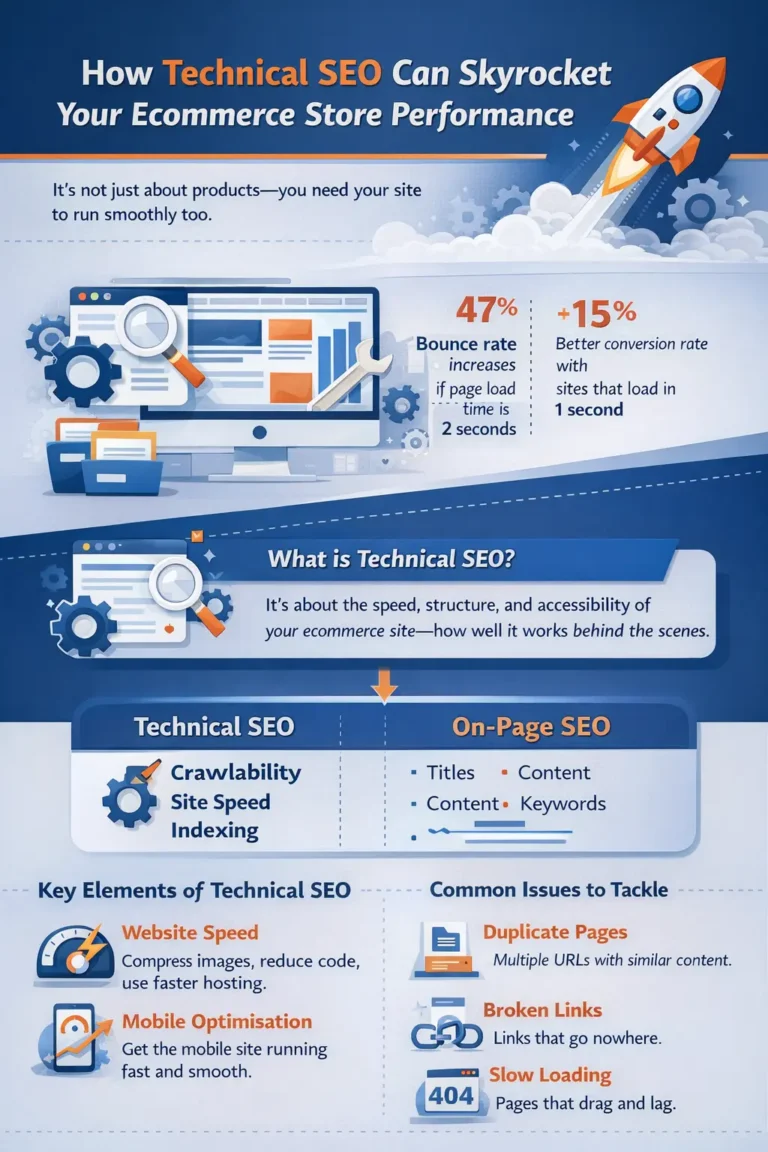
Key Elements of Ecommerce Technical SEO You Must Optimise
Strong ecommerce technical SEO does not come from one fix. It is built through a set of small, precise improvements. Each one removes friction. Together, they shape how your site performs.
Website Speed Optimisation
Speed affects every click. Slow pages break momentum.
- Image compression: Large images slow pages down. Compress them without losing clarity. Product visuals still need to look sharp.
- Lazy loading: Load images only when they appear on screen. This reduces the initial load time and keeps pages responsive.
- CDN usage: A content delivery network stores copies of your site across locations. Users load pages from the nearest server, which cuts the delay.
Mobile Optimisation & Core Web Vitals
Around 70% of UK online orders are made via mobile. Performance here cannot be ignored.
- Mobile-first indexing: Search engines look at the mobile version first. If it feels broken or slow, rankings suffer.
- Performance benchmarks: Core Web Vitals measure loading speed, interactivity, and visual stability. These are not abstract scores. They reflect how real users experience your site. Only 43.4% of mobile sites meet Core Web Vitals standards. That leaves clear room for improvement.
Site Structure & Navigation
Structure guides both users and search engines.
- Flat architecture: Important pages should not sit too deep. A user should reach most products within a few clicks.
- Category hierarchy: Group products in a clear way. Categories should make sense at a glance. Confusion leads to drop-offs.
URL Structure Optimisation
URLs should be simple. Nothing extra.
- Clean, keyword-rich URLs: Short and readable URLs help users understand the page before clicking. They also help search engines.
- Avoid dynamic parameters: URLs containing symbols or filters can create duplicates. These versions compete with each other and weaken visibility.
XML Sitemaps & Robots.txt
Search engines need direction.
- Guide search engines: An XML sitemap lists important pages. It helps search engines find and prioritise them.
- Avoid indexing irrelevant pages: The robots.txt file blocks pages that don’t add value. This keeps focus on the pages that matter.
Best Technical SEO for Ecommerce Stores – Proven Strategies
Getting the best technical SEO for ecommerce right often comes down to fixing what slows your site down or holds it back. These are not surface-level tweaks. They shape how your store is read, trusted, and ranked.
Fix Duplicate Content Issues
Duplicate pages confuse search engines. They split ranking signals and reduce visibility.
Product variations:
Different sizes or colours can create separate URLs with nearly the same content. This leads to overlap. Search engines struggle to pick the main version.
Canonical tags:
A canonical tag points to the preferred page. It tells search engines which version to index and rank. This keeps authority in one place.
Implement Structured Data (Schema Markup)
Structured data adds context. It helps search engines understand what your page contains.
Product schema:
This highlights key details like price, stock status, and product name. It can improve how your listings appear in search.
Review schema:
Ratings and reviews can show directly in search results. This draws attention and builds trust before users even click.
Optimise Product Pages for SEO
Product pages carry most of the value. They need to be easy to find and easy to reach.
Internal linking:
Link related products and categories. This spreads authority across your site and helps search engines move between pages.
Crawl depth:
Important pages should not sit too deep. If it takes too many clicks to reach a product, it may be overlooked.
Secure Your Website with HTTPS
Security affects trust. It also affects rankings.
Trust signals:
Users look for signs that a site is safe. A secure connection reassures them, especially during checkout.
Ranking factor:
Search engines favour secure sites. HTTPS is now expected, not optional.
Ecommerce Site Optimisation Techniques to Improve Performance
Strong ecommerce site optimisation focuses on removing delays and dead ends.
Reduce Page Load Time
Faster pages keep users engaged.
Code minification:
Remove unnecessary spaces and characters from code. This reduces file size and speeds up loading.
Server response time:
A slow server delays everything. Improve hosting or backend performance to reduce wait time.
Improve Internal Linking Structure
Links guide movement. Without them, users get stuck.
Category → product linking:
Clear paths from category pages to products make navigation easier. It also helps search engines understand relationships.
Breadcrumb navigation:
Breadcrumbs show users where they are. They also create extra links that support the site structure.
Eliminate Broken Links and Errors
Errors break trust. They also waste crawl resources.
404 pages:
When a page no longer exists, guide users to a useful alternative. Don’t leave them at a dead end.
Redirect chains:
Multiple redirects slow things down. Keep redirects short and direct to avoid delays.
Future Trends in Technical SEO for Ecommerce
The next phase of technical SEO for ecommerce is less about fixes and more about precision. Systems are getting smarter. Expectations are rising. What worked before may not hold for long.
AI and Automation in SEO
Manual checks are fading. AI-driven audits now scan large ecommerce sites in minutes. They detect crawl gaps, slow pages, and indexing issues without delay.
More importantly, they don’t just flag problems. They suggest patterns like:
- Which pages underperform?
- Where does the structure break?
This shifts the focus. Less time spent finding issues. More time fixing what matters.
Voice Search and Mobile Optimisation
Search is changing in tone. People no longer type short phrases. They ask full questions.
This affects how pages are structured. Content needs to match natural language with clear answers and direct flow.
Mobile plays a bigger role here. Voice searches mostly happen on phones. If pages feel slow or cluttered, users drop off before they engage.
Core Web Vitals Evolution
Performance metrics are becoming stricter. Core Web Vitals already measure load speed, interaction, and visual stability. These signals now carry more weight, not as a bonus, but as a baseline.
User experience is no longer separate from rankings. It is part of it. Sites that feel smooth gain an edge. Sites that lag fall behind, even if the content is strong.
Conclusion
Technical SEO for ecommerce affects how a store holds up over time. It shapes access, speed, and flow. When these parts are in place, the site runs with fewer gaps.
Results don’t spike overnight; they build. Pages get picked up more often. Users move with less effort. That shift adds up.
Short-term fixes fade fast. Ongoing work keeps things steady. It also reduces the chance of hidden issues growing unnoticed.
At Midland Marketing, the approach stays focused on clarity and control as the site expands. Technical SEO goes beyond rankings. It supports a faster, more stable ecommerce experience that users can rely on.
Frequently Asked Questions
1. What is technical SEO for ecommerce?
It looks at how an ecommerce site is built. This includes speed, structure, and how search engines access pages. When these parts are clear, products show up more reliably.
2. Why is technical SEO important for online stores?
Online stores have many pages. Some get missed if the setup is weak. A clean setup keeps pages visible and easier to reach.
3. How can I improve my ecommerce site speed?
Start with images. Reduce their size without losing quality. Cut down heavy code. Use faster hosting if needed. Small changes here often lead to quicker load times.
4. What are common technical SEO issues in ecommerce websites?
Extra page versions appear from filters. Links break over time. Slow pages are common. These issues spread if ignored.
5. How often should I perform a technical SEO audit?
There’s no strict timing. A check every few months works well. After updates, review sooner. Regular checks keep the site stable.