


Introduction
Internal linking shapes how search engines move through your site and decide what matters. Internal linking for crawlability and ranking is not just a tidy SEO habit. Good links guide crawlers. They also pass value between pages. That affects both indexing and position in results.
On small sites, this is easy to manage. On large sites, things break fast. Pages get buried. Some never get found. Others hold too much weight. This creates uneven ranking signals.
If you are working on a national SEO strategy, structure becomes critical. You need clear paths, not random links. Every page should sit in a system. When done right, internal links improve crawl efficiency and balance authority across your site.
Table of Contents
Why Internal Linking Directly Impacts Crawlability And Rankings
Search engines follow links to move through your site. At the same time, those links pass value. That is why structure affects both discovery and rankings.
How Search Engines Discover Pages Through Internal Links
Crawlers move from one page to another using links. This creates a path, and the path is clear; pages get found faster. If not, they stay hidden.
- Links inside clean HTML are easy to crawl
- JavaScript-rendered link discovery can delay or block access
- Poor structure can leave key pages unreachable
When links are buried or missing, search engines may skip those pages.
Understanding Link Equity (PageRank) Flow Across Your Site
Link equity (PageRank) flow shows how authority moves. Strong pages pass value through links. That value helps other pages rank.
If links point in the right places, priority pages gain strength. If not, authority spreads too thin or stays trapped
Crawl Depth Management And Its Impact On Indexing
Crawl depth is the number of clicks from the homepage. The deeper a page sits, the harder it is to reach. Deep pages often get less attention, and some are not indexed at all.
Crawl depth management helps fix this by keeping important pages close and reducing unnecessary layers. This makes crawling faster and more consistent.
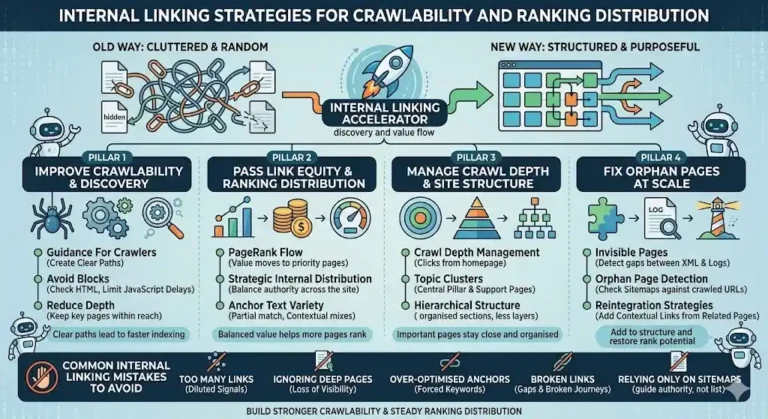
Internal Link Equity Distribution: Building Strong Ranking Signals
Internal link equity distribution decides where strength flows. If handled well, key pages gain support. If not, value gets lost across low-impact areas.
How To Pass Authority To Priority Pages Without Overdoing It
Ensure you hold the link with purpose. Not every page needs equal weight. So focus on what drives results.
- Link from high-value pages to priority pages
- Keep links relevant to the topic
- Limit excessive links that dilute impact
Too many links on one page can weaken the signal. Clear intent works better than volume on Internal linking for crawlability and ranking
Anchor Text Optimisation Without Triggering Spam Signals
Anchor text optimisation should feel natural. Forced keywords can do more harm than good. Use a mix:
- Partial match phrases
- Branded or generic anchors
- Context-driven wording
An exact match every time looks unnatural. Variety keeps it safe and effective.
Identifying And Fixing Weak Internal Link Paths
Some pages sit in weak positions, and they receive little value and struggle to rank. So make sure to look for:
- Broken internal links
- Pages with only one or two links
- Isolated content with no clear connections
Strengthen these paths. Add contextual links from stronger pages. This helps balance authority across the site.
Optimising Crawl Budget For Large Sites Without Waste
Optimising crawl budget for large sites is about focus. Search engines will not crawl everything. You can improve your site’s efficiency by understanding how crawl budget is allocated and ensuring search engines are guided toward the pages that drive real business value.
Where Crawl Budget Gets Wasted On Big Websites
Large sites often create noise. This makes things tough as crawlers spend time on pages that add no value. Common issues:
- Duplicate pages with slight URL changes
- Filter and parameter-based URLs
- Auto-generated low-value pages
These drain crawl activity. Important pages then get ignored or delayed.
XML Sitemap Vs Internal Links: What Matters More?
The debate around XML sitemap vs internal links is simple. Both help, but they do not carry equal weight. Sitemaps list pages and internal links, guide discovery, and pass value. Crawlers rely more on links within the site structure. A page in a sitemap without links often stays weak.
Structuring Links To Reduce Crawl Friction
Good structure reduces effort and also makes crawlers move faster when paths are simple.
- Use clean navigation with clear categories
- Keep key pages within a few clicks
- Avoid unnecessary layers and loops
Fewer hops mean better access. When paths are smooth, indexing improves.
Fixing Orphan Pages At Scale And Improving Index Coverage
Fixing orphan pages at scale is not optional on large sites. These pages sit outside your structure. Search engines rarely find them, and they pass no value.
What Orphan Pages Are And Why They Kill Rankings
An orphan page has no internal links pointing to it. That makes it almost invisible. No links means:
- No crawl path
- No authority flow
- Low or no indexing
Even strong content will struggle if it cannot be reached.
Practical Ways To Find Orphan Pages Across Large Sites
You need data from more than one place. A single crawl is not enough.
- Use SEO tools to map internal links
- Check XML sitemaps against crawled URLs
- Analyse log files to see what bots actually visit
This helps you spot gaps between what exists and what gets crawled.
Reintegration Strategies That Actually Work
Once found, these pages need a place in your structure. Random links will not fix the issue. Add:
- Contextual links from related pages
- Links from category or hub pages
This brings them back into the crawl path and restores their ability to rank.
Hierarchical Internal linking For Crawlability And Ranking
Hierarchical internal linking models give structure as your site expands. Without a clear system, growth creates chaos. Pages compete, paths break, and value spreads unevenly.
Flat Vs Deep Site Structures: What Works Best Today
A flat structure keeps pages close to the homepage. A deep one adds layers, and both have limits. Too flat, it makes you feel messy and lacks clear grouping. As for being too deep, it slows down crawling and hides key pages. Balance works best. Keep important pages within reach, but still organised under clear sections.
Topic Clusters And Pillar Pages In National SEO Strategy
Cluster linking connects related content. A central page supports smaller ones. In a National SEO Strategy, this matters more. You may target many locations or services. A pillar page links out. Cluster pages link back. This creates strong topical signals and clear paths for crawlers.
Building A Scalable Internal Linking Framework
You need a system that repeats. Not one-off fixes.
- Use templates for categories and content types
- Keep linking rules consistent
- Review the structure as new pages are added
This keeps your site stable as it grows, without constant rework.
Common Internal Linking Mistakes That Limit Crawlability
Small mistakes can block crawling more than you expect. They often go unnoticed, yet they weaken structure and slow discovery.
- Too Many Links On A Page: When a page is packed with links, signals get diluted. Search engines struggle to understand what matters most.
- Ignoring Deep Pages: Pages buried too far down rarely get attention. They sit outside the main flow and lose visibility over time.
- Over-Optimised Anchors: Using the same keyword again and again looks forced. It reduces trust and can weaken relevance signals.
- Broken Internal Links: Dead links waste crawl effort. They also break user journeys and create gaps in your structure.
- Relying Only on Sitemaps: Sitemaps list pages, but they do not guide authority. Without internal links, pages stay weak and disconnected.
Fixing these issues does not require complex tools. It needs awareness, small adjustments, and regular checks.
Conclusion
Internal linking for crawlability and ranking works best when it stays simple. Clear paths help search engines move faster. Balanced links spread value where it matters.
There is no shortcut here. Quick fixes fade; structure holds and focus on consistency. Keep pages connected. Reduce depth where needed. Support key pages with purpose.
Over time, this builds stronger crawlability and steady ranking distribution without relying on risky tactics.
Frequently Asked Questions
1. How do we improve crawlability with internal links?
We create clear paths between pages. We keep key pages close. We remove blocks like broken links or heavy scripts.
2. What is the ideal number of internal links on a page?
We focus on relevance, not a fixed number. Too many links weaken signals. We keep only what adds value.
3. How do we handle orphan pages on large sites?
We find them using tools and logs. Then we add links from related or stronger pages.
4. Do internal links help rankings directly?
Yes, we use them to pass value and guide search engines. This supports better visibility over time.
5. How often should we review internal linking?
We check it regularly, especially after adding new pages or changing the structure.