


Introduction
Large national websites often carry thousands of pages, yet many sit disconnected. One section grows, another gets ignored. Over time, links weaken, paths break, and search engines struggle to move through the site. This leads to wasted crawl budget and lost authority that never reaches key pages.
That is where structure matters. Instead of adding links at random, strong sites treat internal linking like a system. Every page has a role. Every link has a direction. With Automated internal linking for enterprise SEO, this system can run at scale without relying on manual effort.
In this guide, I will show how to build that structure, keep it consistent, and use automation to maintain it across a large national website.
Table of Contents
Why Internal Linking Breaks Down at National Scale
As a site expands, structure often falls behind. Thousands of pages go live without a clear linking plan. Some areas grow fast, while others stay thin. This breaks the flow and forces search engines to waste crawl budget on low-value pages while ignoring your most important content.
Page Volume Creates Structural Gaps
As a site expands, structure often falls behind. Thousands of pages go live without a clear linking plan. Some areas grow fast, while others stay thin. This breaks the flow. Without Topical Map automation for national brands, clusters lose shape. Pages sit outside the main path. Over time, gaps form, and search engines lose context. This is where Semantic SEO automation and Entity-based interlinking become critical to keep relationships clear.
Manual Linking Cannot Keep Up
Editors cannot manage links at this scale. They miss key connections or add links based on guesswork. Anchor text shifts with each writer. There is no pattern. Without AI-powered internal linking systems, linking stays uneven. Even strong content fails to connect. Modern enterprise SEO automation tools in 2026 solve this by applying rules instead of relying on memory.
Authority Gets Trapped in Silos
Some pages gain links, others get none. Authority is built in one section, but does not spread. This weakens the whole site. Without programmatic internal linking at scale, link equity stays locked. Internal PageRank (IPR) automation helps move value where it is needed, while Real-time orphan page remediation ensures no page stays hidden.
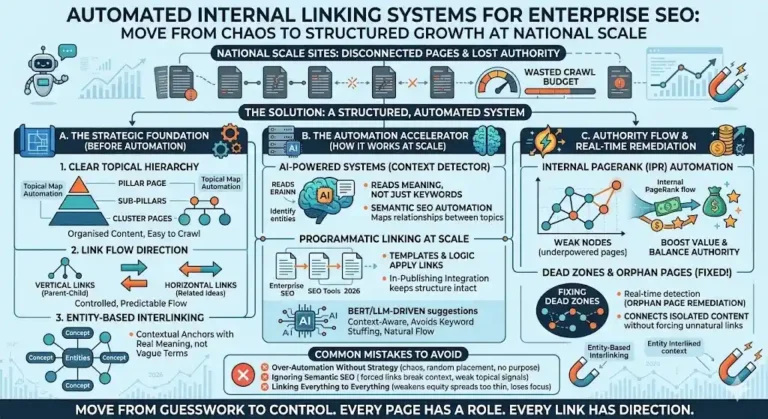
Internal PageRank Flow and Authority Distribution
Internal links do more than guide users. They move value across the site. If that flow breaks, even strong pages lose impact.
What Internal PageRank Means in Practice
Internal PageRank is about how link equity spreads. Some pages carry more weight, but that value must pass through the site. Without control, key pages stay underpowered. With programmatic internal linking at scale, you can guide that flow with intent. This also supports Semantic SEO automation, where links reflect real topic importance, not random placement.
Internal PageRank (IPR) Automation
Manual control is not enough at scale. Internal PageRank (IPR) automation helps identify weak nodes across the site. These are pages with low incoming links but high value. Using enterprise SEO automation tools in 2026, you can boost them with targeted internal links. This keeps authority balanced and prevents important pages from being ignored.
Fixing Dead Zones in Large Sites
Dead zones form when sections receive no internal links. They sit outside the main structure. This creates authority gaps. With Real-time orphan page remediation, these pages are detected and connected. Combined with Entity-based interlinking, links are added in the right context, restoring balance without forcing unnatural connections.
Fixing Orphan Pages and Maintaining Coverage
Orphan pages often go unnoticed. They sit live but stay disconnected. Over time, this weakens the whole structure and wastes crawl effort.
Real-Time Orphan Page Remediation
Fixing this should not be manual. With Real-time orphan page remediation, systems can:
- Detect pages with zero internal links
- Match them using Entity-based interlinking
- Insert links from relevant content
This process relies on AI-powered internal linking systems to keep links natural and context-driven. It also supports Semantic SEO automation, so links fit the topic, not just the keyword.
Continuous Monitoring Instead of One-Time Audits
One audit is never enough. Large sites change daily. New gaps appear fast.
Using programmatic internal linking at scale, automation runs in the background:
- Scans new and updated pages
- Applies linking rules instantly
- Maintains structure without delay
Modern enterprise SEO automation tools 2026 ensure coverage stays complete, even as the site grows.
Common Mistakes That Break Internal Linking at Scale
Most large sites do not fail by accident. The same patterns show up again and again. Small errors spread fast when the scale increases.
Over-Automation Without Strategy
Automation without rules creates chaos. Links appear, but they lack purpose.
- Random placement with no structure
- No hierarchy to guide flow
Even with AI-powered internal linking systems, you still need a clear plan. Without it, programmatic internal linking at scale becomes noise, not value.
Ignoring Semantic SEO Automation
Many teams still link based on keywords alone. This breaks context.
- No use of Entity-based interlinking
- Weak topical signals
Semantic SEO automation fixes this by connecting meaning, not just words. Without it, links feel forced and lose impact.
Linking Everything to Everything
Too many links weaken authority. Not every page needs a connection.
- Link equity spreads too thin
- Search engines lose focus
Strong systems, often built with enterprise SEO automation tools in 2026, keep links selective and intentional.
Conclusion
Internal linking is not a small task. It is the base of how a large site works. Without it, pages drift and value fades. Effort alone cannot fix this. Scale needs systems that hold everything together.
A structured and automated approach makes the difference. With Automated internal linking for enterprise SEO, you move from guesswork to control. Programmatic internal linking at scale ensures every page fits into the wider structure and supports growth.
As search evolves, linking will become more precise and more context-driven. The sites that adapt early will hold stronger positions and stay ahead.
Frequently Asked Questions
1. How do I manage internal linking on a very large website?
We start with a clear structure. Mapping key pages, then building links around them. After that, we use automation to apply the same logic across the site. This keeps everything aligned as the site grows.
2. What is automated internal linking for enterprise SEO?
We use systems that read content and place links where they make sense. These follow the rules we set, so links stay relevant and consistent.
3. Are AI-powered internal linking systems reliable?
We trust them for scale, but do not leave them unchecked. We define rules and review outputs to keep quality high.
4. How do I fix orphan pages quickly?
We use tools that find pages with no links. Then connect them to related content without delay.
5. Does internal linking still matter with modern search engines?
Yes, we treat it as a core signal. It shapes structure, controls authority flow, and helps search engines understand the site.