


Introduction
There’s a quiet frustration in most national marketing teams right now. The targets keep rising with more regions, more landing pages and more topical depth. But the team? Still the same size or smaller.
At the same time, the search itself is shifting. Google’s AI Overviews are rewriting how visibility works, summarising, citing, and compressing. It’s no longer just about ranking blue links. It’s about being selected, referenced, surfaced.
That’s where AI SEO content automation stops being a shiny experiment and starts becoming operational infrastructure. Not to replace writers and not to flood the web, but to scale intelligently. They can map gaps, model intent, and accelerate production in ways manual workflows simply can’t sustain anymore. The pressure is real, and so is the opportunity.
Table of Contents
The State of Content Production Challenges in National SEO
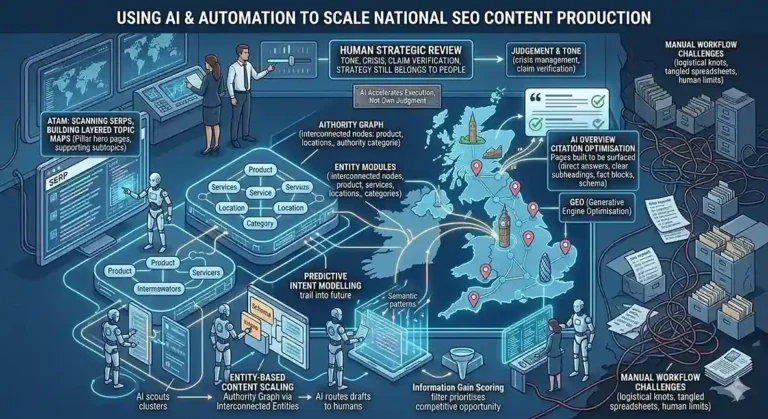
Scaling content at a national level sounds straightforward on paper. Like identify locations, map keywords, produce pages, repeat. In reality, it becomes a logistical knot.
Every new city variation multiplies research, internal linking decisions, and performance tracking. What begins as an organised roadmap slowly turns into scattered documents, duplicated efforts, and missed gaps in coverage.
Why Traditional Workflows Fail At Scale
Planning alone becomes overwhelming when teams attempt dozens of geo-specific and intent-rich clusters. Manual keyword mapping rarely accounts for Predictive Intent Modelling, so content reacts to search behaviour instead of anticipating it.
Writers work from static briefs, editors optimise retrospectively, and distribution happens as an afterthought. Without Automated topical authority mapping or structured Entity-based content scaling, pages compete against each other. They do it rather than reinforcing a coherent authority graph.
Even optimisation for emerging formats like GEO (Generative Engine Optimisation) and AI Overview citation optimisation gets bolted on too late, once rankings plateau.
AI as a Force Multiplier, Not a Replacement
AI should not be mistaken for the chef running the kitchen. It is closer to the sous-chef who prepares the mise en place, so the head chef can focus on craft and taste. When used correctly, it supports scaling national SEO with AI agents.
This enables Automated content engineering for UK brands that reduces friction in research, structuring, and refinement. It does while leaving strategic judgement firmly in human hands.
Harnessing AI SEO Content Automation: The Strategic Core
If the earlier sections described the pressure, this is where the release valve sits. AI SEO content automation is not about publishing faster for the sake of it. It is about building a system that thinks ahead. They connect dots and remove repetitive friction from national campaigns.
What AI SEO Content Automation Really Means In Practice
In practical terms, it begins long before a draft appears. AI supports ideation by analysing live SERP shifts. And it applies entity extraction to strengthen Entity-based content scaling.
The layers in Predictive Intent Modelling reflect where demand is moving, not where it has already peaked. From there, structured briefs are generated with built-in Information gain scoring. This helps teams to avoid recycled angles.
This is not mere text generation. It is Automated content engineering for UK brands. Where outlines, schema suggestions, internal link pathways, and revision checkpoints are systemised. Briefs evolve, pages re-optimise in loops. And adjustments happen continuously, not quarterly.
AI Agents & Workflow Orchestration
True impact emerges when organisations move towards scaling national SEO with AI agents that act as orchestration layers. These systems scout topic clusters through automated topical authority mapping.
They generate structured briefs, route drafts to human editors, and auto-refresh content. It does to align with GEO (Generative Engine Optimisation) signals and AI Overview citation optimisation opportunities.
This is not tool stacking. It is a deliberate workflow architecture, adaptive, and built to scale without collapsing under its own weight.
Emerging Frameworks Driving Scalable SEO Content
Tactics come and go, but the frameworks endure. If national SEO is going to scale without turning chaotic. It needs structured models that guide production beneath the surface. Not louder publishing and smarter architecture.
Automated Topical Authority Mapping (ATAM)
Automated topical authority mapping replaces guesswork with live intelligence. Instead of manually exporting keywords into sprawling spreadsheets. AI scans evolving SERPs, competitor ecosystems, and question clusters in real time.
It identifies gaps, overlapping intent, and thin areas of coverage. Then it builds layered topic maps. Such as pillar hero pages, supporting subtopics, and micro-intent assets beneath them.
The difference is subtle but powerful. Spreadsheets freeze strategy in time. ATAM tend to adapt. It strengthens signals for scaling national SEO with AI agents. This ensures every page reinforces a coherent authority footprint rather than floating in isolation.
Entity-Based Content Scaling
Search engines increasingly interpret meaning through entities, not just keywords. Entity-based content scaling treats topics as interconnected concepts. Following it, products are linked to services, services are tied to locations, and locations are embedded within broader category clusters.
Schema integration and structured data deepen those relationships. This creates authority graphs that align with how AI systems interpret context.
This structural depth is exactly what Automated content engineering for UK brands requires in a landscape. It is shaped by AI retrieval systems.
Predictive Intent Modelling + Information Gain Scoring
Looking back at historic search data is safe. It is also limiting. Predictive Intent Modelling analyses behavioural shifts, emerging queries, and semantic patterns. It is to anticipate what users are likely to search next. Layer in Information gain scoring, and content ideas are prioritised by projected uniqueness. And a competitive opportunity rather than volume alone.
This approach elevates GEO (Generative Engine Optimisation) readiness. And even improves AI Overview citation optimisation. Because pages are designed to answer tomorrow’s questions before competitors notice the pattern. That foresight changes everything.
Deep Dive: Automating For AI Overview Citation Optimisation
A top ranking used to be the goal. Now it is not enough. If your page is not cited inside an AI Overview, you are often invisible.
With strong AI SEO content automation, citations are planned early. It is not added at the end. Structure comes first. Polish comes later.
Pages built for AI Overview citation optimisation often include:
- Short, direct answers near the top
- Clear subheadings that match real questions
- Small fact blocks with trusted statistics
- A schema that strengthens Entity-based content scaling
- Context written with GEO (Generative Engine Optimisation) in mind
The shift is subtle but powerful. When teams start scaling national SEO with AI agents, they can test heading formats, summary blocks, and structured snippets at speed. Weak sections are replaced. Strong ones expand.
One UK retail brand used Automated content engineering for UK brands to rebuild product guides into tight answer modules. They selected topics through Predictive Intent Modelling, then filtered them with Information gain scoring to avoid generic angles.
Within weeks, more of their pages appeared in AI summaries. No tricks, just structure, clarity, and steady refinement.
Human Oversight: Where People Still Win
Automation can map clusters, score ideas, and even flag gaps through Predictive Intent Modelling. It can strengthen structure with Entity-based content scaling and support scaling national SEO with AI agents at a pace no team could match alone.
But it does not understand tone shifts after a crisis. It does not make sense when a claim feels off. It cannot weigh brand risk the way a human can. Strategy still belongs to people.
Even in advanced Automated content engineering for UK brands, humans decide what not to publish. They question data. They adjust nuance for GEO (Generative Engine Optimisation) realities.
AI accelerates execution. It does not own judgment. And that difference matters more than most teams admit.
Conclusion
National SEO cannot run on static calendars anymore. Search moves too fast. Intent shifts. AI reshapes visibility rules almost overnight. If workflows stay fixed, performance stalls quietly at first, then all at once.
This is where AI SEO content automation becomes practical, not theoretical. Start small. Test one cluster. Automate the research layer. Refine briefs. Measure citation lift. Learn. Adjust.
Do not rebuild everything in a week. Build proof instead. The teams that win will not publish the most content. They will build the smartest systems, then improve them steadily, while everyone else is still updating spreadsheets.
Frequently Asked Questions
1. Is AI SEO content automation only for large enterprises?
Not at all. Smaller teams often benefit more because it removes heavy research work. Even one automated workflow can free hours each week.
2. Does scaling national SEO with AI agents reduce content quality?
It can, if left unchecked. But with strong human review and clear structure, quality usually improves because gaps and overlaps become easier to spot.
3. How does Automated topical authority mapping help?
It shows where coverage is thin or outdated. Instead of guessing, you build around real search patterns.
4. Is GEO really necessary now?
If AI summaries affect your visibility, yes. GEO shapes how content gets surfaced, not just ranked.
5. Can AI replace strategy?
No. It speeds up execution, and decisions still belong to people.