

Introduction
Search engines no longer read pages the way they once did. They do not just scan for keywords. They try to understand the meaning.
That shift has changed how content needs to be written and structured. It is no longer enough to describe something well. You also need to explain it in a way that machines can interpret clearly.
This is where structured data comes in.
It serves as a sort of guide. It is actually explaining to search engines what your content is about, rather than just what it says. If utilised appropriately, using schema markup for SEO can help tie your brand, content and expertise together to the actual entities.
And that connection plays a direct role in how your site performs in modern search.
Table of Contents
Why Structured Data Matters in Entity SEO
Structured data does something simple, but powerful. It removes confusion.
When a search engine reads a page, it tries to interpret meaning from text. That works to a point. But language can be unclear. Words can mean different things depending on context.
Structured data is the key to fixing this problem. It helps tag and explain what each bit of information is about. For example, a name might be a person, a company, or a product. Structured data removes that confusion.
There is also a difference between what users see and what search engines process.
- Visible content explains ideas.
- Structured data explains meaning.
This matters for entity SEO.
Search engines rely on connections. They link entities together inside systems like the Knowledge Graph. Structured data helps build those links.
It strengthens:
- Entity recognition
- Relationship mapping
- Contextual understanding
Without it, search engines rely on guesswork. With it, they rely on clarity.
Schema Markup for SEO
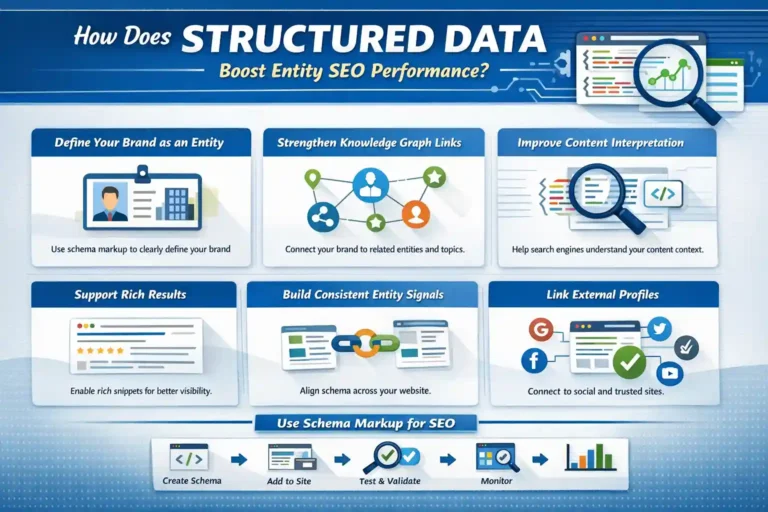
Define Your Brand as a Clear Entity
Start with identity. Search engines must know exactly what your brand is, not a vague idea. Schema markup helps define this clearly.
Using the Organisation or Person schema, you can describe:
- Your business name
- Logo
- Website
- Location
- Key details
These attributes form a clear entity profile. Without this, your brand may appear fragmented across the web. With it, everything connects. It reduces ambiguity. It tells search engines, “This is who we are.” That clarity becomes the foundation of entity SEO.
Strengthen Knowledge Graph Connections
Search engines build relationships between entities. They connect people, brands, topics, and ideas. Structured data supports this process.
When you define entities clearly, search engines can link them more easily. Your content becomes part of a larger network. This is how knowledge graph signals grow.
For example, if your content connects your brand to specific services, tools, or topics, those relationships become stronger over time. It is not immediate. But it builds.
Once those connections form, your brand becomes easier to recognise in search results.
Improve Search Engine Interpretation of Content
Content can be clear to humans but confusing to machines. Structured data bridges that gap. It helps search engines understand:
- What the page is about
- Who the content is for
- How it connects to other topics
Instead of relying only on text, search engines use structured signals to interpret meaning. This improves semantic SEO.
Your content becomes easier to classify. It aligns better with entity-based search systems. It reduces the risk of misinterpretation. Think of it as adding structure to meaning.
Support Rich Results and Enhanced Visibility
You may have seen search results that look different. Some show ratings. Others show FAQs. Some display detailed information. These are rich results.
Structured data makes them possible. When search engines understand your content clearly, they can present it in enhanced formats. This improves visibility and builds trust.
Users tend to trust results that look complete and well-structured. A clean, detailed result stands out more than a plain link.
That small difference can influence clicks. Visibility is not just about ranking. It is also about presentation.
Build Consistent Entity Signals Across Pages
One page is not enough. Entity SEO works best when signals are consistent across your entire site. Structured data helps maintain that consistency.
By using a similar schema across pages, you reinforce your identity.
For example:
- Your brand details remain the same
- Your services are consistently defined
- Your content connects back to your core entity
This creates a network. Each page supports the others, and each signal reinforces the next. Over time, this consistency strengthens recognition. Search engines begin to trust your entity more.
Connect Structured Data with External Signals
Your website is only part of the picture.
Search engines also look at external sources. They compare information across platforms. They check if your brand appears consistently elsewhere. Structured data helps connect these signals.
You can link:
- Social profiles
- Official pages
- External references
This creates alignment. When your internal data matches external data, your entity becomes stronger. Trust increases.
If there is a mismatch, confusion grows. Consistency across platforms is not optional. It is essential.
Use Tools to Implement and Validate Schema
Structured data needs to be accurate. Small errors can break its effectiveness. The good news is that tools exist to help.
You can use:
- Structured data generator tools
- Schema markup checker tools
- Validation tools from search engines
A simple process works well:
- Create your schema
- Add it to your website
- Test it using a checker
- Monitor for issues
Do not skip testing. Even a minor mistake can stop search engines from reading your data properly. Validation ensures everything works as expected.
How Structured Data Impacts Entity SEO Performance
Structured data strengthens how search engines understand your brand. It improves entity recognition. It connects your content to the knowledge graph. It supports semantic understanding.
Over time, this leads to better visibility. Your content becomes easier to interpret. Your brand becomes easier to trust. Your pages become more aligned with entity-based search.
Using schema markup for seo is not about quick wins. It is about building a clear and reliable presence. It supports a long-term strategy.
As search continues to evolve, structured data becomes more important, not less.
Conclusion
Search is moving toward meaning, not just matching. Structured data plays a key role in that shift. It helps search engines understand what your content represents. It removes confusion and builds clarity.
For entity SEO, this is essential. When your brand is clearly defined, consistently presented, and properly structured, it becomes easier to recognise and trust.
That is what modern search systems look for. Using schema markup for seo is not a shortcut. It is a foundation that supports everything else you do in SEO.
Start small. Keep it consistent. Over time, the impact becomes clear.
Reach out to secure your service today.
Frequently Asked Questions
1. What is schema markup in SEO?
Schema markup is a form of structured data that helps search engines better understand the meaning of your content.
2. How does structured data help entity SEO?
It defines entities, connects relationships, and improves how search engines interpret your content.
3. Do I need schema markup for my website?
It is not mandatory, but it strongly improves clarity and visibility in modern search systems.
4. How can I add schema markup to my site?
You can use structured data generators or manually add schema code to your website pages.
5. What tools can I use to check schema markup?
You can use schema validation tools and markup checkers to test and verify your structured data.