


Introduction
Internal linking works well on small sites. You can manage it by hand. But things change fast at the national level. A site may hold thousands of pages. Some grow daily, and what worked before starts to break.
Links get added without a plan. Pages sit too deep. Some never get found. Others get too many links and lose focus. This creates weak crawl paths. It also wastes authority that should move to key pages. This is where most teams struggle. They try to fix it by adding more links. That rarely helps.
Internal linking for large scale websites is not about volume. It is about control. Clean structure matters more than link count. When links follow a clear system, search engines perform better. Authority flows where it should.
Table of Contents
Why Internal Linking for Large Scale Websites Fails Without Structure
Large websites rarely lack links. The real issue is poor structure. Pages pile up, and links get added without rules. Over time, the site becomes hard to crawl and hard to understand. When this happens, SEO site architecture for national brands breaks down and valuable authority gets lost.
Link Volume Without Direction Dilutes Authority
- Too many links on one page weaken the Internal PageRank (IPR) flow.
- Important pages lose strength because nothing guides priority.
- Internal link equity distribution at scale becomes random instead of intentional.
- Search engines struggle to find your true money pages.
Flat Navigation Cannot Support A National Scale
A single navigation cannot guide thousands of pages. It flattens the structure. This hurts crawl depth optimisation (3-click rule). Important pages drift further away. Search engines see no hierarchy. That slows discovery.
Random Internal Links Break Topical Relevance
Links often get added without context. This weakens the topical cluster internal linking strategy. It also disrupts entity-based internal linking. When relationships are unclear, search engines struggle to map meaning. Relevance drops, even if the content is strong.
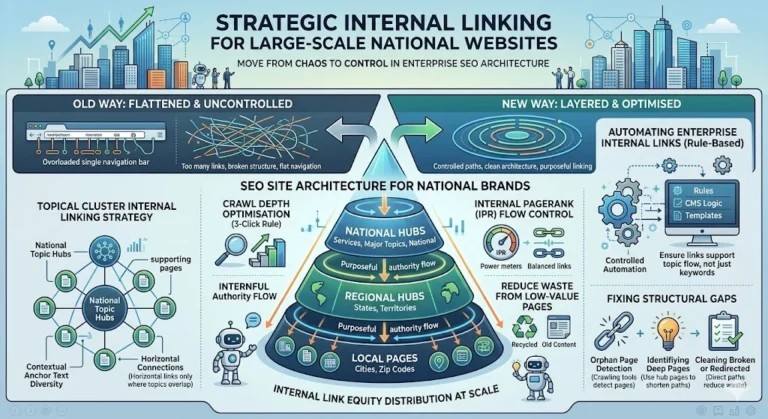
Designing SEO Site Architecture for National Brands
Structure must match the size of the business. Simple category trees are not enough here. Large sites need clear paths, or they lose control fast. Strong SEO site architecture for national brands helps search engines read intent and scale at the same time.
Build Layered Hierarchies Based on Intent and Geography
Create Controlled Crawl Depth (3-Click Rule in Practice)
Start broad, then go deeper. A national page should lead to regional sections, then local pages. Each layer must serve a clear purpose. Avoid mixing services and locations in random ways. That breaks the flow and weakens entity-based internal linking. Clean layers help define topics and improve how search engines connect meaning.
Important pages should not sit too deep. Keep them within reach. Use hub pages to shorten paths and guide movement. This supports crawl depth optimisation (3-click rule) and improves access across large structures.
Use Entity-Based Internal Linking to Strengthen Topics
Link ideas in your content, not just URLs. Connect related concepts with context. This builds stronger signals and supports semantic clarity across the site.
Internal Link Equity Distribution at Scale
Authority does not move on its own. It follows a structure. On large sites, this flow often breaks. Links get placed without thinking about value. Over time, strong pages weaken. A clear plan for internal link equity distribution at scale keeps control in place.
Prioritise Pages That Drive National Visibility
Not every page needs equal attention. Focus on pages that bring traffic and conversions. These often sit at the core of your SEO site architecture for national brands. Guide links toward them. Let supporting pages feed authority upward. This builds stronger signals across the site.
Control Internal PageRank (IPR) Flow with Intentional Linking
Limit the number of links on key pages to protect Internal PageRank (IPR) flow
- Avoid linking out to weak or unrelated pages
- Keep link paths short and purposeful
- Support the topical cluster internal linking strategy by linking within related groups
- Small changes here can shift how authority moves across thousands of pages.
Reduce Waste from Low-Value Pages
Old blogs, thin pages, or expired content still absorb value. This creates drag and limits internal links pointing to them. Where possible, update or merge content. Clean linking improves flow and supports stronger topic relevance.
Topical Cluster Internal Linking Strategy for National Reach
Clusters behave differently on large sites. What works on small blogs often fails here. You need order, not just connections. A clear internal linking for large scale websites approach helps clusters carry authority across thousands of pages without confusion.
Build National Topic Hubs That Support Subtopics
Start with one strong hub. This acts as the centre of the topic. Then connect supporting pages under it. Each page should serve a clear role. This builds a clean topical cluster internal linking strategy and supports a strong hierarchy. It also improves entity-based internal linking, as related ideas stay grouped.
Connect Clusters Horizontally Where It Makes Sense
- Link only when topics truly overlap
- Keep relevance tight between pages
- Avoid linking just for SEO gain
- Support natural paths across clusters
This helps search engines understand relationships without noise.
Maintain Contextual Anchor Text Diversity
Repeating the same anchor weakens signals. Keep it natural. Mix phrases. Use context. This improves contextual anchor text diversity and supports semantic clarity. It also reduces the risk of over-optimisation while keeping links useful for users.
Automating Internal Links for Enterprise SEO Without Losing Control
Automation can save time. It can also create problems fast. Large sites need systems, but they also need limits. A smart approach to automating internal links for enterprise SEO keeps control while scaling effort.
Rule-Based Linking Systems for Scale
Set clear rules before you automate anything. Decide where links should appear and why. Use keyword triggers with care. Not every match needs a link. Strong rules protect internal link equity distribution at scale and support better entity-based internal linking. This keeps relevance intact across thousands of pages.
Dynamic Internal Linking via Templates and CMS Logic
- Use templates to insert links across similar pages
- Apply CMS logic to control placement
- Keep links aligned with SEO site architecture for national brands
- Ensure links support topic flow, not just keywords
This creates consistency without manual effort.
Avoid Over-Automation That Creates Spam Signals
Too much automation leads to noise. Repeated anchors look forced. Irrelevant links break trust. This harms contextual anchor text diversity and weakens structure. Keep automation tight. Review outputs often. A controlled system always performs better than a fully automated one.
Fixing Structural Gaps That Block Authority Flow
Even well-built systems can fail over time. Gaps appear as sites grow. Pages get missed. Links break. These small issues can block internal link equity distribution at scale and weaken overall performance
Orphan Page Detection at Scale
Orphan pages sit outside the structure. They have no internal links pointing to them. Search engines struggle to find them. Use crawling tools to detect these pages and reconnect them. This improves entity-based internal linking and restores visibility.
Identifying Deep Pages That Never Get Crawled
Some pages sit too far from the main structure. High depth reduces access and slows indexing. Fix this with hub pages and better paths. This supports crawl depth optimisation (3-click rule) and aligns with strong SEO site architecture for national brands.
Cleaning Broken or Redirected Internal Links
- Remove links pointing to redirects
- Fix broken URLs quickly
- Keep link paths direct and clean
These fixes reduce waste and improve flow across the site.
Conclusion
Internal linking often looks simple. At scale, it is not. Large websites need control, not more links. When structure is clear, authority moves with purpose. When it is not, value gets lost across the site.
Good systems guide flow. They show search engines what matters most. They keep important pages close and connected. This is where many national sites win or fail.
Automation can help, but it should never lead the process. Strategy must come first. Rules, structure, and intent decide how links behave.
In the end, internal linking for large scale websites is not about adding more paths. It is about shaping them. Done right, it builds strength across the whole site.
Frequently Asked Questions
1. How do we handle internal links on very large websites?
We set clear rules first. Then we apply them across templates. This keeps the structure stable as the site grows.
2. Why does link structure matter more than link count?
More links can create noise. A clean structure helps the authority move to the right pages.
3. What is the best way to support topic clusters at scale?
We build strong hubs and connect related pages with context. This keeps topics clear.
4. How can we stop important pages from losing value?
We limit unnecessary links and guide flow using internal PageRank signals.
5. Should we rely fully on automated internal linking?
We don’t. Automation helps, but we always control rules to keep links relevant.