

Introduction
Going global sounds simple at first. You add new pages and translate your content. It feels like traffic should follow soon. But that is not what happens. Traffic stays flat. Rankings barely move. Something feels off.
Most people blame the content. That seems like the obvious reason. But in many cases, it is not true. The real issue sits in the background. It comes from how the site is set up.
This is where Domain Structure SEO starts to matter. It shapes how search engines read your site. It also guides where your pages appear. If the structure is weak, things can break. Good content alone will not save it.
Fixing this is not as complex as it seems. You just need to see what is going wrong. Then you can adjust the setup step by step. With the right structure in place, your site can grow across new markets.
Table of Contents
What Is Domain Structure SEO and Why It Matters for Global Visibility
Domain Structure SEO is about how your site is set up. It looks at your domains and your URLs. This setup shapes how search engines read your pages. It is not just about design or menus. It goes deeper than that.
Think of it like the base of your site. Everything sits on top of it. If the base is weak, things can fall apart. If it is strong, your site holds steady.
In international SEO, this matters even more. Your structure shows where your content should appear. It tells search engines which country you want to reach. If those signals are not clear, confusion starts. And when that happens, rankings can drop.
Search engines use your structure to make sense of things. They look at location, language, and page links. This helps them decide what to show and where.
If your structure feels messy, problems build over time. You may not notice it at first. But slowly, your visibility can start to slip.
How Domain Structure SEO Influences Global Search Visibility Across Markets
There’s a direct relationship between structure and performance. Not always obvious, but always present.
A well-planned Domain Structure SEO approach improves:
- Visibility across multiple countries
- User trust in local markets
- Crawl efficiency for large websites
A poorly planned one does the opposite.
Search engines don’t just look at content. They analyse your global SEO structure to decide which version of your site belongs in which market. If those signals are unclear, your pages compete against each other, or worse, don’t rank at all.
Let’s break this down further.
Choosing the Right International Domain Structure
One of the first decisions businesses face is choosing between ccTLD vs subdomain vs subdirectory. Each comes with trade-offs.
Structure Type | Example | Best For | Key Advantage | Limitation |
ccTLD | example.fr | Country-specific targeting | Strong geo signals | High cost, harder to manage |
Subdomain | fr.example.com | Regional separation | Flexible setup | Weaker authority sharing |
Subdirectory | example.com/fr/ | Scalable global sites | Consolidates authority | Requires a strong structure |
There’s no universal answer here.
- ccTLDs work well for a strong local presence
- Subdomains suit semi-independent markets
- Subdirectories are ideal for scalable international growth
The choice depends on your domain strategy for SEO, resources, and expansion plans.
URL Structure for International SEO and Geo-Targeting Signals
Your URL structure for international SEO is more than just formatting. It acts as a signal.
Clean, logical URLs help search engines:
- Identify the country being targeted
- Understand content hierarchy
- Crawl pages efficiently
For example:
- /uk/services/ clearly signals UK targeting
- /services/page1?id=123 does not
Strong geo-targeting SEO relies on clarity. If your URLs are inconsistent, your targeting signals weaken.
Keep it simple. Predictable. Structured.
Multilingual Website Structure and Hreflang Implementation Best Practices
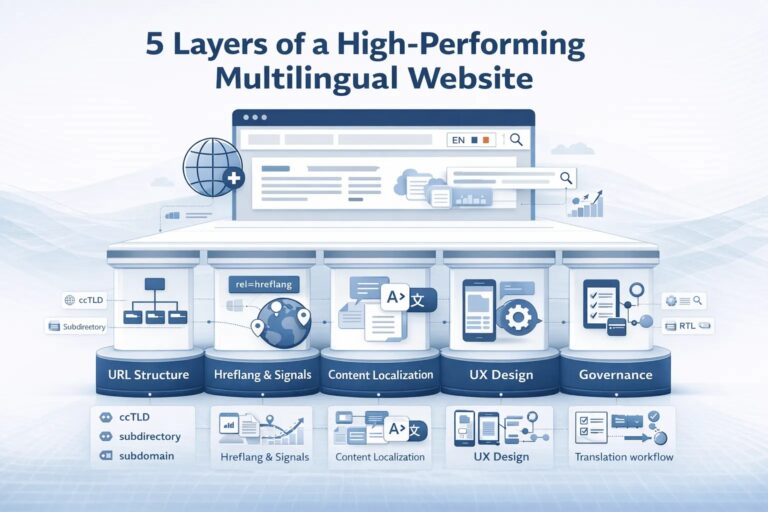
Handling a multilingual website structure introduces another layer of complexity.
Without proper hreflang implementation, search engines may:
- Show the wrong language version
- Flag duplicate content
- Split ranking signals across pages
Best practices include:
- Mapping language and region correctly
- Using consistent URL patterns
- Avoiding auto-redirects based solely on IP
It’s not just technical. It directly impacts user experience and international search rankings.
Common Domain Structure SEO Mistakes That Limit Global Rankings
Some issues are obvious. Others hide in plain sight.
Many websites struggle not because they lack effort, but because their structure sends mixed signals.
International Domain Structure Errors That Confuse Search Engines
An inconsistent international domain structure creates confusion.
Common issues include:
- Targeting multiple countries with the same page
- Overlapping regional content
- Competing domains for the same keywords
This leads to domain cannibalisation, where your own pages compete instead of supporting each other.
Global Website Architecture Issues That Impact Indexing
Your global website architecture determines how efficiently search engines crawl your site.
If pages are buried too deep or poorly linked:
- They may not get indexed
- Or get indexed too late
Crawl inefficiencies are often overlooked. But they directly affect visibility.
Domain Strategy for SEO Misalignment Across Multiple Countries
Scaling across regions without a clear domain strategy for SEO leads to fragmentation.
You might see:
- Different structures for different countries
- Inconsistent URL formats
- No unified hierarchy
This creates long-term scalability issues.
And fixing it later? Much harder.
Best Practices to Optimise Domain Structure SEO for International Growth
There’s no perfect structure. But there are proven principles.
The goal is alignment between your business, your markets, and your website
Website Structure for International Targeting and Scalability
A strong website structure for international targeting should:
- Be consistent across all regions
- Allow easy expansion
- Maintain a clear hierarchy
Plan for growth early. Retrofitting the structure later is expensive and risky.
Country-Specific Domains and International Search Rankings Strategy
Using country-specific domains can strengthen international search rankings, but only if managed properly.
They work best when:
- You have local teams or operations
- Content is tailored for each market
- Branding remains consistent
Otherwise, they become difficult to maintain.
Domain Hierarchy SEO and Internal Linking for Global Visibility
A clear domain hierarchy SEO approach improves both user experience and search performance.
Internal linking plays a key role here:
- Connect related regional pages
- Reinforce topic relevance
- Guide search engine indexing
Think of it as building pathways, not just pages.
How to Choose the Right Domain Structure SEO Strategy for Your Business
There’s no one-size-fits-all answer. And that’s often where businesses get stuck.
Instead, consider:
- Business size – smaller teams benefit from simpler structures
- Target regions – local vs global focus
- Resources – content, technical support, ongoing management
If you’re targeting multiple countries with limited resources, a subdirectory model often makes sense.
If local dominance is the goal, ccTLDs may be worth the investment.
The key is not choosing what’s “best” in theory, but what’s sustainable in practice.
Conclusion
Global visibility doesn’t happen by accident. It’s built — layer by layer, decision by decision. And at the centre of it sits Domain Structure SEO. When your structure aligns with your international goals, everything else becomes easier. Search engines understand your intent. Users find the right content. Rankings improve naturally.
But when structure is overlooked, even strong content struggles to perform. If you’re serious about scaling internationally, your domain strategy isn’t just a technical choice. It’s a strategic one.
To go deeper, explore our International SEO Strategy pillar or speak with our team at Midland Marketing to build a structure that supports long-term growth.
Frequently Asked Questions
What is Domain Structure SEO in international SEO?
Domain Structure SEO is about how your site is arranged for different countries. It includes your domains, your URLs, and how pages connect. When the setup is clear, search engines can quickly tell where each page belongs and who should see it.
How does domain structure affect global search visibility?
Your site structure gives signals to search engines. It shows which country your content targets. If things are messy, pages can get lost. When it’s clean and simple, your content is easier to find and rank.
Which works better: ccTLDs, subdomains, or subdirectories?
There isn’t one perfect choice here. Some brands use ccTLDs to feel more local. Others stick with subdirectories because they’re easier to handle. It really comes down to your goals and how you want to grow over time.
What does a good international URL structure look like?
A good setup feels easy from the start. You should be able to read a URL and understand it. Paths like /uk/ or /fr/ make things clear. Both users and search engines can follow them without confusion.
How can I set up my site for multiple countries?
Start simple and keep things organised. Use a clear structure that makes sense. Keep your URLs steady across pages. Add hreflang where needed, and make sure your setup can handle growth later on.