


Introduction
Search has transformed dramatically with the rise of AI search models powered by large language models (LLMs). In 2026, search engines no longer function as simple indexing systems. Instead, they interpret intent, retrieve semantically relevant information, and generate contextual responses. Understanding how LLMs retrieve content, how LLMs rank content, and the evolving AI search ranking factors 2026 is critical for digital marketers, publishers, and SEO professionals navigating generative search ecosystems.
Table of Contents
The Evolution of AI Search Models
From Keyword Matching to Semantic Search AI
Traditional search engines were primarily rule-based systems. They relied on keyword matching, backlink authority, anchor text signals, and technical SEO indicators. A page ranked well if it matched the search query terms and had strong link authority. Relevance was largely surface-level, driven by lexical similarity rather than contextual meaning.
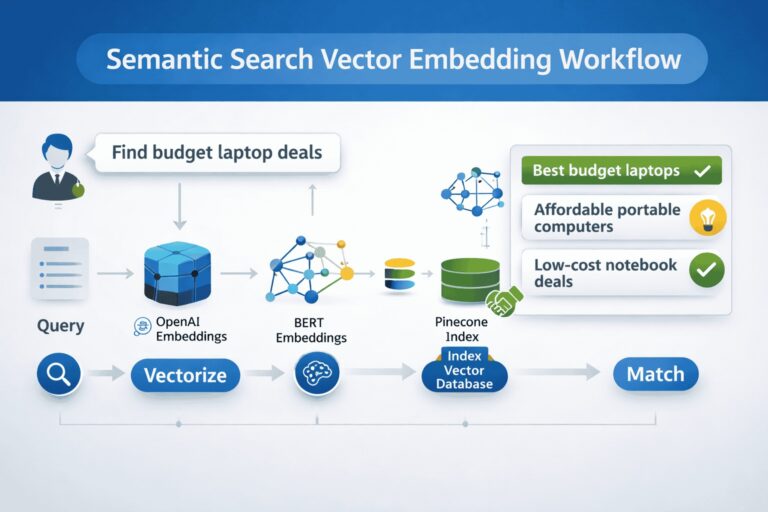
In contrast, modern AI-powered search engines operate on semantic search AI principles. Instead of scanning for exact keywords, AI systems analyse contextual relationships between terms. They interpret what a user intends to know rather than what they typed verbatim. This shift means that content visibility is determined by depth, coherence, and semantic alignment rather than keyword density alone. Key differences include:
- Traditional search ranks full pages; AI retrieves contextual content chunks.
- Keyword repetition is replaced by semantic similarity.
- Authority extends beyond backlinks to entity and citation validation.
- Results are synthesised answers instead of link directories.
The Emergence of Generative Search Engines
Generative search engines combine retrieval systems with transformer-based language models to produce synthesized answers. Instead of returning ten blue links, they generate summaries based on multiple sources, often incorporating citations. This marks the shift toward conversational and zero-click search experiences. Users now expect:
- Direct explanations
- Follow-up question continuity
- Context retention
- Summarized insights
This transformation has reshaped discoverability. Content must now be structured in a way that allows AI systems to extract and synthesize it effectively. Ranking is no longer about being “position one” but about being selected as a trusted input during answer generation.
What Powers AI Search Models?
Large Language Models and Transformer Architecture
Large language models are built on transformer architecture, which uses attention mechanisms to understand contextual relationships across text. Instead of processing language sequentially, transformers evaluate multiple word relationships simultaneously. This allows for deeper contextual interpretation and multi-step reasoning. LLMs demonstrate several capabilities relevant to search:
- Context-aware language modeling
- Multi-layer semantic understanding
- Natural language processing (NLP) precision
- Entity recognition and linking
- Coherent text generation
However, LLMs do not inherently access real-time information. Their pretrained knowledge must be supplemented by external retrieval systems. This is where retrieval-augmented frameworks become essential.
How LLMs Retrieve Content
Embeddings and Vector Search
In 2026, AI search models convert both queries and content into embeddings. Embeddings are high-dimensional numerical representations that encode semantic meaning. When a user submits a query, it is transformed into a vector. That vector is compared against millions of stored vectors representing content segments.
This process, known as vector search, enables semantic matching rather than lexical matching. For example, a query about “AI content ranking” can retrieve material discussing contextual ranking systems or citation-based authority even if the exact phrase does not appear. The retrieval process typically includes:
- Query embedding generation
- Vector similarity comparison
- Retrieval of top-matching content chunks
- Context validation before synthesis
Unlike traditional indexing, which retrieves whole documents, vector search retrieves relevant fragments. This improves precision and allows AI systems to assemble answers from multiple sources.
Retrieval-Augmented Generation (RAG)
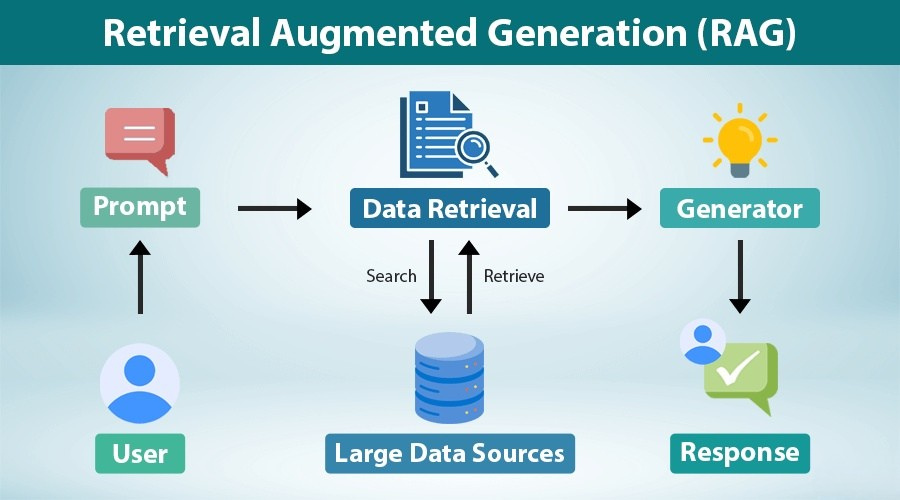
Most generative search engines use Retrieval-Augmented Generation (RAG). This framework enhances reliability by combining retrieval systems with generative models. After retrieving relevant content chunks, the system provides them as contextual grounding for the LLM. The LLM then:
- Synthesizes the retrieved information
- Structures it coherently
- Adds citations when applicable
- Reduces hallucination risk
RAG ensures that responses are anchored in real data rather than relying solely on pretrained memory. This has significantly influenced LLM search optimization strategies, as content must now be both retrievable and generatively usable.
How LLMs Rank Content in 2026
AI Search Ranking Factors 2026
Ranking in AI-driven systems is multi-layered. AI search ranking factors in 2026 extend beyond backlinks and technical SEO. Ranking now evaluates semantic and contextual attributes. Core ranking factors include:
- Semantic relevance to query intent
- Contextual completeness
- Entity clarity and relationship mapping
- Authority signals
- Citation frequency
- Factual consistency
- User engagement signals
AI content ranking is dynamic and adaptive. It does not assign a single fixed position; instead, it recalculates relevance in real time based on user intent and conversational context.
Contextual Ranking and Search Intent
Search intent plays a decisive role in how LLMs rank content. AI systems classify queries into informational, transactional, navigational, or conversational categories. Content is evaluated against the inferred intent. For informational queries, AI prioritizes:
- Depth of explanation
- Structured reasoning
- Comprehensive topic coverage
For transactional queries, the system may emphasize:
- Clear solutions
- Practical guidance
- Decision-support information
Contextual ranking also measures logical coherence. Content that flows naturally from foundational explanation to advanced insight tends to perform better because it aligns with user cognitive patterns.
Authority Signals and Citation-Based Ranking
Authority in AI-powered search is multi-dimensional. While backlinks still contribute, AI systems incorporate broader credibility indicators. Citation-based ranking has become especially important. If a source is frequently retrieved and cited in generated responses, its authority increases within the AI ecosystem. Modern authority signals include:
- Knowledge graph alignment
- Consistent entity representation
- Cross-source validation
- Structured data integrity
- Historical trust patterns
Citation-based reinforcement creates a feedback loop. High-quality content becomes more visible as it is repeatedly selected during generative synthesis.
Knowledge Graphs and Entity Recognition
Entity Recognition in Semantic Search
AI search models use entity recognition to identify structured concepts within content. Entities may include technologies, organizations, people, or conceptual frameworks. These entities are mapped within knowledge graphs that define relationships between them.
When content clearly explains relationships, for example, between large language models, retrieval augmented generation, vector search, and embeddings, it strengthens contextual clarity. AI systems prefer content that aligns with structured knowledge frameworks. Entity-driven optimization improves:
- Semantic disambiguation
- Contextual ranking accuracy
- Factual reliability
- Retrieval precision
Knowledge Graph-Based Ranking
Knowledge graphs enhance ranking stability by validating relationships between entities. If content aligns with verified data structures, it receives stronger trust weighting. Conversely, ambiguous or contradictory information may be ranked lower due to reduced confidence scores.
This integration supports hallucination prevention and reinforces reliable generative outputs.
Multimodal and Conversational Search
Multimodal Search Capabilities
AI search in 2026 extends beyond text. Multimodal search allows users to combine text, images, voice, and structured inputs. Embeddings are generated across formats, enabling cross-modal semantic comparison. Multimodal ranking evaluates:
- Cross-format semantic alignment
- Context consistency
- Visual-text correlation
This expansion increases the complexity of AI search optimization, as content must now support broader interpretive contexts.
Conversational Search and Dynamic Ranking
Conversational search systems maintain session memory. When users refine queries, AI adjusts retrieval and ranking dynamically. For example, a second query builds upon the first, narrowing semantic context. Dynamic ranking involves:
- Context carryover
- Intent refinement
- Progressive narrowing of semantic scope
This enables more precise contextual ranking but also demands structured, logically layered content.
Hallucination Prevention and Grounded Ranking
Hallucination remains a known challenge in generative systems. To mitigate this, AI search models rely on grounding mechanisms. Retrieval-augmented frameworks and citation-based validation ensure that generated answers are evidence-backed. Content that demonstrates:
- Clear sourcing
- Entity alignment
- Factual consistency
- Contextual coherence
LLM Search Optimization (AISO) in 2026
LLM search optimization, often referred to as AI search optimization (AISO), requires adapting content strategies to semantic retrieval environments. Optimization now focuses on meaning, clarity, and structural coherence rather than keyword stuffing. Effective optimization involves:
- Structuring content with logical H2 and H3 hierarchies
- Covering topics comprehensively
- Integrating related entities naturally
- Writing semantically rich paragraphs
- Avoiding thin or fragmented content
Because AI retrieves chunks independently, each section should provide standalone value while contributing to overall thematic depth.
Conclusion
AI search models in 2026 retrieve and rank content using semantic similarity, contextual intelligence, and entity-based validation. Large language models powered by transformer architecture rely on embeddings, vector search, and retrieval-augmented generation to produce grounded answers.
As generative search engines continue to evolve, visibility is increasingly determined by how well content integrates into AI reasoning systems. Success in this new landscape requires optimizing for meaning, structure, authority, and contextual intelligence rather than relying solely on traditional SEO tactics.
Frequently Asked Questions
How do AI search models work?
AI search models use large language models, embeddings, and vector search to understand user intent and retrieve semantically relevant information instead of relying only on exact keyword matches.
What is Retrieval-Augmented Generation (RAG)?
Retrieval-Augmented Generation (RAG) combines retrieval systems with AI language models to generate accurate, context-aware responses using external information sources.
What are the main AI search ranking factors in 2026?
Key ranking factors include semantic relevance, contextual depth, entity recognition, citation authority, factual consistency, and user engagement signals.
How does semantic search differ from traditional SEO?
Semantic search focuses on understanding meaning and context, while traditional SEO mainly relied on keyword matching, backlinks, and exact search terms.
What is LLM search optimisation?
LLM search optimisation involves structuring content for AI-driven retrieval systems by improving semantic clarity, topic depth, entity relationships, and content structure.
Why are knowledge graphs important in AI search?
Knowledge graphs help AI systems connect entities and relationships, improving contextual understanding, ranking accuracy, and factual reliability in generated responses.