


Introduction
You know that feeling. Things seem steady. Sales look fine. Nothing feels urgent. Then it changes. A new competitor appears almost overnight. Customers begin asking for features you never planned. Suddenly, your product feels behind. It throws you off balance.
Everywhere you look, people talk about the next big shift. Conversations often revolve around AI, sustainability, new platforms, and changing customer expectations. Some of it matters. Some of it doesn’t. The problem is knowing which is which. Many businesses react too fast. They jump from one idea to another. They spend money. They lose focus. Progress stalls.
That is how strong companies weaken. Real stability comes from clarity. From stepping back and watching patterns form. Not the loud spikes. The quiet, steady movement underneath. Market trend analysis helps you see that movement. It removes guesswork. It replaces panic with direction. You stop reacting. You start preparing. And that changes everything.
Table of Contents
What Is Market Trend Analysis and Why It Matters
Let’s get one thing straight. This isn’t about magic. You won’t predict the future. Nobody can. Market trend analysis is simpler. It’s looking at what’s happened. What’s happening now. And asking intelligent questions about where it’s going. You look for patterns. You check the data. You talk to people. Then you make a call.
Understanding Market Trends Beyond Headlines
A real trend has weight. It’s not a flash in the pan. Think about it. Remember when everyone had a Crocs moment? Some loved them. Some hated them. But the trend underneath? Comfort. People wanted shoes that felt good. That lasted. Crocs were just one expression of that deeper want.
Headlines scream at you. This changes everything. Usually, it doesn’t. A trend whispers. It builds slowly. It shows up in small ways first. A customer request here. A supplier comment there. You have to listen carefully.
Why Trend Analysis Is Essential for Sustainable Strategy
Why bother? Because guessing is expensive. Companies that ignore trends don’t fail overnight. They fade. They become irrelevant. Slowly. Then suddenly.
Paying attention helps you:
- See problems before they become crises
- Find new customers before your competitors do
- Stop wasting money on things people don’t want anymore
- Sleep better at night knowing you have a plan
A sustainable business strategy needs a foundation. Trend analysis is the foundation. It’s honest. It’s grounded. It’s real.
Identifying the Right Types of Market Trends
Not all trends are created equal. Some will reshape your entire world. Others are just noise. You need to know the difference.
Macro Trends: Economic, Social, and Technological Shifts
These are the big ones. The kind that makes or breaks industries. We’re talking about:
Demographics: Countries are getting older. Workforces are shrinking in some places, booming in others.
Technology: AI isn’t just a tool. It’s a new kind of worker.
The Climate Crisis: Not politics. Physics. It’s changing supply chains, insurance costs, and consumer expectations.
You don’t control these. You adapt to them. End of story.
Industry-Specific Trends
Now we’re getting closer to home. These are the shifts happening inside your own sandbox. If you’re in retail, it’s the death of the storefront and the rise of “buy now, pay later.” If you’re in manufacturing, it’s automation and the fight for skilled labour. This is where industry trend research pays for itself. It shows you who’s gaining ground and who’s about to disappear
Consumer Behaviour Trends
People are weird. Their wants change. Right now, we’re seeing some fascinating stuff. People want less stuff. They want experiences. They want brands that don’t make them feel icky about buying from them. They have zero patience for slow service or clunky websites. If you ignore these shifts in consumer behaviour trends, you’re basically handing your customers to someone who paid attention.
How to Conduct Market Trend Research Effectively
Okay. Enough theory. How do you actually do this? You don’t need a massive budget. You need a system.
Gathering Reliable Data Sources
One source is an opinion. Two sources are a theory. Three sources are a trend. Cross-check everything. Talk to your frontline. Your customer service team knows more about emerging problems than any consultant.
Read the boring stuff. Government labour statistics. Academic papers. They’re free, and they’re rigorous. Listen to the edges. What are the weirdos in your industry talking about? The ones at the fringe are often the first to spot the future.
Analysing Historical Performance Patterns
Look backwards. Seriously. Your company’s history is a roadmap. Pull up the last five years of sales data. When did things dip? When did they spike? What else was changing around the world during that period? You’ll start to see cycles. You’ll see what external forces actually move your needle. It grounds your market forecasting methods in reality, not wishful thinking.
Monitoring Competitive Movements
Your competitors are paranoid. They’re watching everyone. So watch them. Did a rival just hire a bunch of sustainability experts? They see a trend. Did they launch a dirt-cheap version of their product? They’re worried about a price war. This is free competitive market insights. Their moves tell you where they think the market is going. Use it.
Turning Market Insights into Strategic Decisions
Aligning Products and Services with Emerging Demand
Let’s say your research shows people are desperate for transparency. They want to know exactly where their product came from. Can you give that to them? Can you put a QR code on your packaging that shows the whole journey? That’s alignment. That’s turning an insight into a feature. It’s how long-term business growth strategy is built, one small, smart move after another.
Adjusting Pricing and Cost Structures
Tough markets require tough choices. If people have less money, you can’t just charge the same. Maybe you can introduce a “lite” version. Maybe you bundle products to create value. On the flip side, if your trend analysis shows people are willing to pay more for ethical production, charge more. Build the cost of doing good into your price. It’s honest. And it works.
Investing in Innovation and Technology
Don’t buy tech because it’s cool. Buy it because it solves a trend-driven problem. Customers want everything faster. Invest in automation. They want personalisation? Invest in data analytics. The technology is just a tool. The trend is the reason. Keep that order straight.
Risk Management and Market Trend Planning
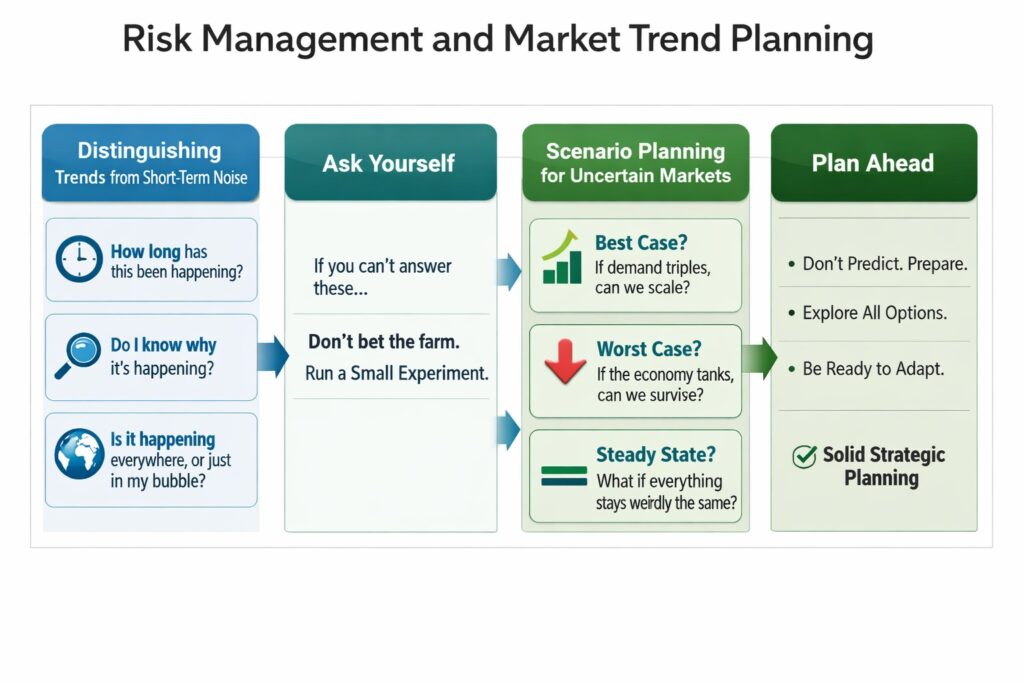
Here’s the uncomfortable part. Sometimes you’re wrong. Sometimes trends reverse. You need a plan for that.
Distinguishing Trends from Short-Term Noise
This is the hardest part. Everyone looks smart in a boom. The skill is spotting the mirage.
Ask yourself:
- How long has this been happening?
- Do I know why it’s happening?
- Is it happening everywhere, or just in my little bubble?
If you can’t answer those, don’t bet the farm. Run a small experiment instead.
Scenario Planning for Uncertain Markets
Don’t predict. Prepare. What’s the best case? What’s the worst case? What’s the “everything stays weirdly the same” case?
For each one, sketch out a rough response. If demand triples, can we scale? If the economy tanks, can we survive? This isn’t pessimism. It’s adult responsibility. It’s the core of solid strategic business planning.
Building a Sustainable Business Strategy Around Trends
Long-term doesn’t mean static. It means flexible. It means rooted in something solid but able to bend in the wind.
Long-Term Strategic Alignment
Your whole company needs to march in the same direction. If the trend is sustainability, your product people need to design for it. Your marketing people need to talk about it (honestly). Your logistics people need to find green shipping. If only one department cares, you’re not aligned. You’re just noisy.
Strengthening Organisational Agility
Agility is a buzzword, but it’s real. It means when a new trend emerges, you can turn the ship without capsizing. It means short decision chains. It means trusting your people to act on what they see. A rigid company breaks in a storm. An agile one bends and stays standing.
Integrating Sustainability and Responsibility
This isn’t about hugging trees. It’s about survival. Regulations are coming. Customers are demanding it. Investors are screening for it.
Ignoring this trend is like ignoring seatbelts. You might be fine for a while. But when the crash comes, it hurts. Bake responsibility into your model now. It’s insurance for your future.
Measuring the Impact of Trend-Based Strategy
If you can’t measure it, you can’t manage it. How do you know your trend bets are paying off?
Key Performance Indicators to Track
Don’t just look at total revenue. Look deeper.
- Are you winning new customers in the segment you targeted?
- Are your best customers sticking around longer?
- Is your brand showing up in conversations it wasn’t in before?
These lagging indicators tell you if your leading insights were any good.
Continuous Review and Adaptation
Trends don’t stop. Neither should you. Every quarter, sit down. Look at your assumptions. Are they still true? Look at your numbers. Are they going up or down? Look at the world. What’s changed? This isn’t about doubting yourself. It’s about staying alive.
Common Mistakes in Market Trend Analysis
Let’s be honest. People mess this up all the time.
- They only look for good news. They ignore the data that says their baby is ugly.
- They drown in data. They have 50 dashboards and zero decisions.
- They hoard insights. The CEO knows something, but the product team doesn’t. Useless.
- They move too late. They wait until the trend is a tidal wave, then wonder why they’re overwhelmed.
Conclusion
Success isn’t about luck. It’s about preparation. Businesses that understand change early win. Market trend analysis gives you that understanding. It shows you the path. It cuts through the noise. It helps you build something real. Something that lasts. Something that grows even when things get hard. Trend analysis turns confusion into clarity. It guides your choices. It strengthens your business. It builds confidence. At Midland Marketing, we help you do this. We turn data into direction. We provide clear insights for confident decisions. If you want a stronger, future-ready business, contact Midland Marketing today. Let’s build a strategy based on evidence. Not guesses. Not hope. Real evidence.
Frequently Asked Questions
What is market trend analysis?
Studying patterns in customer behaviour, industry activity, and economics to guide smarter business decisions and long-term planning.
Why is business trend analysis important?
It helps you spot opportunities early, avoid costly mistakes, and make choices that support steady, lasting growth.
How does industry trend research support business strategy?
It reveals changes in your sector, shows what competitors are doing, and helps you plan for what’s coming next.
What are the best market forecasting methods?
Looking at past data, studying customer patterns, watching competitors, and building different scenarios for the future.
How do consumer behaviour trends affect businesses?
They change what people buy and why. Understanding them keeps your products and message relevant to real humans.