


Introduction
Search has changed. It is no longer just a list of blue links. Now, AI reads your site and takes your facts to build its own answers. If your content is messy, the AI skips you. This is why you need to optimise content for AEO results. It is the art of being the chosen source.
Rankings are fading. The new goal is to be the voice the machine trusts. AEO helps you talk to the systems that run search. It makes your data easy to find and hard to ignore. We are moving from a web of pages to a web of answers. You must pivot now to stay relevant.
This guide shows you how to win the “zero-click” game. You will learn to build trust without using old tricks. Follow these steps to keep your brand visible. Learn to write for humans while being perfect for machines.
Table of Contents
What Is Answer Engine Optimisation

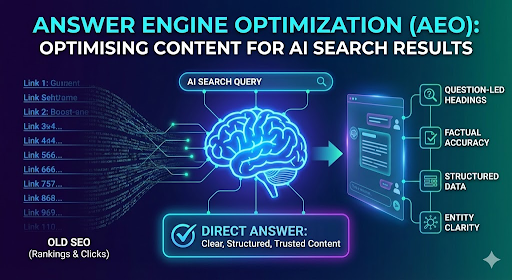
Answer Engine Optimisation is the process of structuring content. AI-driven search systems can clearly extract and present it as a direct response to user questions. The goal is not to rank a page but to make the content eligible to be selected as the answer itself.
Unlike older optimisation models, Answer Engine Optimisation focuses on precision, clarity, and intent alignment. AI systems do not want long build-ups or vague commentary. They want a clean response they can trust.
Well-optimised AEO content is:
- Question-led and explicit
- Factually accurate and verifiable
- Easy for machines to interpret and summarise
How AEO Differs from Traditional SEO
Traditional SEO aims to improve rankings through keywords, backlinks, and technical signals. AEO strategy works higher up the funnel. It focuses on whether content is chosen as the response, not where it sits on a results page.
The most important differences are structural and semantic, not technical.
Key distinctions include:
- Direct responses instead of long introductions
- Meaning and context over strict keyword placement
- Entity clarity rather than exact-match phrases
In practice, this means a page ranking first can still lose visibility if it does not answer the question clearly enough.
Why Answer Engine Optimisation Matters in 2025 and Beyond
Search behaviour is shifting fast. AI summaries, voice responses, and conversational results reduce the need for users to click at all. This is not a future trend. It is already happening.
Rise of AI Search and Zero-Click Results
Modern search interfaces often resolve queries inside the results page. Users receive answers instantly, sometimes without seeing the source page. This creates a visibility gap for content that relies only on rankings.
Answer Engine Optimisation closes that gap by ensuring your content appears inside AI-generated responses. Even when traffic drops, presence and authority remain. Without AEO, content risks becoming background noise.
Impact on Visibility, Trust, and Brand Authority
When AI systems repeatedly reference the same source, users begin to recognise and trust that brand. Over time, this compounds.
Being selected as an answer improves:
- Perceived expertise
- Brand recall
- Long-term trust signals
This influence often matters more than a single visit because it shapes how users remember and evaluate a brand.
How Answer Engines Choose Content
Answer engines do not guess; they assess clarity, relevance, and reliability at scale. Understanding their selection logic is central to effective AI search optimisation.
Question Matching and Intent Clarity
AI systems prioritise content that mirrors the question being asked. If the query is specific, the answer must be equally specific.
Pages that define concepts clearly, avoid fluff, and follow natural language patterns perform better. Ambiguity lowers selection confidence.
Clear intent matching signals that the content is safe to reuse.
Content Structure and Semantic Understanding
Structure helps machines to read faster. Such as logical headings, short paragraphs, and consistent terminology is good. They make relationships between ideas easier to interpret.
Semantic clarity also matters in content. Using related concepts naturally helps search engines confirm relevance without relying on repetition. Well-structured content reduces interpretation risk.
Trust, Accuracy, and Source Signals
Trust determines whether content is reused or ignored. AI systems evaluate multiple credibility signals together.
These include:
- Accuracy and internal consistency
- Alignment with other trusted sources
- Clear expertise and ownership
- Content freshness and updates
Content that demonstrates care and accountability is more likely to be cited.
How to Do Optimise Content for AEO Results (AEO)
In February 2026, Ahrefs updated its data showing that AI Overviews (AIOs) have siphoned away up to 58% of clicks from position-one results. This perfectly backs up your point about “rankings not being the final goal. Effective Answer Engine Optimisation is practical, not complex. It relies on disciplined writing and clear intent.
Write Direct Answers First
Start with the right answer, then some made-up sentences. Do not hide it halfway down the page. Leading with a clear response allows AI systems to extract it instantly. And also, it can still give readers depth later.
This approach improves featured snippets SEO and generative search optimisation. It happens because it removes friction and adds depth to content for clarity.
Use Question-Based Headings
Question-led headings align content with how people interact with AI tools. They also signal relevance directly to answer engines.
Natural questions improve scanning, accessibility, and machine comprehension. They reduce guesswork for both humans and systems.
Each heading should clearly imply the answer beneath it.
Optimise for Entities, Not Just Keywords
Keywords describe words, and entities describe meaning. AI systems rely on entities to confirm context and reduce ambiguity.
Make sure to define concepts clearly and use consistent naming. And avoid switching terms casually. This helps answer engines verify understanding and attribution. Entity clarity can strengthen the content confidence.
Implement Structured Data Where Relevant
Structured data gives machines explicit context about relationships and meaning. Schema markup supports validation and reuse.
It may not be required for every page. But still, structured data improves reliability and supports accurate extraction when used correctly. Think of it as reinforcement to your content, rather than a shortcut.
Keep Content Updated and Verifiable
Outdated content loses trust fast with both AI and readers. AI systems favour sources that demonstrate ongoing accuracy.
Regular updates, current references, and factual checks signal responsibility. This matters more than frequency as freshness protects credibility.
Common AEO Mistakes to Avoid
Many failures come from applying old habits to new systems. These mistakes reduce the selection chances of your content.
Over-Optimising for Keywords
Excessive repetition hurts the clarity of your topic. Answer engines prefer natural language that reflects real questions and answers.
AI search optimisation rewards the content with the right answer and presents it well. AI expects an understanding, not density.
Burying the Answer Deep in Content
If the answer is difficult to find, it may never be selected. Even the right answers need the right placement, as it also matters. Put the core response where it can be extracted easily.
Ignoring E-E-A-T and Trust Signals
Lack of visible expertise reduces confidence. Missing authorship, vague claims, or stale data weaken trust. Strong experience and authority improve reuse likelihood. Trust signals aren’t just an SEO trick, but a regulatory and ethical standard.
AEO vs SEO: How They Work Together
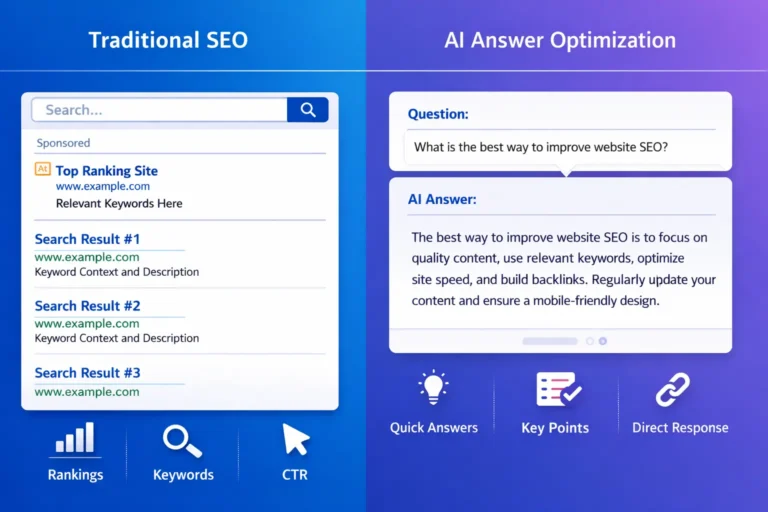
Answer Engine Optimisation and Search Engine Optimisation serve different jobs. Still, they both rely on each other to work well. One brings your content into view, and the other decides whether it is used.
Why AEO Complements, Not Replaces SEO
Search Engine Optimisation makes your content discoverable. It helps pages get indexed, understood, and surfaced in search systems. Without strong SEO, AI tools may never find your content in the first place.
Answer Engine Optimisation takes over once discovery happens. It shapes content so AI systems can trust it, extract it, and present it as a direct answer. This is where clarity, structure, and intent alignment matter most.
SEO opens the door, and AEO decides who gets invited inside. When both work together, content stays visible even as clicks decline. Pages rank, answers get selected, and brands remain present across AI-driven search experiences.
Final Thoughts: Is Answer Engine Optimisation Worth It
Answer Engine Optimisation is no longer optional for brands that depend on search visibility. AI systems now decide which content becomes the answer, not just which page appears first. When content is clear, accurate, and easy to extract, it stays visible even as traditional clicks fall.
Businesses optimise content for AEO results to build authority over time. Their content gets reused, quoted, and remembered. This creates steady brand exposure without relying on traffic alone.
Optimising for answers means writing for how people ask questions. And also, it means how machines understand them. That shift makes content useful today and resilient tomorrow.
Frequently Asked Questions
What is the main goal of Answer Engine Optimisation?
The main goal is to make content easy for AI systems to extract and reuse as a direct answer. It focuses on clarity and accuracy rather than page rankings or traffic volume.
Is Answer Engine Optimisation only for large brands?
No. Smaller businesses can benefit just as much. Clear, well-structured content often performs better than long pages backed by authority alone.
Does AEO replace keyword research?
Keyword research still matters, but it plays a smaller role. Understanding questions, intent, and meaning is more important than repeating phrases.
How does AEO affect website traffic?
Traffic may change, but visibility often improves. Even when users do not click, brands still gain exposure and trust through AI answers.
How often should AEO-focused content be updated?
Content should be reviewed regularly. Updates help maintain accuracy and show AI systems that the information is current and reliable.