


Introduction
Search plays a central role in how modern businesses attract demand, evaluate opportunity, and convert attention into revenue. Almost every digital acquisition channel eventually connects back to search behaviour, whether that interaction happens through organic listings or paid placements. This is why discussions around SEO vs SEM continue to surface at every stage of business growth, from early traction to large-scale expansion.
Despite frequent comparisons, SEO and search engine marketing are not opposing strategies. They are two distinct methods of accessing the same search demand, each operating under different mechanics, timelines, and cost structures. The challenge is not choosing one over the other, but understanding which approach aligns with business goals, budget constraints, and risk tolerance at a given point in time.
Table of Contents
What SEO and SEM Actually Mean in Practice
People often talk about SEO and SEM as if they sit in separate rooms. In reality, they sit on the same results page and chase the same users. The real difference is how each one wins attention.
Organic search (SEO) builds presence by matching helpful content, clean site structure, and signals that show pages are trusted. Paid search (SEM) buys presence, usually through auctions like Google Ads, to appear for chosen queries right away. Both point users to answers, but the rules that govern them are not the same.

The Core Difference Between Organic and Paid Search
The big divide is how placement is earned versus bought. SEO earns rankings slowly as relevance and authority add up. Paid search wins placement fast by bidding: budget, competition, and ad relevance decide who shows.
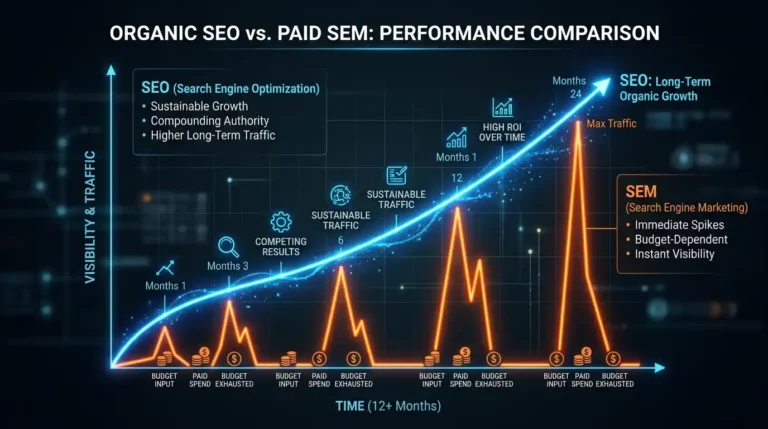
One practical result is simple: stop paying and the traffic stops almost instantly. Pause SEO work, and traffic tends to taper more slowly because earned pages keep attracting clicks. That single difference changes how you think about costs, scale, and stability.
Why SEO and SEM Are Often Confused
They look similar on the surface. Both target keywords. Both appear on the same search results page. Both help move people toward a decision. That overlap causes confusion.
But they react to pressure differently. An algorithm update can lower organic ranks even if your content is solid. A bidding war can send your paid costs up overnight, even when your ads are good. They are related tools, yes, but they respond to different forces, so treating them as interchangeable leads to surprises.
Tactical Differences Between SEO and SEM
The tactics used in SEO and SEM determine how predictable and defensible each channel becomes over time. These tactical differences explain why performance curves and risk profiles vary so widely between the two approaches.
SEO Tactics and Execution
SEO tactics are focused on building relevance and trust signals that search engines recognise as indicators of value. This includes content aligned with search intent, technical optimisation to ensure efficient crawling and indexing, and authority development through links and brand recognition.
Because SEO relies on cumulative signals, changes often take time to influence rankings. However, once momentum is established, results tend to compound rather than reset, which makes SEO particularly effective for long-term organic growth.
SEM Tactics and Execution
SEM tactics prioritise speed, control, and testing. Keyword bidding strategies, match types, ad copy experimentation, and budget pacing allow advertisers to adjust performance in near real time. This makes SEM an effective tool for rapid experimentation and immediate demand capture.
The trade-off is that performance remains directly tied to ongoing spend. When budgets pause or competition intensifies, results fluctuate accordingly, which limits long-term predictability.
Cost Structures and Budget Realities
Cost is where the difference between SEO and SEM becomes most visible for decision-makers. Search performance is easy to compare on dashboards, but budgets reveal how each channel truly behaves over time. The way costs build, pause, or compound affects planning, risk, and long-term return more than short-term results ever do.
How SEO Costs Accumulate Over Time
SEO requires both upfront and ongoing investment to remain effective. This includes content production to meet search intent, technical optimisation to keep the website accessible and stable, and continuous strategy and maintenance to adapt to changes in competition and search behaviour. These costs are usually predictable and spread over time rather than tied to individual clicks or impressions.
The key difference is what happens when spending slows or pauses. Organic traffic does not stop immediately, because rankings and visibility are earned rather than rented. Pages can continue attracting users long after the initial work is completed. Over time, this makes SEO more cost-efficient, as the same investment supports sustained traffic and reduces dependence on continuous spending to maintain visibility.
How SEM Pricing Actually Works
SEM pricing is shaped by the market rather than by fixed effort or long-term build-up. Costs change based on how many advertisers want the same keywords and how much they are willing to pay for visibility. When keywords are highly competitive, cost per click rises quickly, even if the ads and targeting remain unchanged. As more advertisers enter the auction, prices increase further, which pushes acquisition costs higher over time.
SEM also works on a direct exchange model; visibility is paid for in real time. When spending continues, traffic flows. When spending stops, traffic stops immediately. This gives strong control over timing and volume, but it offers little protection against rising costs. Because there is no lasting visibility, SEM provides speed and flexibility, but limited cost insulation for long-term planning.
Speed, Scalability, and Predictability
SEO and SEM respond very differently when speed and pressure come into play. The way each channel reacts to urgency, growth targets, and competition affects how predictable results feel over time. Understanding these differences helps businesses choose the right approach for both short-term needs and long-term stability.
Time to Results and Ramp-Up Periods
SEM delivers visibility as soon as campaigns go live, which makes it suitable for new product launches, short-term campaigns, and time-sensitive offers. Traffic can be switched on quickly and adjusted as needed. SEO works at a slower pace, as rankings build through relevance and trust rather than payment. While it takes longer to show results, SEO supports steady and sustainable demand capture that continues beyond the initial investment.
Scaling Challenges in SEO vs SEM
Scaling SEM usually requires increasing budgets, since performance grows in direct proportion to spend. Scaling SEO focuses on expanding content coverage and building authority. With SEO, effort does not scale evenly with cost, as well-structured work can unlock long-term gains without continuous spending increases.
Traffic Quality and Conversion Intent
Not all traffic behaves the same once it reaches a website. The source of that traffic strongly influences how users interact, how quickly they act, and how likely they are to convert. This is where the difference between SEO and SEM becomes clear.
User Intent Differences Between SEO and SEM
Native units slip into the page’s rhythm instead of clanging against it. Think sponsored posts that read like other articles, or in-feed recommendations th
helpful pointers, not sales pitches. When done well, readers treat the ad like useful information, not wallpaper. Instead of shouting “I’m an ad!”, they whisper “I might be useful.”
Conversion Rate and Attribution Considerations
SEM conversions are easier to track because the path from click to action is direct. SEO often supports conversions in less visible ways by influencing decisions before users return through another channel. Ignoring assisted conversions can undervalue SEO and hide its true contribution to revenue growth.
Risk, Dependency, and Long-Term Control
Search channels do not fail in the same way, and that difference matters when planning for growth. SEO and SEM each carry risk, but the source of that risk shapes how much control a business keeps over time.
Algorithm Risk vs Budget Risk
SEO risk is tied to changes in how search engines rank content. Algorithm updates or stronger competing pages can reduce visibility, even when the work remains sound. These shifts tend to happen gradually, which allows time to adjust and recover. SEM risk is financial and external. Rising cost per click, dependence on advertising platforms, and auction volatility can increase costs without improving results. When budgets tighten, exposure drops immediately. Both channels involve risk, but the impact and recovery paths are very different.
Ownership of Traffic and Visibility
SEO builds visibility that is earned and retained through content and authority. SEM provides access that is rented through ongoing spend. This difference affects long-term planning, stability, and how search-driven growth is valued over time.
When SEO Makes More Sense Than SEM
Search channels do not fail in the same way, and that difference matters when planning for growth. SEO and SEM each carry risk, but the source of that risk shapes how much control a business keeps over time.
SEO is often the better choice when business conditions favour stability, efficiency, and long-term return rather than immediate results.
- Budgets are constrained, and ongoing paid spend is difficult to sustain without increasing acquisition costs.
- The time horizon is long, allowing rankings and organic visibility to build gradually and compound over time.
- Trust and authority matter, especially in industries where users research carefully before making decisions.
In markets with high cost per click, SEO is commonly used to protect margins by reducing dependence on paid traffic and creating more predictable acquisition costs.
When SEM Is the Better Strategic Choice
SEM is the stronger option when speed, control, and rapid feedback are more important than long-term visibility.
- Immediate demand capture is required, such as during launches, promotions, or urgent offers.
- New markets or offers need testing, where fast data helps validate pricing, messaging, and intent.
- Seasonal or campaign-based traffic matters, and visibility is needed for a limited time window.
In these situations, SEM performs best because it delivers quick exposure and measurable results, even when long-term longevity is not the primary goal.
How SEO and SEM Work Best Together
The strongest search strategies do not treat SEO and SEM as separate choices. They work best when used together, with each channel supporting the other at different stages of growth. Combining both creates balance, reduces risk, and improves overall performance across digital acquisition.
Using SEM Data to Inform SEO Strategy
Paid search provides fast and reliable insight into how users actually behave. SEM data shows which keywords convert, which messages attract clicks, and where real demand exists, as highlighted in this SEO and SEM strategy guide. This information helps remove guesswork from SEO planning.
- High-converting keywords reveal where organic content should be prioritised.
- Messaging that resonates helps shape page titles, headings, and content tone.
- True demand signals confirm what users are actively searching for, not just what tools predict.
Using SEM insights allows SEO efforts to focus on what already works.
Using SEO to Reduce Paid Dependency
As organic visibility improves, reliance on paid spend decreases. Strong SEO coverage captures ongoing demand without paying for every visit, which helps stabilise acquisition costs over time. This reduces exposure to rising CPCs and budget pressure.
Together, SEO and SEM create a balanced acquisition engine that combines speed with stability and supports sustainable growth.
Conclusion
SEO vs SEM should be understood as a strategic decision rather than a competitive comparison between two channels. Each approach serves a different purpose within a broader search marketing strategy and performs best under specific conditions. SEO supports long-term growth by building organic visibility, credibility, and efficiency over time, making it well-suited for businesses focused on sustainable acquisition and cost control.
SEM, on the other hand, offers immediate exposure, precise targeting, and faster feedback, which is valuable when speed, testing, or short-term demand capture is required. When viewed together, SEO and SEM complement rather than replace each other. Using SEM to generate quick insights and capture high-intent traffic while SEO builds lasting authority allows businesses to balance risk, manage budgets more effectively, and reduce overreliance on any single channel.
A well-aligned approach to SEO vs SEM creates a stronger foundation for predictable growth, improved cost efficiency, and long-term control over search-driven acquisition. For businesses looking to apply these strategies effectively, Midland Marketing provides guidance based on practical experience. If you need support in aligning SEO and SEM with your growth goals, you can contact Midland Marketing to explore the right approach for your business.
Frequently Asked Questions
What is the main difference between SEO and SEM?
The main difference between SEO and SEM is how visibility is achieved. SEO earns traffic organically through content and optimisation, while SEM uses paid ads to appear instantly in search results.
Which is better for long-term growth, SEO or SEM?
SEO is better for long-term growth because it builds sustainable visibility and continues to generate traffic over time. SEM is more suitable for short-term results and immediate demand capture.
Can SEO and SEM be used together?
Yes, SEO and SEM work best when used together. SEM provides quick insights and traffic, while SEO builds long-term authority and reduces reliance on paid advertising.
Why does SEM traffic stop when budgets are paused?
SEM traffic stops immediately when budgets are paused because it depends on paid placements. Once the ad spend ends, visibility is removed from search results.
How does SEO help reduce marketing costs over time?
SEO helps reduce marketing costs by generating ongoing organic traffic without paying for each click. Over time, this lowers acquisition costs and reduces dependence on paid campaigns.