

Introduction
Search behaviour has changed. People no longer search in neat, short phrases. They ask specific questions, add locations, compare options, and look for exact answers. That shift is where programmatic SEO earns its place.
A scalable programmatic SEO strategy for long-tail traffic focuses on building many focused pages, each mapped to real demand. Not guesses. Not broad topics. Real searches with clear intent.
Done right, this approach helps brands appear where competitors stay invisible. It turns data into pages, pages into traffic, and traffic into action.
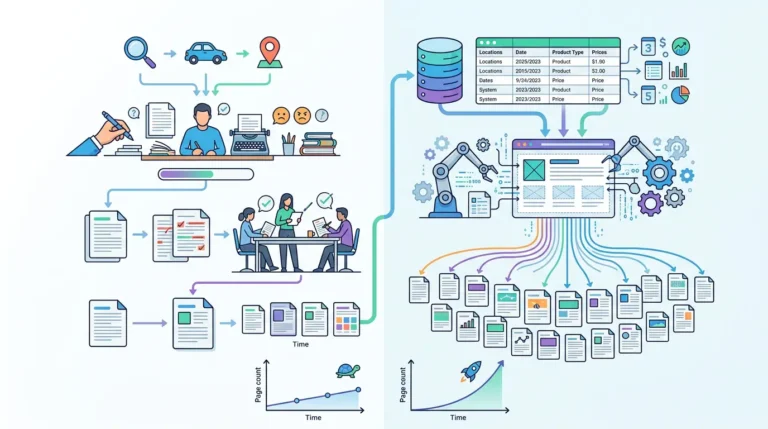
Table of Contents
What Programmatic SEO Actually Is (and What It Is Not)
Programmatic SEO means building long-tail SEO pages using structured data, patterns, and logic. It is not about writing thousands of random pages. It is about search demand mapping first, then creating pages that answer real, repeated search needs.
This approach supports a scalable SEO strategy because it focuses on consistency, not creativity. Users land on these pages for quick, clear answers. Scale becomes the advantage. That is how SEO at scale works when done right.
Programmatic SEO vs Traditional SEO
Traditional SEO is manual by nature. They do one page at a time and rely heavily on editorial input. Also, they need to be careful with keyword choices.
Programmatic SEO designs the system first, and pages come later. Using SEO automation, SEO page templates, and data-driven SEO, teams can cover thousands of intent-led searches.
Not a few big keywords, but many small ones. Those long-tail SEO pages stack up fast and drive steady demand.
Why Programmatic SEO Is Often Misunderstood
Programmatic SEO gets a bad name because of poor execution. People link it to thin pages, lazy templates, or keyword abuse.
Good programmatic SEO is the opposite. It needs more planning, more structure, and clearer intent signals. Dynamic landing pages only work when the data behind them is solid. When done well, it compounds, and when it is rushed, it collapses.
Scalable Programmatic SEO Strategy Makes Sense
Programmatic SEO only works when search intent behaves in a repeatable way. It shines in markets where people ask similar questions again and again, just with small changes. In those cases, an SEO strategy for long-tail traffic becomes practical, not forced.
If the demand can be mapped, grouped, and structured, SEO at scale makes sense. If not, it becomes noise.
Search Patterns That Support Programmatic SEO
Programmatic SEO performs best when searches follow clear formats, such as:
- “service in location”
- “tool for use case”
- “product alternatives”
- “industry rules by region”
These searches show intent. Users are comparing, checking fit, or narrowing choices. That is where location-based SEO pages, B2B programmatic SEO, and eCommerce programmatic SEO perform well. Structured needs suit dynamic landing pages.
Situations Where Programmatic SEO Fails
It struggles when searches are emotional, opinion-led, or story-driven. If users want depth, voice, or strong brand trust, templates fall short. In those cases, a manual approach wins. Programmatic SEO is about structure.
How Programmatic SEO Pages Are Structured
Strong programmatic pages do not feel mass-produced. They feel planned. Each page exists for a clear reason and answers a specific search. That is what separates usable pages from noise. A scalable SEO strategy for long-tail traffic is depends on structure first, volume second.
When the structure is right, SEO at scale feels natural. When it is wrong, every new page weakens the site.
Template Design That Supports Search Intent
A good template does more than repeat layout. It matches intent. Every page should answer four things: What this is, Who it helps, How it compares, and What happens next.
This is where SEO page templates and data-driven SEO meet. If a template cannot guide action or clarity, scaling it spreads the problem. SEO automation only works when the foundation holds.
Data Sources That Power Programmatic Pages
Programmatic SEO runs on structured inputs. Clean data, clear rules and no guesswork.
Common sources include locations, product details, pricing ranges, rules, and feature lists. These feed dynamic landing pages and keep content accurate.
Real-World Examples of Programmatic SEO
Programmatic SEO already shapes many crowded search results. You see it most where users need options, not opinions. These pages are built to answer quickly and at scale. That is why a scalable programmatic SEO strategy to capture high-intent long-tail traffic works best in comparison-heavy markets.
Marketplace and Comparison Platforms
Marketplaces lean on volume. They rank for service lists, local checks, and filtered categories.
This is a classic marketplace SEO strategy. Pages are structured, searchable, and easy to scan. Location-based SEO pages help users find what fits, fast. The edge is not depth. It is present across thousands of searches.
SaaS and B2B Use Cases
SaaS brands use programmatic SEO to support research. Not to sell on the first click. Common examples include integration pages, industry views, and use-case hubs. This is where B2B programmatic SEO shines. Pages answer narrow questions during validation. Quiet help, low friction and high intent.
How to Build a Programmatic SEO Strategy

In 2026, volume is no longer enough; search engines now prioritise attribution and fairness. The UK’s CMA recently proposed new conduct requirements to ensure that structured, data-driven content is ranked fairly and that publishers maintain control over how their data is used in AI-generated responses.
The SEO strategy to capture high-intent long-tail traffic only works when planning is tight, and assumptions are tested early. If the system makes sense on paper, it usually works in search.
Mapping Search Demand at Scale
Begin with patterns, not single terms. Look for searches that repeat with small changes. Cities. uses. industries.
This is search demand mapping. It shows whether long-tail SEO pages can be built without forcing relevance. If patterns do not exist, stop. Scaling the wrong idea wastes time.
Designing Templates Before Writing Content
Templates come first, always. Lock structure early using SEO page templates that guide intent, comparison, and action. This supports SEO automation and avoids large rewrites later. Each section must earn its place. If it does not help the user, it does not scale.
Technical SEO Considerations at Scale
Scale breaks weak sites. SEO at scale needs rules around crawling, indexing, canonicals, and URLs. Without guardrails, pages compete with each other. Rankings drop. Control first. Growth second.
Risks, Trade-Offs, and Quality Control
Programmatic SEO is unforgiving. It amplifies what you do well and exposes what you ignore. The SEO strategy can lift a site fast, but mistakes spread just as quickly; scale has memory. Quality is not optional. It is the control lever.
Thin Content and Indexation Risk
Search engines do not reward volume alone. Pages that add little value get indexed, then quietly ignored. That drag affects the whole site.
With SEO at scale, weak pages hurt strong ones. Engagement matters. Clarity matters. Long-tail SEO pages still need to answer something real.
Maintaining Page Quality Over Time
Nothing stays fixed. Data shifts. Markets move. Templates lose relevance. Good programmatic SEO includes regular checks. Pages are reviewed, trimmed, or improved. This is where data-driven SEO protects performance. One launch is not enough. Maintenance keeps rankings alive.

How Programmatic SEO Fits Into a Broader SEO Strategy
Programmatic SEO works best as part of a wider plan. It should sit alongside editorial work, not compete with it. A scalable SEO strategy for long-tail traffic fills gaps that long-form content cannot reach. Editorial pages handle depth. Programmatic pages handle a range. Used together, this creates balance and resilience.
Supporting Editorial and Authority Content
Editorial content builds trust. It explains, persuades, and shows expertise. Programmatic pages do something different. They meet users at the moment of need.
This mix strengthens a scalable SEO strategy. Authority pages support credibility, while long-tail SEO pages bring in consistent demand.
Measuring Success Beyond Traffic Volume
Volume alone can mislead. Page count means nothing without impact. Look at qualified visits, assisted journeys, and downstream results. With data-driven SEO, value shows up in paths, not just numbers.
Conclusion
Programmatic SEO is not a hack. It is a design choice. It works when pages follow how people actually search, not how teams wish they searched. A scalable programmatic SEO strategy for long-tail traffic helps businesses meet demand without chasing trends or guessing intent.
When systems are built with care, scale becomes an advantage. When the structure is weak, flaws spread fast. Programmatic SEO does not hide problems. It reveals them.
Frequently Asked Questions
What is programmatic SEO in simple terms?
Programmatic SEO is about creating many focused pages using data and templates. Each page targets a real search with clear intent, not broad topics.
Is programmatic SEO the same as SEO automation?
No, SEO automation is a toolset. Programmatic SEO is the strategy behind it. Automation helps publish pages, but planning decides if they should exist.
Does programmatic SEO work for small websites?
It can, but only when search patterns repeat. Without enough demand, a manual or editorial approach often works better.
How do I know if long-tail SEO pages are worth building?
Start with search demand mapping. If users search for the same thing with small changes, the opportunity is real. If not, stop early.
Can programmatic SEO hurt my site?
Yes, if only the quality slips, the scalable SEO strategy works for the long-tail traffic. But it only works when pages stay useful, current, and controlled.