


Introduction
Creating content without a clear audience profile is one of the most common reasons blogs fail to generate engagement, traffic, or conversions. A strong content persona for blog strategy transforms assumptions into structured audience insight. Instead of writing for “everyone,” you write for a defined reader with specific goals, challenges, and behaviours.
A well-researched content persona improves SEO performance, increases engagement, strengthens brand positioning, and aligns your blog with real user intent. This guide explains how to research, build, and apply a content persona in a practical and strategic way.
Table of Contents
What Is a Content Persona for Blog and Why Does It Matter
Defining a Content Persona for Blogging
Let us start with a simple truth. Most blogs fail because they are written for nobody in particular.
A content persona fixes that. Think of it as a character sketch. You build it from real conversations, website data, and patterns you notice in your audience. It is not real, not one single person. But it represents real people who read your work.
Here is the catch. It does not refer to a buyer persona. That tool focuses on money, who buys, when they buy, and why they pick up their credit card. A content persona looks elsewhere. It asks what someone reads on a Tuesday morning. It wonders if they skim or study every word.
Picture this. Your buyer persona might describe a 45-year-old IT director. Big budget. Plenty of authority. Good information to have. But the content persona digs deeper. It shows you that the same director reads industry news on Sunday nights, dreading Monday. It reveals they skip past listicles and click on long case studies. It tells you they type “implementation guide” into Google, never “what is.”
For blogs, a good content persona answers a handful of questions. What does this person search for at work? What problem burns right now, this second? How much do they already know? Do they trust a friendly tone or a formal one? Phone or laptop? Morning or night?
These details shape your words. They decide if someone stays on your page or leaves after five seconds.
Stop guessing who reads your blog. Start knowing. That small shift changes everything. Readers feel understood. They trust you faster. They come back. That is what a content persona does.
The Strategic Value of a Content Persona
Here is what changes when you have one. SEO stops being about volume. You stop chasing big numbers that bring the wrong crowd. Instead, you match topics to what people actually want. Someone types a question. Your post answers it. Simple.
Your content starts mattering to real humans. Not because you got lucky. Because you know what hurts them. You know what keeps them up at night. You write about that. Nothing else.
People read longer. They click around. They share things. That happens when your tone fits, and your depth matches their hunger. Not too basic. Not too fancy. Just right.
Money stuff becomes clear, too. You see where someone stands. Are they just looking? Comparing options? Ready to buy? Your words meet them there. You do not ask for the sale too soon. You do not hide it too late.
Skip the persona, and here is what you get. Bland posts. Stuff for everyone, which means stuff for no one. Surface level. Forgettable.
A persona changes that. It forces hard choices. It makes you pick a side. That discipline? That is what makes content work.
Conduct Deep Audience Research
Creating a content persona begins with research. Assumptions weaken strategy. Data strengthens it. The organisations that build durable personas treat research as an ongoing discipline rather than a one-time project.
Analysing Website and Search Data
The first place to look is your own website. You already have data waiting there. It just needs someone to read it carefully. Start with the search queries. These are the actual words people type before they land on your pages. Read through them slowly. You will notice patterns in how people ask for things. Some phrases come up again and again. That matters. Look at your best-performing posts. Which topics keep bringing people back? Which ones get shared? Make a list. Then look at the posts that barely register. The ones people click and leave. Sometimes the difference between them is small. Sometimes it is obvious. Bounce rates deserve attention, but not panic.
A high bounce rate might mean your content missed the mark. Or it might mean someone found exactly what they needed and left happy. You cannot tell from one number alone. You have to look at the whole picture. Time on page adds context. When people stick around, when they scroll to the bottom, that usually means you gave them something worth their time. Not always. But often enough to pay attention. Conversion paths show you something different.
They trace the route people take from that first click to signing up or buying. Some posts drive action better than others. Figure out why. Then do it again. Here is the truth about data. It shows you what happened, but not why it happened. That part is on you. You bring the questions. You bring the curiosity. Why did this post work and that one fail? What were people really looking for? Keyword research tools help answer those questions. Not by showing you search volume but by showing you intent. Read the phrases closely. Someone typing “how to start a blog” wants something basic. Someone typing “best blogging platform for photographers” wants something specific. The words they use tell you where they are in their journey. Your persona has to live inside these differences. It has to understand both kinds of readers without mixing them up. That takes work. But that work is what makes content finally click.
Gathering Direct Audience Insights
Talking directly to your audience reveals things data never will. Send surveys after purchases or newsletter signups while experiences stay fresh in their minds. Watch which social media posts generate real conversation and which ones barely register. Read email replies carefully because engaged readers often share unfiltered thoughts there.
Your sales team hears objections every single day. Ask them what prospects worry about. Your support team fields the same questions repeatedly. Those are content opportunities waiting to be addressed.
These conversations expose recurring challenges and knowledge gaps. They also reveal the emotional side of your audience, the frustrations that keep them awake and the goals that drive their work.
Pay attention to the exact words people use. If they keep asking for simple explanations, your persona should value clarity above all else. If they want proof before believing anything, prioritise case studies and hard data. Their language becomes your language. That is how content starts to feel personal.
Studying Competitor Audience Engagement
Competitor blogs reveal valuable intelligence about what works in your space. Which topics attract high engagement through comments and social shares? Which content formats generate discussion and debate? What type of audience interaction occurs in response to different approaches?
This analysis helps you identify gaps in the market and refine positioning for your own persona. If every competitor publishes beginner-level content, the advanced practitioner in your audience remains underserved. If every competitor writes listicles, the reader seeking deep analysis has nowhere to go. Those gaps represent opportunities.
Define Core Persona Characteristics
Once research is complete, transform data into a structured profile. This is where raw information becomes actionable intelligence.
Demographic and Professional Profile
Demographic details alone do not define a persona, but they provide useful context about your reader’s perspective. Age matters when it influences how someone consumes information, though its relevance depends entirely on your topic. Financial planners need to know age, while software companies might care less, and the key is understanding whether age actually shapes engagement with your specific material.
Job roles offer clearer signals about priorities because a customer support representative faces completely different pressures than a chief technology officer. Knowing someone’s title helps you anticipate what they actually need from your content before they even start reading.
Industry background colours how people interpret information, with healthcare professionals reading through the lens of compliance, while construction thinkers focus on safety and timelines. These professional contexts shape every interaction someone has with your material, often in ways they do not consciously recognise.
Company size might be the most telling detail of all, as a solo founder needs answers that work today with minimal investment, while a marketing director at an established company needs frameworks that scale across multiple departments. Both professionals might read your blog, but they come looking for entirely different things.
Education and experience determine how deep you need to go, with someone new to a field requiring foundational guidance, while a veteran wants advanced discussion and nuanced edge cases. Your persona must hold these distinctions clearly, not to exclude others but to know exactly who you are speaking to in each piece. When other readers arrive, they recognise the clarity and precision of your thinking even when you are not addressing them directly.
Goals and Motivations
Define what the persona wants to achieve. These goals drive search behaviour and determine which content resonates. Goals may be professional, personal, or organisational. They may be explicit or unspoken. Your job is to identify them and address them directly.
Examples include improving SEO rankings to demonstrate marketing effectiveness, reducing operational risk through better information, growing blog traffic without additional budget, or understanding industry compliance requirements before they become urgent. Each goal suggests different content priorities and different measures of success.
Understanding goals ensures content provides meaningful value rather than surface-level information that fails to address underlying needs. Readers recognise when you understand what they are actually trying to accomplish.
Pain Points and Frustrations
Effective blogs solve problems. Identify the obstacles that prevent your persona from achieving their goals. Common obstacles might include organisational resistance to new ideas. Knowledge gaps might involve emerging technologies or methodologies. Time constraints might limit how much content they can consume and apply. Budget limitations might restrict their options for solving problems. Regulatory concerns might introduce complexity and risk into their decision-making.
Pain points guide your blog topics and subtopics. Each piece of content should address a specific frustration or remove a specific obstacle. When readers encounter content that speaks directly to their struggles, they immediately recognise that you understand their world.
Content Consumption Behaviour
This area is often overlooked but crucial for an effective content strategy. Determine preferred content length based on when and where your persona reads. Understand device usage to optimise formatting for mobile or desktop reading. Identify visual versus text preference to allocate resources appropriately. Consider the frequency of reading to determine the appropriate publishing cadence. Map preferred platforms, including Google search, LinkedIn, industry forums, and specialised publications.
A time-poor executive may prefer concise insights delivered weekly. A specialist may prefer an in-depth technical analysis published monthly. Delivering the right content at the right cadence through the right channels determines whether your blog becomes essential reading or background noise.
Map the Persona to Search Intent
A content persona must connect to the SEO strategy. Understanding search intent ensures your content appears for the right queries and satisfies the needs behind those queries.
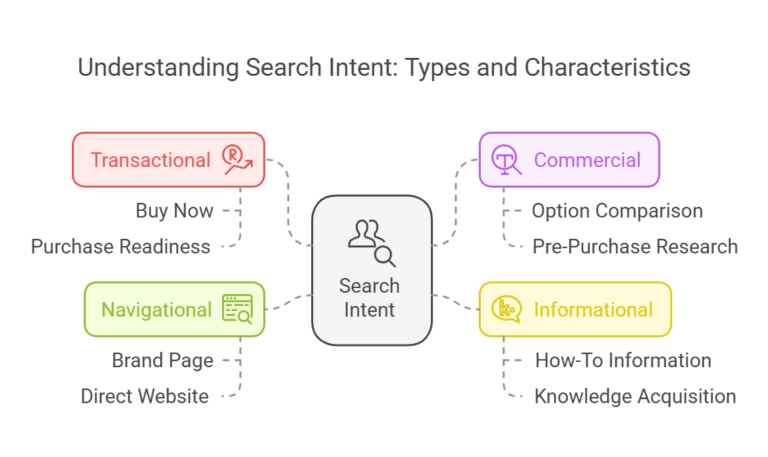
Informational Intent
At this stage, readers seek education and guidance. They may be exploring a topic for the first time or deepening their understanding of familiar territory. Blog posts should focus on definitions that establish common understanding, how-to guides that provide practical instruction, step-by-step tutorials that walk readers through processes, and industry explanations that contextualise developments within broader trends.
Content should prioritise clarity and structure. Readers with informational intent need to build mental models before they can take action. Your content should facilitate that cognitive work.
Commercial Investigation Intent
Here, readers compare options or evaluate solutions. They have moved beyond general education to specific consideration. Blog content may include comparison articles that weigh alternatives against each other, pros and cons analysis that identifies trade-offs, cost breakdowns that reveal financial implications, and case studies that demonstrate real-world application.
Tone should be analytical and solution-focused. These readers want to make informed decisions. Your content should provide the framework and data that those decisions require.
Decision-Stage Intent
Some blog readers are ready to take action. They have done their research, evaluated their options, and reached a point of commitment. Content should address remaining objections that might delay action, provide implementation clarity for readers who need to execute, demonstrate expertise through detailed exploration of complex topics, and highlight measurable outcomes that justify the decision.
Mapping persona behaviour to intent ensures your blog supports the full decision journey. Readers encounter your brand at different stages. Your content should meet them where they are and guide them toward where they need to go.
Create a Structured Persona Profile
Once insights are gathered, formalise them into a documented profile. The act of documentation forces clarity and provides a reference point for content creators.
Persona Overview Section
This should include a persona name that is fictional but representative, making the persona feel real and memorable. Document the role or situation that defines their professional context. Capture the primary objective that drives their behaviour. Identify the core challenge that stands between them and success.
Example:
“Marketing Manager Maya, Responsible for increasing organic traffic but limited by budget and internal resources.”
This overview provides an at-a-glance understanding of who you are writing for and what matters to them.
Behavioural Summary
Document typical search queries that reveal how your persona finds content. Note preferred content formats based on consumption patterns. Identify key objections that arise during their decision process. Capture influencing factors that shape their perceptions and choices.
This transforms research into practical editorial guidance. Content creators can refer to the behavioural summary when making decisions about topic selection, format choice, and persuasive approach.
Content Alignment Summary
Define topics to prioritise based on persona goals and pain points. Specify the tone of voice that resonates with their preferences and expectations. Determine the depth of explanation appropriate to their knowledge level. Identify visual requirements that support their learning style. Clarify call-to-action style that matches their readiness to engage.
This ensures content creators stay aligned with the persona’s needs throughout the development process. The persona becomes a quality control mechanism as well as a planning tool.
Apply the Persona to Your Blog Strategy
Creating a persona only matters if you actually use it. Integration takes work and consistency.
Topic Selection
Choose topics that speak directly to what your persona worries about and wants to achieve. Writing for everyone usually means connecting with no one. Before settling on any subject, ask yourself a few questions. Would this person care about this? Would they learn something useful? Would they send it to a coworker facing the same struggle? When you have a solid persona guiding you, topic selection stops feeling like guesswork.
Tone and Complexity
Match your language to where your reader stands. Beginners get lost when things get too technical too fast. Experienced folks roll their eyes when you explain things they already know. Your persona tells you where they fall on that line, so you can adjust accordingly without second-guessing.
Structure and Formatting
Some readers want to scan. They need clear headings and short sections that they can move through quickly. Build things step by step so nothing feels overwhelming. Others want the full treatment. They want depth and context and all the nuance you can offer. Let the reader decide the format, not your personal preference.
Call-to-Action Alignment
What you ask someone to do should match where they are in their thinking. Someone still learning might appreciate a guide they can download. Someone comparing options might want pricing details or feature breakdowns. Someone ready to move forward might book a consultation or start an implementation. Matching the ask to the moment shows respect for their process and usually leads to better results.
Review and Refine Regularly
A content persona cannot sit still. Markets move under our feet, search behaviour shifts with each algorithm update, and what your audience cared about six months ago might not be what keeps them up tonight. Regular reviews keep things honest.
Monitor Performance Metrics
Watch how people interact with what you publish. Are they sticking around or leaving fast? Check where your pages rank for the terms you care about. Look at whether more people take action after reading. Notice which topics generate heat and which ones go cold. These numbers tell you when something is working and when it is time to adjust.
When things slide, ask yourself what changed. Maybe your persona drifted away from who actually shows up. Maybe your writing wandered off course without anyone noticing. Either way, the data gives you a reason to look closer.
Update Based on New Data
As more people find your work, you might spot patterns you missed before. Some readers need the beginner treatment, while others came looking for advanced stuff. A solo business owner thinks differently from someone running a large team. Freelancers do not read the same way agency people read.
Building these distinctions into your thinking makes your content sharper over time. You do not need everything perfect from day one. You just need to keep making it better as you learn more. That is how good content turns into something people actually rely on.
Common Mistakes in Content Persona Development
Relying on Assumptions Instead of Data
Personas built purely on opinion often miss real audience needs. Internal stakeholders may believe they understand customers, but belief is not evidence. Research grounds personas in reality rather than wishful thinking.
Creating Too Many Personas
Over-segmentation dilutes content focus. Start with one primary persona and expand only when necessary. A single well-developed persona provides more value than multiple superficial profiles.
Ignoring Search Intent
Even accurate personas fail if the content does not match search behaviour. Understanding who your reader is matters little if you do not understand what they are looking for and how they look for it.
Treating the Persona as Static
Audience expectations change. Competitor approaches evolve. Search algorithms update. Persona refinement should be ongoing rather than occasional. The persona that worked last year may not work this year.
How a Content Persona for Blog Strengthens Long-Term SEO
When you write for a real person, search results follow. Instead of guessing keywords, you use the exact phrases your audience types. That simple shift changes everything.
Write the pieces they actually need, and you won’t skim the surface; you’ll dig in. One useful article leads to another, and the links between them feel natural. Readers move from page to page because each step answers a question, not because you shoved in a keyword. They stay longer, bookmark a page, and come back again.
Those user behaviours matter. Search engines watch how people interact with your content. When visitors linger and find value, the algorithm treats that as a signal: your site knows its topic. A clear persona keeps your intent honest. You stop guessing what someone wants and start building every headline, paragraph, and call-to-action around that single person.
Do this consistently, and the payoff compounds. Better content brings more engaged readers. Engaged readers send stronger signals. Stronger signals bring more traffic. All from understanding one person well, and writing for them, every time.
Conclusion
Building a content persona takes time. But once you have one, everything else falls into place. You stop writing blind. You stop hoping something works. Instead, you know who you are talking to and what they actually need to hear. That changes everything.
Your writing gets tighter. Your topics hit home more often. And when you look at the numbers, they start making sense.
Companies that take the time to understand their audience always come out ahead. Their blogs pull in people who actually care. Readers stay on the page longer. More of them sign up or buy something down the road. None of this happens by luck. It happens because someone decided to stop guessing and start listening.
Keeping your persona fresh takes effort. You have to check in now and then. See if anything shifted. But look at what comes back to you. Better search rankings. Readers who trust you more. A clear path from that first click to a real conversation. That is what you get when you build things on purpose instead of crossing your fingers.
When you are ready to build a content persona strategy that actually works, reach out to Midland Marketing. We help you dig into the research. We help you make sense of what you find. And we help you turn all of it into content that brings people in and keeps them coming back. Better writing. Better results. Growth that does not stop.
Frequently Asked Questions
Why is a content persona important for blog success?
A content persona helps you understand readers, create relevant posts, improve engagement, and support consistent long-term blog growth.
How often should a content persona be updated?
Review your content persona regularly using new data, search trends, and audience behaviour to stay accurate over time.
What information should a blog content persona include?
A persona should include goals, challenges, search habits, content preferences, and knowledge level to guide effective content decisions.