

Introduction
Here’s a confession. I spent years obsessing over blog post word counts. I would stare at competitors’ epic 3,000-word guides and panic. Then I would see a snappy 500-word post go viral and second-guess everything. Sound familiar?
Turns out, I was asking the wrong question.
The real question isn’t “short or long?” It’s “what does my reader need right now?” A surgeon about to operate doesn’t want a poem. A poet searching for inspiration isn’t looking for a technical manual. Format follows function. Always.
After crafting content strategies for over a hundred brands, I have learned this balance isn’t just theory; it’s the core of how you connect, convince, and convert. Let’s ditch the dogma and get practical.
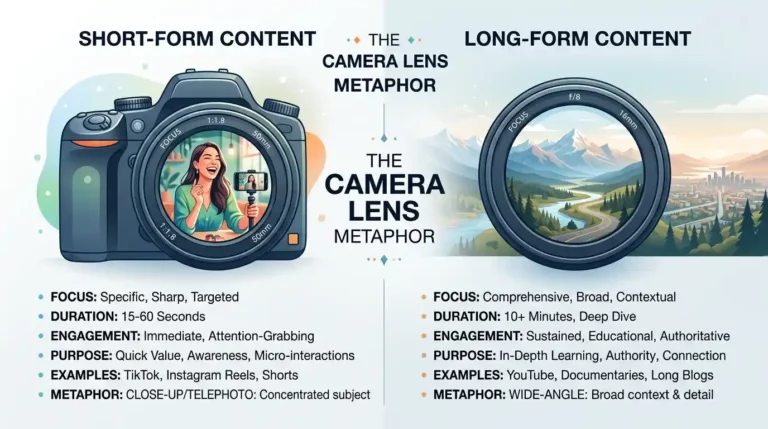
Table of Contents
Understanding the Difference Between Short-Form and Long-Form Content
Think of content length like a camera lens. Short-form is a tight, sharp close-up. It isolates one idea with clarity. Long-form is a wide-angle view. It captures the entire landscape, showing how everything connects. This choice changes how information lands, how long people stick around, and frankly, how Google judges your authority.
What Is Short-Form Content
We are talking about content you can digest in a coffee break. Typically 300 to 800 words. It’s direct, focused, and built for our fragmented attention spans. Its job is to inform quickly, not exhaustively.
Examples from my own work:
A 600-word blog post explaining a new Google algorithm update on the day it happened. It got straight to the “what it means for you” and drove a ton of immediate, reactive traffic.
A series of 400-word “Tip Tuesday” emails that consistently had the highest open rates because they offered one actionable nugget, nothing more.
What Is Long-Form Content
This is the deep end. Content that’s 1,200 words and beyond. It’s not just more words, it’s more context, more evidence, more nuance. It aims to be the last piece someone needs to read on a topic.
A personal example: I once wrote a 4,000-word guide on “Local SEO for Restaurants.” It covered everything from Google Business Profile optimisation to managing reviews and local schema markup. Two years later, it’s still a top traffic driver and has directly generated client referrals. Why? Because it solved a complex problem completely.
Why Content Length Influences Performance
Let’s be blunt. Length is a signal. A longer, well-structured piece suggests thoroughness, which can boost “dwell time” (a fancy term for how long someone stays on your page). It naturally allows you to cover related keywords and concepts, which helps SEO. But here’s the kicker: a bloated, repetitive 2,000-word article will perform worse than a crisp 800-word one every time. Relevance and structure trump sheer volume.
When Short-Form Content Works Best
Short-form is your precision tool. Use it when the goal is speed and impact, not immersion.
Answering Simple or Specific Questions
Someone searching “how to change a WordPress password” wants steps, not a history of cybersecurity. Give them a clean, scannable list. They will thank you by not bouncing back to search.
Supporting Social Media and Awareness Campaigns
On LinkedIn or Twitter, you are fighting for milliseconds of attention. A short, provocative blog post (say, 500 words on a hot trend) linked from a compelling social post is gold. It’s a low-commitment ask that builds top-of-funnel visibility.
Publishing Frequent, Timely Updates
When news breaks in your industry, you can’t wait two weeks to publish the definitive 5,000-word analysis. A quick, insightful 700-word take published that afternoon positions you as a timely source. Speed is relevance here.
When Long-Form Content Is the Better Choice
Choose long-form when the value is in the depth itself. When leaving things out would be a disservice.
Covering Complex Topics in Detail
Topics like “How to Build a Content Marketing Strategy” or “Comparing SaaS Pricing Models” are minefields of follow-up questions. Long-form allows you to preempt them. You build trust by showing you understand the complexity.
Building Topical Authority for SEO
Google’s algorithms have gotten scarily good at judging expertise. A pillar page that comprehensively addresses a core topic, say, “Project Management Methodologies,” and internally links to shorter posts on Agile, Waterfall, etc., creates a powerful hub of authority. This is how you rank not just for one keyword, but for dozens.
Supporting High-Value Decision-Making
If your reader is comparing enterprise software or researching investment strategies, they are primed for detail. A superficial post feels like a sales pitch. A long-form guide that acknowledges trade-offs, includes data, and cites sources feels like a consultant’s advice. It builds the credibility needed for high-consideration decisions.
SEO Considerations for Short vs Long Content
Forget the myth of a perfect word count. SEO success here is about alignment, not length.
Search Intent and Content Depth
This is the golden rule. The searcher’s intent dictates everything. “Define inflation” calls for a short, dictionary-style answer. “How does inflation impact 2024 retirement planning?” demands a long, analytical piece. Use the words in the search query as your guide.
Keyword Coverage and Ranking Potential
It’s true: a long-form piece naturally incorporates more semantic keywords and related entities. This helps Google understand your page’s context, potentially ranking it for more variations. But stuffing a piece with off-topic keywords to make it longer? That’s a recipe for disaster. Keep it focused.
Engagement Metrics and Dwell Time
Yes, a captivating long-form piece can keep people reading for minutes. But a confusing one will have them gone in seconds. Use clear, descriptive subheadings (like these!), bolded key points, and visual breaks. Make the experience of reading easy, regardless of length.
Audience Behaviour and Content Consumption
Your audience’s habits should be your guide.
Mobile vs Desktop Reading Habits
A user on a phone during a commute often wants quick answers. A B2B buyer at their desk on a Tuesday afternoon is more likely to dive into a detailed report. Check your analytics to see where your audience engages most and with which content type.
Skimming vs Deep Reading
Most people skim. Fact. Your job is to make skimming rewarding. Use subheadings as a clear map. Start sections with key takeaways. For those who want to dive deep, the detailed paragraphs are there. You are serving both masters.
Can Short-Form and Long-Form Work Together
Absolutely. They are a powerhouse duo, not rivals.
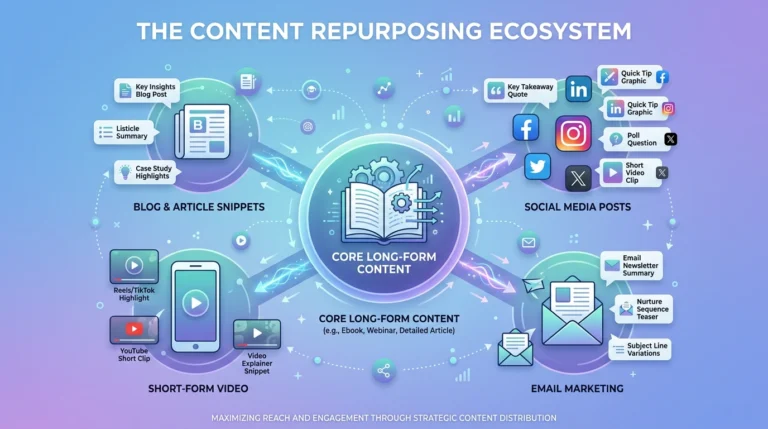
Using Short-Form to Support Long-Form Content
Imagine a short, punchy social media post asking, “Struggling with your email open rates?” It links to your 2,000-word guide, “The 2024 Email Engagement Playbook.” The short-form is the hook; the long-form is the value delivery.
Repurposing Long-Form Content Into Short Assets
Most people skim. Fact. Your job is to make skimming rewarding. Use subheadings as a clear map. Start sections with key takeaways. For those who want to dive deep, the detailed paragraphs are there. You are serving both masters.
How to Decide Which Format to Use
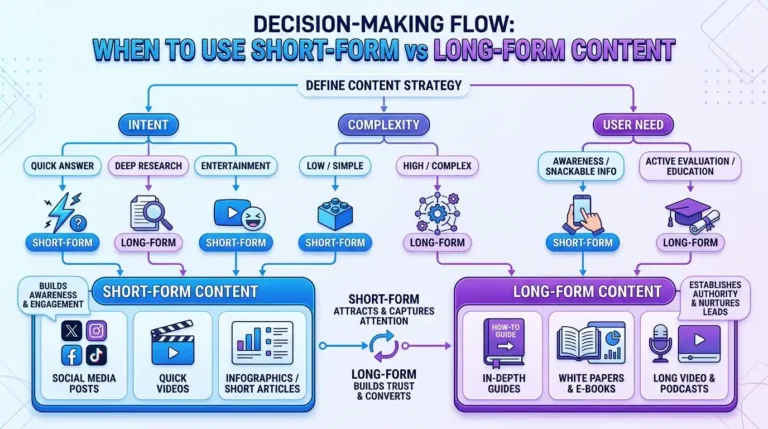
Stuck? Use this simple framework.
Start With the Goal of the Content
Is the goal brand awareness today? Short-form. Is it to generate qualified leads this quarter? Long-form nurturing content likely wins. Let the objective lead.
Consider the Stage of the Customer Journey
- Awareness stage: “What is CRM?” -> Short-form.
- Consideration stage: “CRM comparison: HubSpot vs. Salesforce” -> Long-form.
- Decision stage: “Implementing Salesforce: a 6-month roadmap” -> Very long-form.
Balance Resources With Impact
Be honest about your bandwidth. A fantastic, well-researched short post is better than a thin, rushed long post. Build your long-form pillars gradually, where they will have the most strategic impact.
The Key Takeaway
This isn’t about choosing sides. It’s about choosing a strategy.
Short-form content delivers speed, clarity, and a great hook. Long-form content delivers depth, authority, and trust. The magic happens when you use them intentionally, as parts of a connected system. Match the format to the human need behind the search query. Stop writing for word counts. Start writing for outcomes.
That’s your balance.
Reach out to us for further clarification.
Frequently Asked Questions
Is long-form content always better for SEO?
No. It depends on search intent. A quick answer needs a short post. Long-form wins for complex queries where depth builds authority. Match length to the question behind the search.
Should I avoid long-form for mobile users?
Not if it’s formatted for scannability. Use short paragraphs, bold takeaways, and clear subheadings. Mobile users will engage with depth if it’s easy to navigate.
How do I choose short or long for a topic?
Use the “question test.” Are you answering one simple “what” question? Go short. Are you unpacking a “how” or “why” with multiple steps and caveats? That’s long-form territory.
Can I just add words to a short post to make it long?
Avoid padding. True long-form adds new value: case studies, data comparisons, expert quotes, or step-by-step walkthroughs. Depth, not just length, builds trust.
How can a small team produce long-form?
Start with one cornerstone piece per quarter. Repurpose existing talks, client work, or combine shorter posts. Then, create short-form snippets (social, email) that link back to it, making one asset work harder.