

Introduction
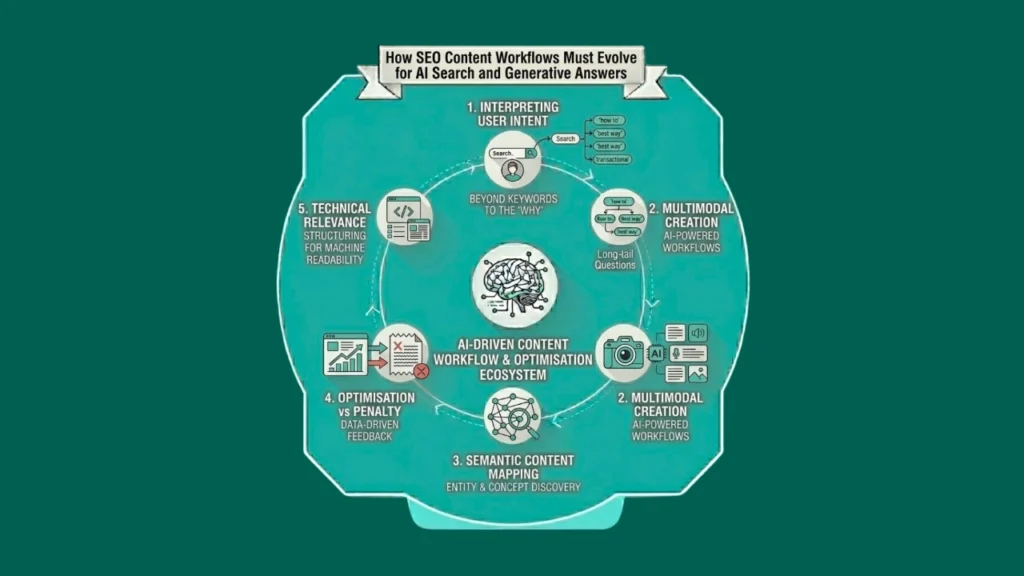
Search is no longer just a list of blue links. AI systems now read, combine, and answer. That single change forces us to rethink how SEO content workflows for AI search are planned, written, and measured. What worked for rankings does not always work for AI answers. This shift is quiet, but it is not small.
Table of Contents
How Search Is Shifting from Organic Results to AI Answers
Search engines are moving away from acting as directories. They now act as interpreters. Instead of sending users to ten pages, they often deliver one clear response.
The Rise of Generative Search and AI Summaries
Generative search systems scan multiple sources, extract facts, and create summaries in real time. Platforms backed by organisations like Google and OpenAI use large language models to answer questions directly.
For users, this saves time. For websites, it changes the rules. If an answer is shown instantly, there is no need to click. Visibility now depends on whether your content is used, not just ranked.
What This Shift Means for Traditional SEO
Ranking on page one still matters, but it is no longer the final goal. Content must be:
- Clear enough to extract
- Trusted enough to reference
- Structured enough to understand
SEO content workflows for AI search must focus on being selected, not just discovered.
Why Traditional SEO Content Workflows Are No Longer Enough
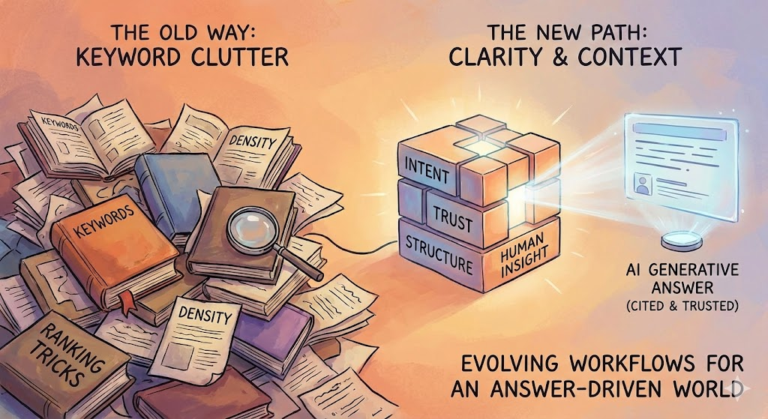
Many SEO processes were built for a different era. They assume traffic comes first and value comes later. AI search flips that order.
Keyword-First Content Planning Limitations
Old workflows start with keywords, then force content to fit. That approach struggles with AI-driven search optimisation.
AI systems care about meaning, not density. They look for intent, context, and entity relationships. Pages written only to hit keywords often feel thin, even when they rank. This is where many generative search SEO efforts fail.
Siloed SEO, Content, and PR Teams
Another problem is separation. SEO teams optimise pages, and content teams write them. Then PR teams build authority elsewhere.
AI answers and SEO depend on trust signals across all three. When teams work apart, those signals weaken. The result is content that ranks but rarely gets cited.
Core Principles of AI-Ready SEO Content Workflows
To adapt, workflows must change at a structural level. Tools and templates are not vital to it only principles support better.
Intent-Led and Entity-Focused Content Design
AI systems map questions to concepts. They do not think in isolated phrases. Effective content optimisation for AI search starts with intent:
- What problem is being solved?
- What decision is being supported?
- What entity is being explained?
Keywords support the answer. They no longer define it.
Structured, Scannable, and Source-Friendly Content
AI extracts information in blocks, not paragraphs. Clear headings and Short sentences help more.
Well-structured content:
- Answers questions directly
- Separates opinion from fact
- Makes sources easy to identify
This is how content becomes “AI readable”.
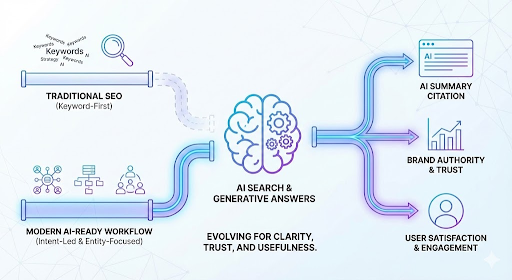
Redesigning the Content Creation Process for AI Search
The mindset shift is simple but uncomfortable. Publishing is no longer enough; only validation matters.
Research Beyond Keywords
Strong generative search SEO starts before writing. Keyword tools still help, but they are not the main input.
Better inputs include:
- Expert interviews
- Original data or observations
- Policy documents or standards
- First-hand experience
AI systems reward depth that they cannot easily replicate.
Human-in-the-Loop AI Content Creation
AI tools speed up drafts for writers to use on content. These do not replace accountability, and still, human review matters in the end. Because they hold:
- Accuracy
- Legal and ethical clarity
- Tone and nuance
In the SEO workflow redesign, AI assists, and humans decide. That balance builds trust over time.
Optimising Content for AI Answers and GEO
GEO and AI search focus on how content is used, not how it performs in isolation.
Answer-First Content Structuring
Direct answers placed early help AI systems extract meaning fast. This does not mean oversimplifying. It means respecting how AI reads:
- One clear answer
- Followed by an explanation
- Supported by evidence
This format increases inclusion in AI summaries and zero-click results.
Schema, Entities, and Contextual Signals
Structured data is vital to the content. Equally, consistency is important. It’s to have the right signal to references.
When AI sees the same entity described clearly across pages, confidence increases. This is a core part of the future of SEO content strategy. Context builds credibility.
Measuring Success Beyond Traditional SEO Metrics
Traffic is no longer the full story. In many cases, it is the smallest signal to know how well your website works with your audience.
Visibility in AI Summaries and Zero-Click Results
Modern measurement looks at:
- Brand mentions inside AI answers
- Citations in generative summaries
- Repeated inclusion across topics
This is harder to track, but far more meaningful.
Engagement and Trust Metrics
When users do click, behaviour matters:
- Time spent reading
- Returning visitors
- Branded search growth
These signals show authority, not just reach. AI systems notice patterns like this over time.
Building Cross-Functional SEO Content Teams for the AI Era
AI search rewards alignment. Fragmented teams struggle to compete.
Collaboration Between SEO, Content, and Brand Teams
The strongest results come when:
- SEO defines intent and structure
- Content teams add depth and clarity
- Brand teams reinforce authority
Together, they create consistent signals across channels. That consistency feeds AI trust.
Governance and Quality Control at Scale
As AI-assisted content grows, rules matter more. Clear governance should cover:
- Fact-checking standards
- Disclosure and authorship
- Editorial review processes
Without this, scale becomes a liability.
The Future of SEO Content Workflows
The direction is clear. SEO is becoming quieter, but more influential.
From Traffic Growth to Influence and Credibility
Being cited by AI systems can matter more than ranking first. Influence replaces volume. Credibility replaces clicks. This is the real future of SEO content.
Why Redesigning Now Creates Long-Term Advantage
Early adopters of AI-ready workflows build durable visibility. Their content trains systems over time. Late movers must fight harder for inclusion.
SEO content workflows for AI search are not optional anymore. They are the foundation of relevance in an answer-driven web.
Those who redesign now will still be visible when rankings fade into the background.
Conclusion
AI search has changed what success looks like. Ranking alone no longer guarantees visibility. Modern SEO content workflows for AI search must focus on clarity, trust, and real usefulness. That means fewer keyword tricks and more intent-led answers. It also means tighter links between SEO, content, and brand teams.
AI-driven search optimisation rewards content that explains, supports, and stands up to scrutiny. As generative search SEO grows, workflows built for speed and volume will fade. Those redesigned for accuracy and authority will last. The future of SEO content belongs to teams that adapt early and write to inform, not just to rank.
Frequently Asked Questions
How do SEO content workflows for AI search differ from traditional SEO processes?
Traditional SEO focuses on rankings and clicks. AI search focuses on answers. Modern workflows prioritise intent, clarity, and trust so content can be selected and summarised by AI systems, not just indexed.
Does AI-driven search optimisation reduce the need for keywords?
No, but it changes their role. Keywords still guide topics, yet AI-driven search optimisation depends more on context, entities, and clear explanations than exact phrase matching.
What is generative search SEO in simple terms?
Generative search SEO means creating content that AI can confidently use to answer questions. It is about being cited and trusted, not only about driving traffic.
How can content optimisation for AI search improve brand visibility?
When content is structured and accurate, AI systems reference it in answers. That builds brand presence even when users do not click through to the website.
Why is SEO workflow redesign important for the future of SEO content?
AI answers are becoming normal. Without an SEO workflow redesign, content may rank but stay invisible. Updated workflows help brands stay relevant as search keeps evolving.