

Introduction
SEO no longer rewards shortcuts. Links still influence rankings. But trust, relevance, and authority now decide how much impact those links have. This is why the debate on Digital PR vs traditional link building has become important.
Both strategies can improve visibility. They work in very different ways. Choosing the right mix determines whether your growth is stable or fragile.
Table of Contents
What Is Digital PR in SEO?
Digital PR is an authority-first approach to link acquisition. Instead of manually placing links, brands earn coverage by publishing content. Such content is found valuable by journalists and publishers. The links come naturally. The brand benefit lasts longer.
This method closely mirrors organic link behaviour on the web. This is why digital PR for SEO aligns so well with modern search algorithms. Beyond rankings, it strengthens brand credibility and entity recognition.
How Digital PR Builds Links Naturally
Digital PR works by positioning a brand as a trusted source. When content adds real insight, publishers reference it without being asked.
Effective link-earning assets often include:
- Original research and data analysis
- Industry reports and surveys
- Expert commentary on trending topics
- Strong thought leadership pieces
Because these links are editorial, they often become high authority backlinks. This lets us continue passing values for years.
Common Digital PR Tactics
Digital PR relies on relevance, timing, and scale. Common tactics include:
- Data-led content and statistics resources
- Press releases with genuine news value
- Journalist outreach focused on expertise
- Reactive PR tied to breaking news
- Expert quotes and opinion features
These methods support white-hat link building while increasing brand visibility across trusted publications.
SEO Benefits of Digital PR
Digital PR delivers layered SEO value, including:
- High-authority editorial backlinks
- Brand mentions with and without links
- Stronger E-E-A-T signals
- Referral traffic from trusted sources
- Improved brand entity recognition
Together, these signals help sites rank more in competitive search results.
What Is Traditional Link Building?
Traditional link building focuses on proactive link placement. Links are acquired through outreach, partnerships, or content submissions. Among these, rankings act as the primary goal.
When done ethically, traditional link-building strategies still contribute to SEO growth. It especially happens to newer or smaller websites.
Common Traditional Link Building Techniques
Typical methods include:
- Guest posting on niche-relevant blogs
- Niche edits within existing content
- Business directories and citations
- Broken link building
- Resource page link placements
These tactics offer more control over anchor text and target URLs. This stays stable even though the quality varies.
How Traditional Link Building Impacts Rankings
When links come from relevant, trustworthy websites, traditional link building can:
- Improve rankings faster than PR-led links
- Strengthen topical relevance
- Support new domains with limited authority
- Help inner pages gain traction
This makes it useful as a supporting SEO tool rather than a standalone strategy.
Risks Associated with Traditional Link Building
Low-quality execution increases risk. Common issues include:
- Algorithmic penalties
- Unnatural anchor text patterns
- Toxic backlink profiles
- Links from PBNs or link farms
- Sudden ranking drops
As search engines improve at detecting manipulation, careless link building becomes easier
Digital PR vs Traditional Link Building: Key Differences
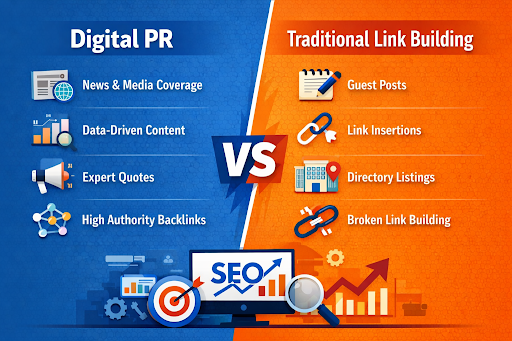
The difference in link building vs digital PR lies in intent. Digital PR earns authority. Traditional link building creates placement.
Digital PR grows more slowly but compounds over time. Traditional link building works faster but requires restraint.
Authority and Trust Signals
Digital PR links often come from:
- News publications
- Industry-leading websites
- Universities and research platforms
These sources send strong trust signals to search engines. Traditional links usually come from niche blogs or resource pages. This offer is relevant but has less authority.
Control vs Credibility
Traditional link building allows control over:
- Anchor text
- Placement
- Target URLs
Digital PR gives up control in exchange for editorial credibility. Search engines increasingly favour the latter.
Which Strategy Is Better for SEO in 2026?
Search engines now prioritise entities, trust signals, and brand authority. In this environment, Digital PR vs Traditional link building aligns naturally with long-term SEO goals. That does not make traditional link building obsolete. It simply changes its role.
Best Choice for Long-Term SEO Growth
Digital PR works best for:
- Brand-focused SEO campaigns
- Competitive national or global markets
- Long-term SEO authority building
- AI-driven and zero-click search visibility
It creates stability that survives algorithm updates.
When Traditional Link Building Still Makes Sense
Traditional link building remains effective for:
- New websites are building baseline authority
- Local SEO and niche industries
- Supporting internal service pages
- Tier-2 and diversification strategies
Used carefully, it enhances rather than harms performance.
Can Digital PR and Traditional Link Building Work Together?
Yes. The most effective SEO link-acquisition methods combine both approaches. Digital PR vs traditional link building builds top-level trust. Traditional links add depth and relevance where needed.
Hybrid Link Acquisition Strategy
A balanced strategy includes:
- Digital PR for homepage and brand pages
- Guest posts and niche links for services
- Citations and directories for local SEO
This creates a diversified and natural backlink profile.
Ideal Link Mix for Competitive Niches
Healthy profiles often include:
- Editorial backlinks
- Contextual niche links
- Brand mentions and backlinks
- Local citations
- Supporting tiered links
This mix reduces risk while improving ranking stability.
Final Verdict: Digital PR or Traditional Link Building?
Digital PR is the future-proof option. Traditional link building is a tactical support. Brands that rely on manual link placement face growing risks. A combination of authority-driven PR with controlled link building gains stability and scale. The smartest choice is not one or the other. But it is knowing how to use strategically.
Frequently Asked Questions
- What is the main difference between Digital PR and traditional link building?
Digital PR earns links through editorial coverage and authority. Traditional link building places links through outreach and partnerships. The difference lies in trust versus control.
- Is Digital PR safer for long-term SEO growth?
Yes, Digital PR aligns well with modern search engine guidelines. It builds authority and brand trust over time. These signals are more resilient to algorithm updates.
- Does traditional link building still work for SEO?
It can work when done carefully and ethically. Relevant, high-quality links still pass value.
However, poor execution increases SEO risk.
- Which strategy delivers faster SEO results?
Traditional link building often shows quicker ranking movement. Digital PR takes longer but compounds in value. Speed and stability rarely come from the same tactic.
- Should businesses use both Digital PR and traditional link building?
Yes, a combined approach works best for most sites. Digital PR builds trust at the top level.
Traditional links support depth and page-level relevance.